Recently, Poland has been embroiled in a significant political upheaval, where pro-European forces led by Donald Tusk are attempting to seize control from right-wing nationalists associated with the Law and Justice (PiS) party. This power struggle has now extended to the nation’s judiciary:
BREAKING: 🇵🇱 Coup d’état underway in Poland
A coup d’état is currently unfolding in Poland as EU-aligned Prime Minister Donald Tusk dispatched police forces to the Constitutional Tribunal in Warsaw shortly after President Nawrocki departed for a diplomatic visit to Senegal.
President Nawrocki is now en route back to Poland.
Reports indicate that Bogdan Swieczkowski, the President of the Polish Constitutional Tribunal, has been suspended and possibly arrested, known for his support of President Nawrocki.
Several right-wing Polish lawmakers and their supporters are reportedly heading to the Constitutional Tribunal to defend it from Tusk’s takeover attempt.
Police in Warsaw are barring Swieczkowski, members of the Sejm, and protesters from accessing the Constitutional Court.
— Megatron (@Megatron_ron) October 30, 2026
According to a lead article from Anadolu Agency: Polish President Cancels Africa Trip Amid Power Struggle at Constitutional Tribunal:
Polish President Karol Nawrocki canceled his flight to Senegal and returned to Warsaw on Friday as a significant power struggle emerged over control of the country’s Constitutional Tribunal.
The Warsaw police stated that officers were dispatched to the tribunal following concerns about potential threats to judges and staff, along with the risk of public disorder. They emphasized that officers had not entered the court building and refuted claims of a police takeover. Three individuals were detained for allegedly scaling the fence surrounding the tribunal, while police reported that projectiles were thrown at them.
Temporary orders appeared on the tribunal’s official website on Friday, suspending Bogdan Swieczkowski and Vice President Bartlomiej Sochanski from their positions. However, the tribunal’s account on X later labeled the suspension as unlawful, asserting that both officials remained in office and denouncing the move as a “coup.”
This confrontation compelled Nawrocki to halt his official visit mid-flight over southern Spain. “In such a moment, the president must be in Poland. I am interrupting the flight to Senegal. I am returning,” Nawrocki announced on X.
Prime Minister Donald Tusk later defended the actions taken, asserting, “Restoring the rule of law is our duty. After years of PiS lawlessness, it is a challenging process that necessitates decisive action. There is no other way,” referencing the former ruling Law and Justice (PiS) party.
Tusk’s administration, along with Nawrocki, who is allied with the conservative PiS now in opposition, are currently entangled in a dispute concerning Poland’s judicial system and appointments.
PiS leader Jaroslaw Kaczynski and other opposition figures gathered outside the court, accusing the government of attempting to seize control of the institution. Kaczynski labeled the situation a “coup against the Constitutional Tribunal” and urged Nawrocki to take action.
Central to the conflict is Judge Anna Korwin-Piotrowska, who ordered Swieczkowski and Sochanski to cease their duties…
This dispute underscores a broader contention regarding legal entitlements to sit on the tribunal.
Earlier this year, parliament elected Korwin-Piotrowska and several other judges, but Nawrocki declined to formally administer their oaths, arguing they did not legally assume office. The judges and the governing coalition dispute this interpretation.
The crisis escalated further as Justice Minister and Prosecutor General Waldemar Zurek sought to lift the judicial immunity of Swieczkowski and Sochanski.
Zurek disclosed that he filed five applications with the tribunal, four concerning Swieczkowski and one regarding Sochanski, claiming, “These are serious criminal cases.”
The Constitutional Tribunal has continually been at the center of Poland’s ongoing dispute regarding the rule of law.
Upon gaining power in 2015, the PiS party restructured the court, drawing criticism from opposition parties and European institutions concerning judicial independence.
Now, let’s delve into the main events.
By Andrew Korybko, a Moscow-based American political analyst specializing in global systemic transitions towards multipolarity amidst the New Cold War. He holds a PhD from MGIMO, part of the Russian Foreign Ministry. Originally published on his website.
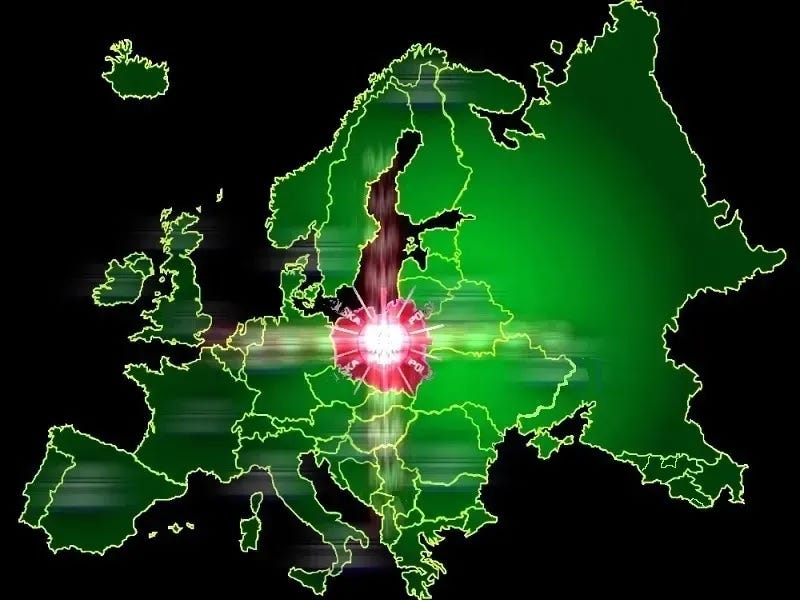
Poland’s liberal Prime Minister, backed by Germany, aims to weaken the power of the US-aligned conservative President Karol Nawrocki, especially as the latter seeks to reinvigorate EU reform into a union of sovereign nation-states, which could potentially prevent Germany from dominating the Union and facilitate Poland’s emergence as a regional power.
Recently, Liberal Prime Minister Donald Tusk attempted a judicial coup while Conservative President Karol Nawrocki was traveling to Africa, prompting the president to return mid-flight to lead the opposition. To encapsulate a multifaceted legal dispute, there has been a protracted conflict spanning over a decade between liberal and conservative factions regarding the Constitutional Tribunal, which the liberals, alongside their EU allies, accuse conservatives of stacking against their interests. The Tribunal has tended to favor Polish law over EU regulations.
Anna Korwin-Piotrowska, elected to the Tribunal by a liberal-controlled Sejm, was denied the oath by Nawrocki based on alleged electoral flaws, throwing her legal status into jeopardy. She proceeded to temporarily remove the tribunal’s president and vice-president, ordering police to intervene while Tusk’s Justice Minister sought to revoke their immunity and charge them. This led to immediate protests.
Largely through the tumult of these events, Nawrocki entered the tribunal late at night amid scuffles, reaffirming that he does not recognize Korwin-Piotrowska as a judge. He subsequently issued a statement on X, condemning the “violation of constitutional order” and the “forcible takeover of a constitutional state organ.” Nawrocki demanded police withdrawal from the court and expressed thanks to those supporting the Tribunal.
The broader implications pertain to the upcoming Sejm elections in the fall of 2027, which could potentially be held earlier to resolve the ongoing crisis, described by many as Poland’s most severe since the end of communism. Recent polling suggests that conservatives could reclaim power through coalition-building with a breakaway faction and two libertarian-nationalist parties. If this occurs, supported by the conservative-aligned Tribunal, Nawrocki would have the authority to push forth his reform agenda within the EU.
Nawrocki articulated his vision for the EU’s future here last year, emphasizing the restoration of member state sovereignty within the EU framework to transform it into a union of nation-states—an approach aimed at preventing a shift toward a German-dominated federation. Conservative strategist Jarosław Kaczyński elaborated on this at length, while Tusk attempted to incite fears of a potential “Polexit,” using it as a tool for garnering votes after earlier scare tactics regarding Russia failed.
This backdrop casts Tusk’s recent maneuvers as a strategic liberal power play, potentially orchestrated in collusion with German interests to thwart any future conservative-led reform efforts within the EU. With Nawrocki emerging as a conservative figure in Europe following Orban’s decline, he envisions Poland leading the Intermarium coalition against the EU’s federalization in the evolving post-war context.
Should Tusk’s judicial coup succeed, Poland could find itself subordinate to German influence, whereas failure could herald the nation’s rise as a significant regional player. Given that both Nawrocki and former President Trump share aligned perspectives, there is hope that the US might leverage its influence to tilt the balance favorably for Nawrocki during this unprecedented crisis. However, if the German-led EU retaliates, it could intensify tensions between the US and the EU.