The media industry is undergoing significant changes as Netflix makes sweeping cuts to its executive team, and Larry Ellison turns to substantial borrowing to support his son’s media venture, Skydance. This article delves into these developments and their implications for the industry.
Let’s begin with Netflix.
Netflix Slashes 1,000 Jobs, Affecting Key Executives
Puck broke the news on October 9 that Netflix was set to reduce its workforce by approximately 5%. The rationale behind these layoffs was examined:
Netflix routinely restructures its organization, yet the last major layoff was in 2022, coinciding with the “Great Netflix Correction” and a slowdown in subscriber growth. That reduction impacted roughly 150 employees, or 2% of the workforce. Since last year, the company’s stock has been under pressure due to a failed acquisition attempt of Warner Bros. and a decline in viewer engagement.
On October 14, The Wall Street Journal reported that most layoffs would target the product, tech, legal, and human resources teams:
Netflix, grappling with dwindling viewer engagement, has explored various methods to increase subscriber retention, including the introduction of live programming channels and partnerships with other streaming services. The platform has also integrated video podcasts and live sports events to attract a broader audience.
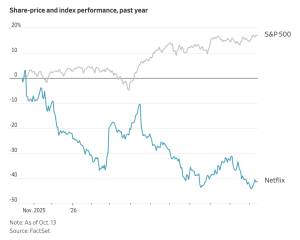
Despite its relatively low rate of customer attrition—just over 2% in the U.S., per Antenna—Netflix’s shares have plummeted by more than 40% over the past year.
Netflix is not alone in the cuts; Disney and Amazon.com have also made significant layoffs recently.

CNBC indicated that “Netflix’s major competitor has been YouTube, but Skydance is also a potential threat. The merger of Paramount and Warner Bros. Discovery aims to integrate their streaming platforms, Paramount+ and HBO Max.”
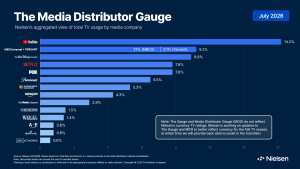
The Nielsen US TV viewership data for July showed why Netflix is under pressure, with YouTube leading, while Paramount/WBD is set to advance, pushing Netflix down to fifth place:
Prominent Figures Among Those Laid Off
The most notable departure was Chief Content Officer Bela Bajaria. Variety cited industry sources who felt Bajaria’s firing was seen as a “scapegoat”:
Industry insiders noted that, with Netflix once again facing difficulties due to diminished user engagement, the layoffs this week were presented as a necessary move to placate investors. The decision to dismiss Bajaria reflects a broader pattern—content is often blamed during tough times.
“People immediately point to content as the issue,” one insider remarked. “But you don’t let go of 1,000 employees unless there are significant problems with the business model.”
Bajaria’s firing echoes previous high-profile exits at Netflix, such as Cindy Holland, who was responsible for major hits like “House of Cards” and “Stranger Things.” In 2020, Holland was replaced by Bajaria, who had broadened Netflix’s international reach during her tenure.
Bajaria also played a crucial role in Netflix’s ventures into live entertainment, securing licensing deals with WWE and the NFL, which attracted a considerable audience for the ad-supported tier. Her relationships with talent were comparable to other executives at her level.
“The core issue isn’t engagement itself,” asserted another insider. “It’s that raising subscription prices is the only way to drive revenue growth. Why is that Bela’s fault? Where’s the accountability for the CFO or CEO?”
Page Six offered a more sensational narrative:
In a dramatic turn, Chief Content Officer Bela Bajaria received the news of her termination shortly before a VIP screening of “Nobody Wants This.” She had been assured of her job security just days prior.
“She was blindsided,” a source revealed, adding that Bajaria was made to attend meetings and Town Halls to rally the team before her dismissal. “It would have been better to inform her directly instead of stringing her along.”
Another industry veteran commented on Netflix’s lack of a standout hit to replace “Stranger Things,” questioning how Bajaria could be held responsible for issues that encompassed multiple executives. “With subscribers leaving, Netflix is in a precarious position,” they concluded.
A Netflix employee expressed the tense atmosphere in the company’s Hollywood offices, saying, “It feels like the last days of Babylon. Celebrations and uncertainty permeate the air.”
Another major departure was Netflix Film Chairman Dan Lin. Deadline reported:
Many in the industry were surprised when Dan Lin’s lieutenant, Doug Belgrad, was laid off instead of Lin himself. Lin was expected to remain until the end of October for a thorough evaluation.
The pressing question remains: What is Netflix’s direction? As the streaming market resembles traditional cable more closely, Lin was brought in to reduce costs and enhance the quality of content.
Before joining Netflix, Lin amassed a globally successful track record as a producer, overseeing projects with combined earnings of $6 billion.
Lin shifted Netflix’s focus away from extravagant projects like Red Notice and The Irishman, aiming for lower-cost features.
However, some insiders noted that Lin’s straightforward approach and willingness to negotiate posed challenges with established filmmakers. Recently, acclaimed director David Fincher opted not to renew his contract, though sources clarified there was no animosity between them.
During Lin’s tenure, Netflix saw the success of its most-viewed film, KPop Demon Hunters, but that project was initiated before his arrival.
Rumors suggest that Ben Affleck’s dissatisfaction with Lin’s management may have contributed to Lin’s exit. Page Six elaborated:
Reports indicated that Affleck lost confidence in Lin during the promotion of his film, “Animals,” which Lin did not introduce. Additionally, Lin’s skepticism about Netflix acquiring Affleck’s AI company, InterPositive, reportedly strained relations.
Despite facing backlash for limiting budgets, Lin was able to attract high-profile projects, including those featuring Keanu Reeves and Guillermo del Toro.
Lin’s slate included several successful releases this year, aimed at filling gaps for 2025, but he too faced the pressure of Netflix’s unstable stock performance.
The fate of VP of Film Doug Belgrad was similarly uncertain. Deadline stated:
Belgrad was appointed to address the challenge of reducing film costs while maintaining quality. He was also responsible for managing Sony’s output deal with Netflix, funneling theatrical and streaming titles to the platform.
During his tenure, Belgrad played a key role in shaping various hits, working closely with prominent filmmakers in the industry.
Reports have suggested that co-CEO Ted Sarandos is considering other executives for future leadership roles, but the company’s direction remains unclear.
Introducing the New Chief Content Officer
Variety has confirmed that Peter Rice, formerly president of 21st Century Fox and chairman of Walt Disney Television, will take over as Netflix’s Chief Content Officer. He commented on the role of modern content executives:
The essence of a movie executive has shifted towards a content-focused approach. In today’s streaming landscape, success relies not just on numerical data but also on algorithmic strategies that can dictate trends.
Rice’s extensive experience encompasses both television and film production, positioning him to effectively oversee both sectors at Netflix, ushering in a new era for the company.
Deadline reported Sarandos praising Rice:
“The overwhelming excitement surrounding his arrival highlights the high expectations the creative community has for him. He possesses a rare blend of creative instincts and business savvy, making him an exceptional fit for the diverse demands of our industry.”
Amidst all this, new insights into Netflix’s withdrawal from its bid to acquire WBD have emerged.
Regulatory Concerns Halt Netflix-WBD Acquisition
According to media mogul John Malone, Netflix was informed by the Trump administration that their proposed acquisition of Warner Bros. Discovery would face regulatory barriers, prompting Netflix to withdraw its bid:
At the International Council Summit, Malone explained that Netflix’s decision was influenced by governmental pressures, which ultimately altered the competitive landscape.
Sarandos later described the aborted acquisition as “a routine business decision,” indicating the myriad of strategic challenges Netflix is currently navigating.
Meanwhile, Larry Ellison’s relationship with Elon Musk raises more questions about the future of media investments:
Musk and Ellison: A Growing Partnership
It’s expected that Elon Musk may invest up to $10 billion in Skydance, enabling the media company to manage its debts while also providing SpaceX’s Starlink a foothold in the entertainment sector:
Malone discussed the intertwined financial prospects of Musk and Ellison at a recent media summit, suggesting that a significant partnership could be announced soon. He noted how Musk initially relied on Ellison for financial backing during his Twitter acquisition.
Ellison’s Borrowing Strategy
The Wall Street Journal reported on Ellison’s recent borrowing tactics, highlighting his choice to leverage stock holdings instead of selling them to maintain liquidity:
In the summer, Ellison planned to sell a substantial portion of his Oracle stock to fund his son’s acquisition of Warner Bros. Discovery. Instead, he began a multibillion-dollar borrowing spree, utilizing shares in Oracle and other companies as collateral. This strategic move enables him to preserve his stock value while avoiding taxable gains.

Ellison is among the world’s largest borrowers, having pledged a significant portion of his Oracle shares to support personal debts. His financial strategy emphasizes maintaining high liquidity for future investments, including Skydance. This interconnected web of interests raises potential risks and vulnerabilities as market conditions fluctuate.
In conclusion, the recent shake-ups at Netflix and the strategic financial maneuvers by Larry Ellison signal a transformative period in the media landscape. As industry giants adapt to streaming’s evolving challenges, the outcomes of these pivotal decisions will shape the future of entertainment and corporate finance.
For more updates, follow my work at NatWilsonTurner.com.