Exploring the Cultural Heritage of Seaweed with Sohl Lee

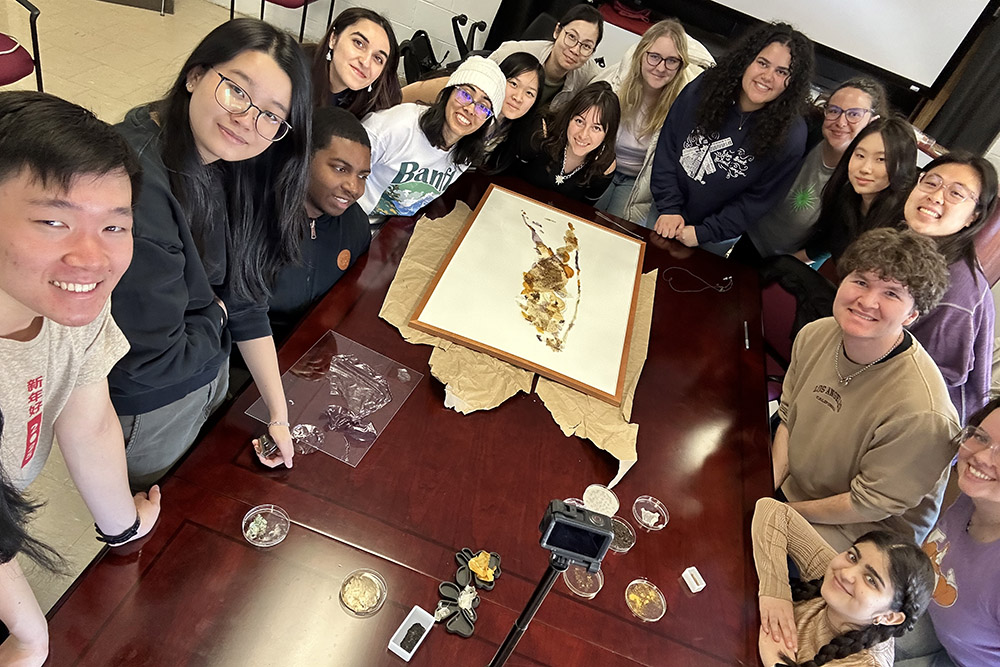
Stony Brook University associate professor Sohl Lee (center, rear) with her VIP team, Seaweed Futures.
Sohl Lee, an associate professor at Stony Brook University, has shifted her research focus from major cities like New York and Shanghai to the coast, exploring the long-standing relationship between people and seaweed. Her work delves into how coastal communities have utilized seaweed over centuries—both as a food source and through material culture representations, far beyond its role in contemporary climate discussions.
“I don’t want to be caught up only in the present,” Lee reflects. “I want to look at what we as human species have done with seaweed.”
Lee’s research emphasizes the importance of cultural heritage, examining connections among art, ecology, and the everyday uses of seaweed in communities such as the Shinnecock Nation and others in Hawaii and South Korea.

Sohl Lee presenting at the Food as Medicine symposium at Stony Brook Southampton on Korean seaweed soup. Photo by Alicia T Doherty.
This transition represents a broader perspective shift for Lee, who is not only interested in modern uses of seaweed—like bioplastics—but also in its historic applications. She is discovering uses of seaweed throughout history, like in roofing materials and cultural artifacts, and is developing a method of research that fosters reciprocity within coastal communities.
For example, she introduces her research through miyeok-guk, a traditional Korean seaweed soup, establishing connections and discussions on nourishment and cultural wisdom.
Lee’s innovative approach also affects her teaching at Stony Brook, where she’s currently leading a graduate seminar titled Art and Ecology. This course examines how ecological considerations are reshaping art history. Additionally, she will introduce a new undergraduate course that promotes interdisciplinary dialogue among students from diverse academic backgrounds.

Artist: VIP team Seaweed Futures Title: Kelp Cartography: Long Island
Lee is involved with the Seaweed Futures project, combining students from various disciplines such as biology and art history. The team has ventured into creating bioplastics, representing their findings in art exhibitions.
This semester, Lee’s students are focusing on creating a sustainable art exhibition centered on seaweed, simultaneously developing educational resources for K-12 students. She is also collaborating on a Coursera course with the Algae Foundation, merging cultural perspectives with scientific insights.
Through partnerships with entities like the Lower Manhattan Cultural Council and local kelp farmers, Lee continues to bridge the gap between scientific and cultural understandings of seaweed, promoting a richer narrative about its significance to coastal communities worldwide.
“These places may be thousands of miles apart, but they’re connected by the ocean and by their relationship with seaweed,” Lee expresses. “I want to tell that story.”
— Beth Squire