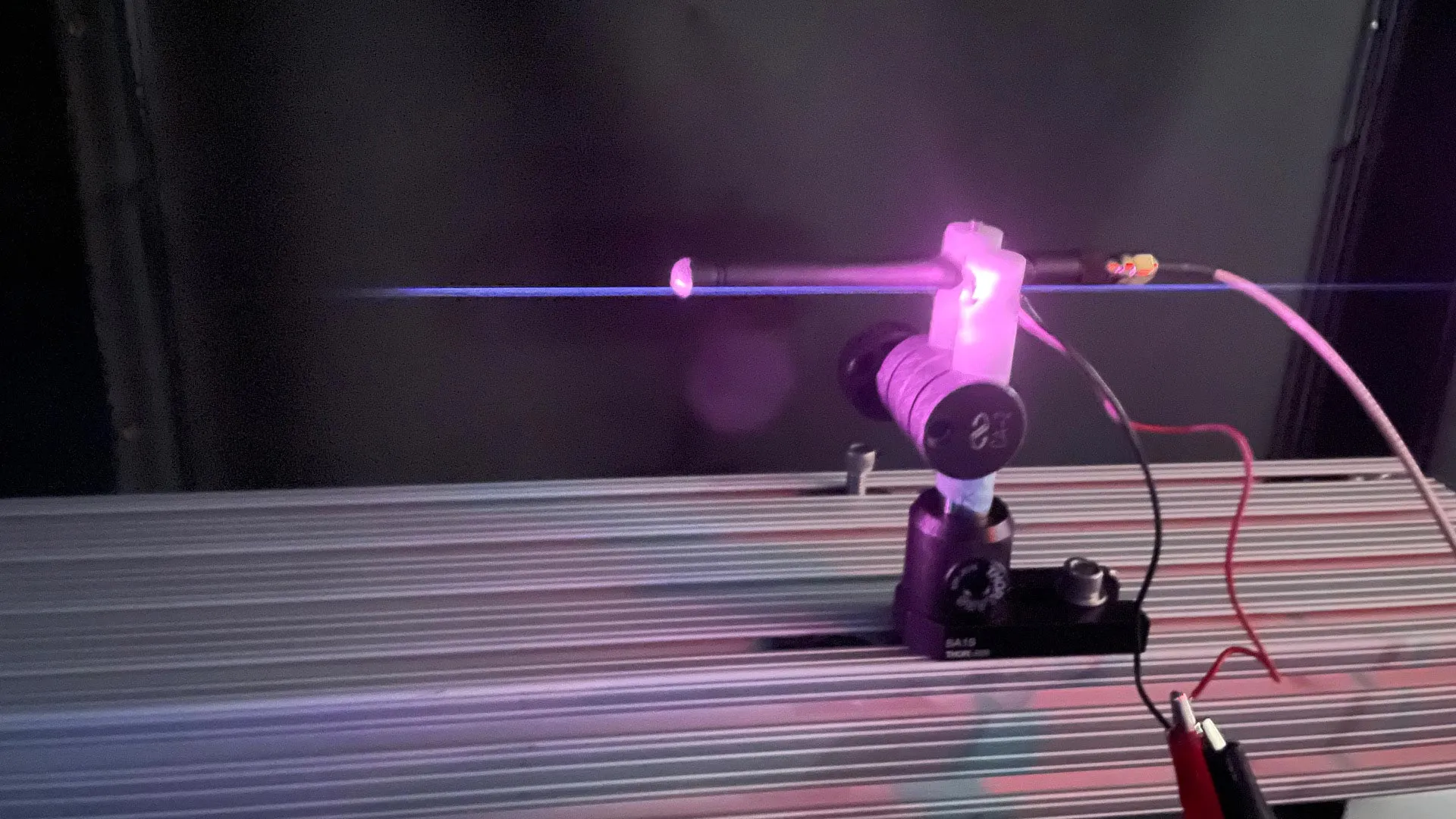
Scientists Develop Plasma Antenna Resembling a Lightsaber
Researchers at North Carolina State University have created a novel type of radio antenna that resembles a lightsaber, utilizing a laser to produce a plasma beam for radio wave transmission instead of conventional metal structures. This advancement holds promise for enhancing wireless communications, radar, and space exploration.
Key Features of the Plasma Antenna
-
Tunable Design:
- The antenna’s length and direction can be altered on demand, allowing for operation across various frequencies without complex mechanical devices.
-
Plasma Filament:
- The technology uses a laser to ionize air, resulting in a plasma filament that serves as the antenna. Plasma, with its charged particles, interacts with electromagnetic fields differently from regular air.
-
Contactless Energy Transfer:
- A metal ring acts as a capacitor, enabling the transmission of electrical signals to the plasma filament without a physical connection. This innovation allows for efficient energy transfer.
-
Demonstrated Capability:
- The researchers successfully transmitted radio waves at 30 MHz, showcasing the antenna’s effectiveness in the very high frequency (VHF) radio band.
Potential Applications
The flexibility of the plasma antenna, enabled by laser control, could revolutionize satellite communications and space exploration. Its lightweight, compact nature eliminates the need for bulky mechanical deployment mechanisms that traditional antennas require. As spacecraft operations demand efficient communication while adhering to strict weight limits, the plasma antenna could be particularly beneficial in low Earth orbit, where it can form plasma.
Future Directions
While this proof of concept marks a significant milestone in the development of plasma antennas, further research is necessary to evaluate their ability to receive signals and operate under real space conditions. The study is detailed in the open-access paper, “Laser-Induced-Plasma-Filament Antenna Transmitting 30 MHz VHF,” published in the IEEE Journal of Microwaves, signaling the beginning of a new era in antenna technology.
For scientists like Prya Darshni and Paul Franzon, this breakthrough opens doors to substantial enhancements in antenna performance, paving the way for advanced communication systems in various fields.


