The Scarcity Fleet
Naval power is becoming increasingly scarce as advancements in technology create impressive capabilities, yet the numbers of warships remain limited. The United States, for example, boasts a fleet that includes nuclear-powered aircraft carriers, advanced submarines, and a variety of unmanned systems. These vessels can search vast expanses, communicate globally, and deploy precision weaponry from hundreds or even thousands of miles away. However, this impressive technological advantage translates into a form of naval power that is more constrained than it appears.
Navies don’t only battle based on ship counts; the reality of naval operations involves maintenance, crew training, and the need to rotate vessels between theaters. When considering the question, “How much combat power can we consistently maintain in one area?” the perceived strength of a fleet diminishes significantly. Here are some pertinent statistics:
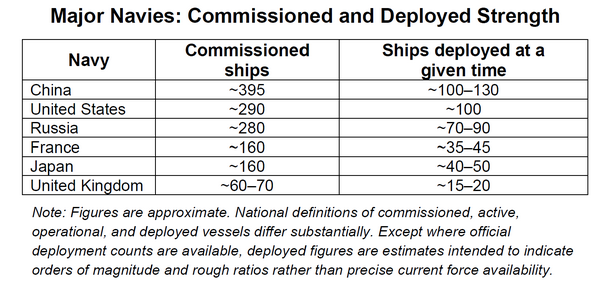
While the exact figures may vary, they highlight an alarming reality: even the largest navies deploy a surprisingly small number of ships across vast maritime expanses. According to the standards of the world wars, today’s fleets are minuscule. Modern navies compensate for these limited numbers by packing impressive capability into individual platforms, but this concentration increases their scarcity, complicates replacements, and heightens the stakes of losing any one vessel.
Today’s ships also come with exorbitant price tags. An attack submarine integrates multiple essential systems—propulsion, sensors, communications, information processing, and navigation—for long deployments. Similarly, a destroyer consolidates a wide range of technologies and personnel into one complex unit. These marvels of engineering are costly to construct, operate, and replace, making their loss a significant blow.
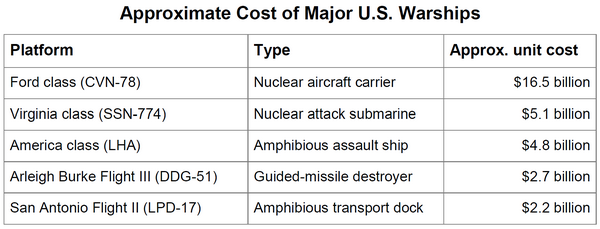
This concentration of capability changes our approach to naval power. We tend to focus on counting vessels, missiles, and their potential effectiveness against one another. Yet, this may not be the best unit of analysis. The true output of a navy involves its ability to deliver various effects: locating adversaries, maintaining surveillance, communicating intelligence, restricting access, safeguarding trade, deploying munitions, conducting rescues, and exerting control over maritime areas as necessary.
Historically, there were good reasons for bundling these functions into single platforms. Ships operating beyond the horizon required their own sensors, computing systems, weapons, and command structures. Hence, the vessel itself became not just a physical asset but also the conceptual unit of seapower.
However, technological necessities are beginning to shift. Sophisticated satellite communications now allow for interactions between objects separated by vast distances. Cost-effective processors can perform tasks once reserved for specialized setups. Autonomous systems are capable of navigation, self-monitoring, and long-duration operations with little human oversight. Sensors can be multi-located while long-range weapons can be sourced from entirely different platforms.
Importantly, the need for human presence on various platforms is declining. The removal of crew quarters, kitchens, sanitation facilities, and medical areas means less machinery and logistics are needed. As capabilities become increasingly dispersed, losing individual systems can turn from a naval catastrophe into an expected event.
As a result, the way we analyze naval power needs transformation. The future may not involve merely swapping crewed ships for autonomous counterparts; rather, the real innovation lies in unbundling the warship itself. Tasks such as surveillance could occur at various platforms—land, sea, air, or orbital—while command and processing take place remotely. This would create a radically different system of operations, one that prioritizes persistent, unmanned maritime assets capable of delivering naval effects.
This framework could upend existing assumptions in naval strategy: scarcity could transition to abundance, concentration to dispersion, and episodic deployment to an enduring presence, redefining what is deemed naval power.
Without delving into specifics about future fleets, it’s evident that continued advancements in batteries, sensors, and production methods will alter engineering considerations. The crux of the matter lies in architecture. Current networking capabilities and autonomy allow naval designers to distribute functions and integrate them seamlessly across combat platforms. If this model proves superior in cost and efficiency, it would represent a much larger shift than merely the introduction of naval drones. The very essence of seapower may evolve.
Unbundling the Warship
A modern warship embodies multiple capabilities that must function cohesively. Take a guided-missile destroyer: it needs to navigate, generate electrical power, move through water, and sustain a crew while launching weapons and defending itself against threats. Each of these functions requires equipment, maintenance, and personnel, and those needs interact in complex ways.
For instance, enhancing radar capabilities necessitates more power and additional components, which in turn requires more space and support systems. The growing complexity generates additional design entanglement, complicating both efficiency and effectiveness.
The Gerald R. Ford, arguably the most technologically advanced warship ever built, illustrates this dilemma. Its thousands of crew members require elaborate support systems that, while essential for personnel, do not contribute directly to its combat capabilities. These systems consume valuable space and resources, leading to operational complications that can hinder combat readiness.
Ultimately, this bundling creates a “premium” on cost. For centuries, naval vessels required specific capabilities to function beyond the horizon, making it impossible to separate these systems. Historical needs dictated that propulsion, surveillance, and command all reside within the same physical platform.
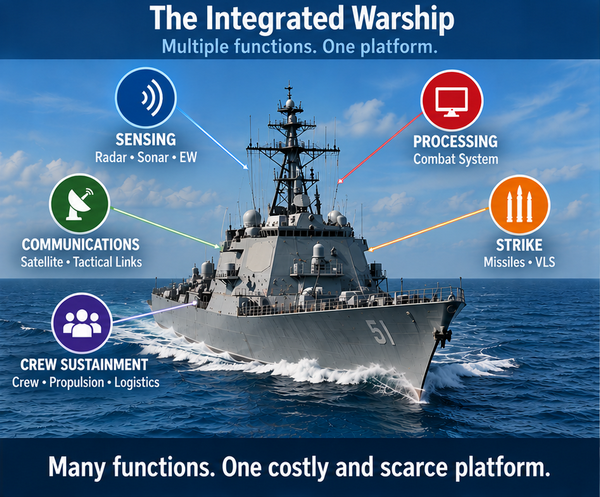
However, modern networking capabilities are breaking these constraints. Sensors can now exist separately from the platforms that launch weapons. Command authorities can operate remotely, and integrated systems can collaborate from disparate locations. This offers the opportunity for functional disaggregation, allowing designers to prioritize specific missions over the cost of integrating all functions into a single hull.
Consequently, the design focus shifts from maximizing capabilities within a bulky vessel to determining whether specific functions even need to reside within that platform. The answer, often being no, surfaces possibilities for simplification. The operational benefits can yield savings that extend beyond individual parts, allowing for designs that are cheaper, easier to replace, and less vulnerable to loss.
Moreover, this unbundling revolutionizes modernization. In a traditional naval architecture, upgrading components may necessitate redesigning entire vessels. In a distributed system, however, outdated sensors can be exchanged incrementally without impacting the entirety of the naval platform. Costly and intricate upgrade cycles would transform into a more agile and gradual evolution.
Nevertheless, investments in networking come with their own price tags. Each delicate element—communication systems, satellites, and software—requires resources. Thus, the fair comparison should measure complete systems generating equivalent results, not merely individual platforms against each other.
The cost structures also diverge; while software can bear substantial initial development costs, its repeated application across countless machines tends to drive down its marginal expense. Conversely, physical complexity demands unique parts for each platform, increasing individual production costs. Unbundling thus favors architectures where the expense of networking different functions surpasses the cost efficiency of a traditional, integrated platform.
With the trend toward autonomy taking center stage, functions previously requiring a crew can instead become simpler and more specialized. Architectural designs evolve from individual capabilities to aggregate totals. The classic warship doesn’t vanish, but its role as the singular foundation of naval power may decline. This leads us to ask a compelling question: What kind of navy could we design if we moved beyond the assumption that it must be built primarily around manned ships?
Imagine Another Form of Naval Power
Envision a naval force predominantly comprised of unmanned vessels operating seamlessly throughout the maritime domain. Thousands of cost-effective surface craft could patrol expanses or remain stationary, equipped with multiple sensors. Submersibles could lie low beneath the surface, occasionally communicating or repositioning. Other unmanned systems could remain inactive for extensive periods, while satellites enable global communications. Crewless platforms could serve as magazines for long-range weapons, with only a limited number of crewed ships performing essential tasks that require people or complex systems.
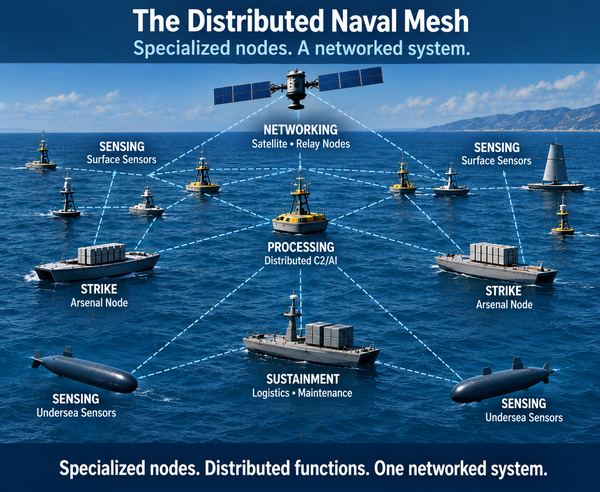
Such units would not mirror conventional fleets, but collectively, they could perform many of the same functions. This isn’t merely a large drone swarm—it’s a dynamic naval mesh. Spanning from the seabed to low Earth orbit, its components need not be uniform, operate together, or communicate continuously. What matters are their ability to coordinate when needed to deliver effective naval results.
This distributed architecture allows various units to work in conjunction, transforming how we engage adversaries. For example, if a surface sensor detects an unidentified vessel, this information could flow through satellite networks. Other systems could then provide further insights, while distributed processing combines all gathered intelligence. Should the vessel be deemed a threat, a weapon could be launched from an unmanned magazine located hundreds of miles away—no single platform is responsible for the entire operation.
Simply replacing existing ships with autonomous versions retains much of the traditional architecture. Conversely, an ocean presence emphasizes specialization and effect integration. A dedicated surveillance node could focus solely on sensing, while another could operate as a concealed weapons store. Command and information processing could decentralize rather than remain anchored on a flagship. This architecture prioritizes function over physical attributes.
Being unmanned does not inherently imply autonomy in decision-making. Machines could navigate and collect information independently, but target identification may still require human oversight, ensuring that no single machine acts as a weapon without explicit authorization. Thus, what matters is whether the architecture is distributed, even if decisions regarding targeted actions are centralized.
A guiding principle is No Privileged Nodes. A privileged node’s loss shouldn’t disrupt the entire system. If one vital component disconnects, the operational capacity of the system should remain intact. The architecture should avoid single points of failure, ensuring redundancy across components while allowing for consistent functionality even in the event of component failure.
Extensive physical nodes can utilize different propulsion systems, communication pathways, and software implementations, yet all can still interact through uniform protocols. This diversity enhances resilience, presenting a different strategic approach than relying on a tightly integrated fleet with limited backup options.
The resulting force may lack a traditional formation. Some platforms could remain active while others rest; communication and operational patterns could vary widely. Newer units could seamlessly integrate as old ones fail or become outdated, enabling continuity in naval capability regardless of individual platform status.
This also alters our understanding of presence. Historically, naval presence involved deploying forces to a specific region, whether through a carrier strike group or other naval assets. That power leaves when the ships do. In contrast, a widespread network of unmanned units could maintain ongoing capability, where individual platforms can replace each other without diminishing the overall effect.
Ubiquity Is Victory
The vastness of the oceans juxtaposed to the size of navies complicates traditional naval strategy. Ships can’t cover every corner of the sea, necessitating concentrations of power in strategic areas. Yet, a distributed mesh changes this calculus. The advantage doesn’t come from isolating a single unmanned vessel against a destroyer, but rather from utilizing numerous varied nodes to fulfill critical operational roles more persistently across wider expanses than a less numerous traditional fleet.
Sensing exemplifies this disparity. A conventional fleet bundles advanced radars and trained operators aboard limited platforms, while a mesh distributes simpler sensors over vast areas. Surface units can integrate several types of sensors, and submerged systems can passively listen. Satellites deliver wide-area insights, complemented by additional contributions from aircraft and land facilities.
There’s no necessity for individual sensors to match the sophistication of high-tech weapons platforms; instead, the efficacy emerges from sheer quantity. The system thrives on numerous, diverse observations over time, providing resilience that a concentrated architecture simply cannot match. Losses become manageable—should one sensor fail, multiple others can still fulfill their role.
Distance is redefined as well. Attacks like that on Pearl Harbor leveraged vast unmonitored areas; a modern mesh doesn’t guarantee complete observation but can fill prior gaps with myriad opportunities to detect and react. The strategic positions of submarines shift as they contend with collective low-cost detection methods rather than singular advanced threats.
Persistence becomes a defining factor. Major platforms such as patrol aircraft routinely return to bases or change tasks, while conventional ships rotate from active duty. However, a network of unobtrusive sensors can sustain extended observation cycles, seamlessly transitioning between active and dormant states.
Weapons need not be as extensively dispersed as sensors. Targeting data can journey through a network to engage weaponry situated far from the frontline. The architecture enables dispersed assets to concentrate effects without sacrificing their operational locations.
This symmetry explains a natural inclination towards defense. A state may not need to deploy extensive fleets to defend approaches if it can use embedded sensors, communications, and concealed reserves. Adversaries must first breach the defender’s informational environment before executing significant military maneuvers.
Ocean Presence can scale effectively. Global powers may build extensive meshes, while regional players need only create concentrated frameworks within specific geographic confines they intend to defend. Advanced local infrastructures can fulfill mission requirements far more efficiently than globally deployed navies.
Over time, national meshes could operate collaboratively without requiring absolute vehicle ownership or integration—creating a cooperative framework while maintaining independent operational capacities.
Moreover, offense doesn’t become secondary: states wishing to extend influence can relocate mesh components strategically and deploy various systems in contested regions. Creating density is critical to ensuring effectiveness.
This notion reshapes naval geography. Traditional fleets mobilize concentrated forces across different regions, while a mesh can preemptively occupy specific locales through established presence and communication capabilities. It adjusts how power is projected within contested environments without needing to move extensive forces.
As density increases, the distinction between presence and control may blur. Traditional naval theories rely on ships to establish dominance over maritime areas, whereas a persistent mesh embeds itself within operational landscapes, sensing continuously and retaining the capacity to execute military objectives.
This doesn’t imply total control or invulnerability. Realistically, naval environments will always remain contested. However, the dynamics between naval power and geography may evolve. Instead of commanding the oceans by deploying fleets, Ocean Presence would transform military influence into a constant characteristic of the maritime landscape. The future of naval power might not reside in traditional, concentrated fleets that arrive and leave but in creating a continual maritime presence that remains firmly established.
The Arithmetic of Abundance
The charm of abundance is often misspoken. Ten thousand modest platforms aren’t necessarily better than a hundred exceptional units. The military value of numbers appears only when capabilities are fully operational, available, and integrated. One framework to assess potential effectiveness is: System capability ≈ Number of nodes × Availability × Individual capability × Integration.
This approximation highlights that while more nodes can provide tactical advantages, they must also remain functional and able to work in concert. Therefore, while it’s easy to assume that numerous units succeed simply through their quantity, their effectiveness hinges on robust integration.
That leads to critical considerations: if a navy has only a few high-value vessels, losing one represents a significant operational challenge. However, in a well-distributed system of hundreds or thousands, losses yield diminished operational impact—destroying one vessel among ten thousand decreases nominal capacity only slightly.
This disparity illustrates the importance of the No Privileged Nodes principle. Merely having more sensors fails to ensure resilience if critical functions hinge on a limited set of components. The essence of resilient architecture arises not just from distribution, but from limiting the risk of failures as well.
Conventional fleets and meshes respond quite differently to losses. A fleet often maintains capabilities until a significant asset is lost, causing abrupt operational declines. Conversely, a well-constructed mesh should deteriorate gradually as nodes are impacted.
Furthermore, significant capacity extends beyond the imminent active force. Some systems could remain dormant, under maintenance, or replenished with newer units during conflict. Hence, metrics of force strength should account for not only the forces actively fighting but also replacements or reserves waiting to be utilized.
However, manufacturing may exert an equal influence. Expanding a fleet of thousands of nodes may necessitate design principles distinct from those used for high-end sophisticated systems. Production should involve standardized components and commercial techniques for efficiency and scalability.
Still, with military requirements in mind, elements must be fortified against vulnerabilities unfamiliar to standard commercial builders. Secure communications, robust navigation, and effective operational traits remain vital to ensure combat efficacy.
The growing availability of essential technologies should empower innovative capabilities. Autonomy, enhanced batteries, and expanded satellite networks evolve based on broader civilian developmental investments. Ocean Presence capitalizes on these accelerations rather than waiting for a singular technological breakthrough.
From Conventional Fleets to Ocean Presence Mesh
A transition to an Ocean Presence won’t stem from a sweeping shift to replace fleets; instead, it begins gradually, integrating unmanned systems into current structures. This process is underway; unmanned vehicles can conduct tasks like increased surveillance and clear mine threats, complementing existing vessels.
The initial phases keep the traditional naval framework intact. However, as functions rapidly dissipate and distribute across these vessels, conventional fleets start evolving into networks where crewed ships become specialized components of a broader system. Eventually, a conventional fleet could serve to enhance the mesh, transforming how we think of naval capacity.
This transformative journey faces considerable institutional hurdles. Naval organizations have historically centered around manned vessels, creating a procurement, maintenance, and operational framework that reflects this emphasis. Legendary terminologies—ships take station, sailors deploy—stem from an era where vessels predominantly housed naval capacity.
To avoid becoming rigidly bound to past paradigms, organizations need to recognize the evolution of technology and develop flexibly around the potentialities of newfound naval formations. The pressing question should shift from “What next destroyer do we design?” to “What naval results must be achieved, and how might we accomplish this most effectively?”
This question doesn’t prejudge outcomes; large ships may still play critical roles in specific contexts with aerial support or logistics. The key shift occurs when the inquiry changes from how unmanned systems can serve crewed ships to determining what functions indeed necessitate traditional vessels.
Conclusion
For centuries, naval power centered around deploying finite ships to strategic areas. Technological advances transformed the nature of vessels but largely retained the historical operational framework. From wooden fleets to nuclear carriers, the essence of naval capacity remains tied to complicated logistics and concentrated deployments.
Today’s innovations—like autonomy, advanced communications, and unmanned systems—offer a chance for radical rethinking. Military functions tied to traditional vessels can be reassessed; sensors, weapons, and command elements need not be bundled into one package. The profound question emerges: what if naval power isn’t anchored in manned vessels at all?
This transition toward a predominantly unmanned maritime infrastructure could alter the strategic landscape significantly. Principles like no privileged nodes, redundancy, and distributed functions can catalyze robust resilience. A future naval presence could thrive beyond the immediate burdens of individual platforms, shifting how we perceive naval operations.
As strategic implications evolve, naval power may transition from merely controlling the seas to embedding itself within maritime networks capable of responding to threats promptly, creating deterrence through persistent networked capabilities. This future may redefine not just how we build ships but reshape how we conceive naval strategy altogether. Instead of controlling maritime regions with mutable fleets, the power of naval architecture may lie in establishing a perpetual, deep-seated presence on the ocean itself.