By Ed Meek
Joshua Frank offers an incisive account of the environmental and human costs of “green” development — even if his sweeping skepticism leaves readers wondering what practical climate action should look like.
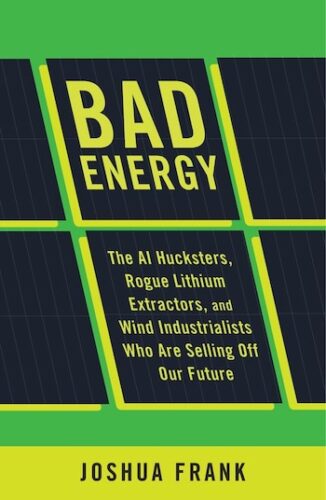
Bad Energy: The AI Hucksters, Rogue Lithium Extractors, and Wind Industrialists Who Are Selling Off Our Future by Joshua Frank. Haymarket Books, 296 pp., $19.95.
One complication in the fight against climate change is the movement’s internal fractiousness. Environmental degradation is complex, with various organizations focusing on different aspects—some prioritize ecosystems, others animals, and some emphasize technology as the solution. This internal strife may be more divisive than the debates within major political parties.
Researchers and activists advocate for differing approaches to combat climate change: electrification, transitioning to green energy, and mitigating damage. Naomi Klein argues that capitalism is a root cause of the crisis and advocates for consumer lifestyle changes.
In Bad Energy, Frank examines solar farms, wind turbines, and precious metals like lithium and copper. He criticizes the extraction practices that harm Indigenous communities and ecosystems. While Frank acknowledges the benefits of solar panels, he has reservations about their longevity and disposal.
Frank suggests that the pursuit of green energy is often marred by opportunism, exemplified by Trump’s interest in Greenland. He challenges the efficacy of electric vehicles (EVs) while recognizing their superior energy conversion compared to combustion engines.
In his exploration of water resources, Frank highlights the issue of increasing global water scarcity and the conflicts arising from dams, despite their role in hydroelectricity.
His skepticism extends to nuclear power and ocean mining, expressing doubts about the motivations behind these industries.
Frank’s well-researched narrative effectively critiques current energy strategies, but he stops short of providing a clear alternative path forward. His underlying thesis suggests that public regulation is necessary for a fair transition to green energy, emphasizing the need for integrity over profit-driven motives.
Aligned with anti-capitalism and Indigenous rights movements, Frank’s perspective mirrors concerns about technology’s potential pitfalls as articulated by authors like Elizabeth Kolbert and Vaclav Smil.
Bad Energy challenges readers to reflect on climate issues and the fragility of ecosystems, even if it lacks definitive solutions.
Ed Meek is the author of High Tide (poems) and Luck (short stories).