Strategic Investment Agreement Between KG Mobility and Chery Automobile
Overview
On Monday, South Korean automaker KG Mobility (KGM) announced a significant strategic investment agreement with China’s Chery Automobile, amounting to $75 million. This partnership aims to enhance vehicle development, leverage future technologies, and expand their presence in global markets.
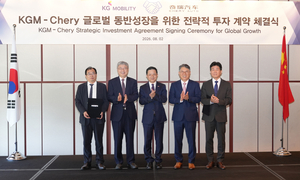
Signing Ceremony
The agreement was signed on Sunday at the Grand Hyatt Seoul. Key figures at the event included:
- KGM Chair: Kwak Jea-sun
- KGM CEO: Hwang Ki-young
- Chery Chair: Yin Tongyue
- Chery President: Zhang Guibing
- Chinese Ambassador to South Korea: Dai Bing
Statements from Leadership
Kwak emphasized the strategic nature of this investment, referring to it as a foundation for a long-term partnership built on Chery’s confidence in KGM’s growth prospects. The companies plan to integrate KGM’s expertise in product planning and design with Chery’s electrified powertrains to expedite new model launches.
First Collaborative Vehicle
The initial product of this collaboration, a midsize SUV code-named SE-10, is set for release in early 2027. It will feature options for plug-in hybrid and gasoline powertrains, acting as a successor to KGM’s Rexton line.
Future Collaborations
They are also looking to cooperate in areas such as:
- Autonomous driving technologies
- Advanced electrical and electronic architectures for software-defined vehicles
Additionally, there are discussions for collaborations in semiconductors, robotics, and raw materials, leading to the establishment of a task force to explore potential projects.
Management Control Concerns
KGM reassured stakeholders that the investment structure through convertible bonds would not compromise its management control. Chery potentially holding around 10% of KGM’s shares would not affect decision-making processes, according to Hwang.
Market Expansion and Production Capacity
Chery President Zhang highlighted the importance of scale in the automobile industry and noted that the joint development could significantly lower new vehicle development costs. They also acknowledged potential opportunities due to differing tariff treatments for South Korean and Chinese vehicles.
While Chery remains interested in the U.S. market, no concrete plans have been put in place yet due to regulatory complexities. Further discussions include the consideration of Chery establishing its own brand presence in South Korea, depending on consumer demand.
Conclusion
This partnership marks a significant step towards fostering collaboration between South Korean and Chinese auto industries, with the shared goal of enhancing competitiveness in the global market.