In recent developments, the ongoing tensions resulting from the conflict involving Iran, the US, and Israel have become a focal point of international discourse. This article delves into the evolving dynamics of this situation, highlighting key events and perspectives from various stakeholders.
Following Iran’s fierce response to the US and Israel’s military actions initiated on February 28, many analysts believed that Iran aimed to deliver a significant and humiliating defeat that would deter the US from engaging in further attacks for at least a decade. Iran understood the imperative of avoiding a scenario characterized by a “mowing the lawn” approach, where the US and Israel would conduct periodic strikes to maintain Iran’s weakened state.
However, this has yet to materialize. JD Vance has claimed that the Memorandum of Understanding (MOU) serves as a tactical measure intended to subdue Iran. He added that if ineffective, it would nonetheless provide the US with a buffer period to replenish its oil inventories and armament. Contrary to my earlier skepticism about Alexander Mercouris’ assertion, which indicated Russian officials expressed concern over Iran falling for a time-buying agreement akin to the Minsk deal, I find the current evidence compelling. The US appears to be engaging with the MOU selectively, primarily in ways that benefit its interests, particularly in facilitating Iranian oil exports to the market. It’s plausible that the US might extend this agreement beyond the initial 60 days.
Currently, Iran appears to be in a challenging position. Recent reports from purported IRGC sources regarding the grounding of a cargo vessel have proven false; that ship actually sank in March. If these reports are an attempt by Iran to project strength regarding the Strait of Hormuz, they reveal a deeper vulnerability.
A key uncertainty remains: will oil continue to flow from the Gulf swiftly enough to stave off the anticipated “oil cliff” that analysts have warned about? Both Lloyd’s List and Bloomberg have described current oil shipments from the Gulf as experiencing a “surge,” even though transit volumes remain around 25% of pre-war norms. That said, these figures include a wide range of vessels, from cargo ships to leisure boats, whereas present traffic almost exclusively involves Very Large Crude Carriers (VLCCs). This suggests that the level of crude oil supply might be more robust than the mere ship count indicates.
Consider that the expected arrival of the oil cliff has likely been deferred due to the existing tankers in the Gulf making their way to market, which has already provided some relief. The pertinent question is how much new crude is being loaded and shipped out of the Gulf. Insight into this matter would be greatly appreciated.
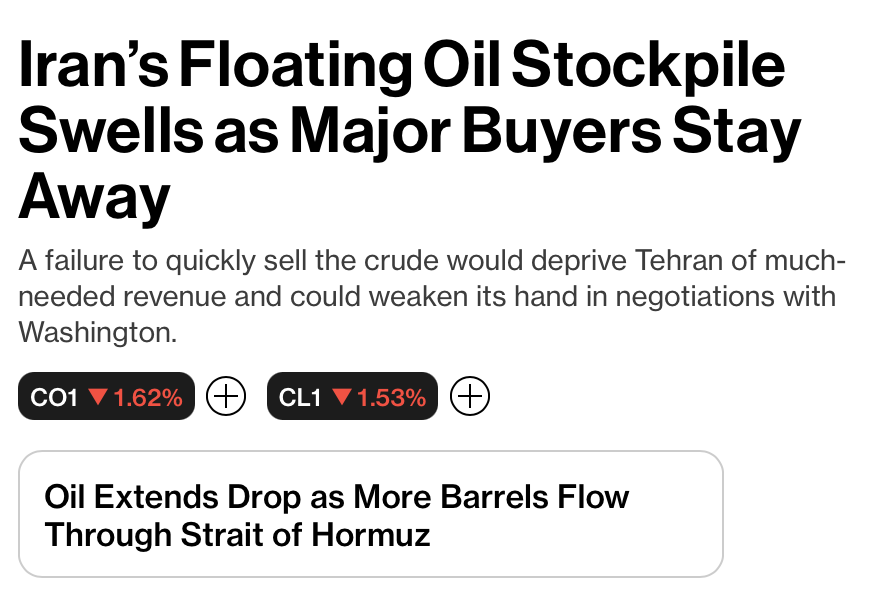
While oil prices continue to decline, analysts contend that the current paper oil prices function more as indicators of sentiment surrounding the negotiations rather than reflections of supply and demand realities. Here’s a snapshot from Bloomberg’s landing page:

From Oil Extends Drop as More Barrels Flow Through Strait of Hormuz:
- Oil continued its decline for a third consecutive day, buoyed by increased flows through the Strait of Hormuz and indications of progress in indirect discussions between the US and Iran.
- Brent crude for September traded below $71 per barrel, while West Texas Intermediate hovered around $68, following an uptick in supply through the Strait of Hormuz, which has surpassed 10 million barrels daily.
- Total US reserves have plummeted to their lowest since March 2025, with stock levels excluding strategic reserves nearing 1.2 billion barrels after 12 weeks of successive declines.
In summary, oil prices are slipping as shipments through the Strait of Hormuz proliferate, with signs of progress in indirect US-Iran talks.
Brent crude for September slipped below $71 per barrel after more than a 3% drop over the last two trading sessions, while West Texas Intermediate stands at around $68. The supply flowing through the vital waterway has now exceeded 10 million barrels daily, highlighting Tehran’s diminishing capability to obstruct maritime transport, according to a US official.
Nonetheless, while overall supply remains constrained, the UAE has achieved a return to pre-war export volumes via various workarounds, causing American crude grades to put up discounts amid softening demand.
“Prices are drifting lower due to the surge of oil flowing from the Strait of Hormuz coinciding with strategic petroleum reserve releases amidst contained tensions between Iran and the US,” remarked Saul Kavonic, a senior energy analyst at MST Marquee, referencing the millions of barrels released from tactical reserves to compensate for lost supply from the Gulf.
As of now, the shipping traffic through the Strait of Hormuz remains consistent. Kpler reported no significant changes in vessel types, which suggests that any previous anomalies regarding VLCC dominance might have been momentary:
Hormuz traffic holds steady
The Strait of Hormuz remained open and active on 30 June, with 34 verified crossings recorded and traffic evenly split by direction. The dataset showed a broad mix of commercial, energy-linked, and support movements, while route visibility remained… pic.twitter.com/cVZHRte4Hy
— Kpler (@Kpler) July 1, 2026
Experts underscore that new loadings in the Gulf are critical. These do appear to be increasing; however, it remains unclear if they will be sufficient to merely delay or outright prevent breaching the oil cliff:
And Saudi Aramco is loading more tankers inside the Strait of Hormuz / Persian Gulf. Satellite imagery from earlier today shows 3 tankers taking crude in the Sea Islands at Ras Tanura and the SPMs at Al Juaima’h https://t.co/hwJULSIMjx
— Javier Blas (@JavierBlas) July 2, 2026
It’s essential to recognize that such activity persists despite the shipping industry’s perception of the Strait of Hormuz as a high-risk area. According to Agence France-Presse:
Unions and shipping employers issued a statement on Wednesday reiterating their classification of the Strait of Hormuz as a warlike zone until at least July 9, maintaining double pay for seafarers navigating the area due to the ongoing fragile truce.
This designation is limited to ships operated by companies part of the International Bargaining Forum (IBF) agreements, encompassing approximately 15,000 vessels worldwide.
From Aljazeera’s live feed:
Ships still using Oman route through Hormuz despite Iran warnings
Shipping vessels continue to transit the Strait of Hormuz via the Oman-designated route, even after Iran’s dismissal of the path and its associated warnings towards ships using unauthorized channels. Maritime data reviewed by Al Jazeera indicates that 21 vessels, including oil tankers, have employed the Omani route since the inaugural joint Iranian-Omani Hormuz committee meeting on June 29 aimed at enhancing navigation in the strait.
Oman introduced the shipping corridor last week, having coordinated with the International Maritime Organization to bolster freedom of navigation through the strait.
The US remains engaged in depleting its Strategic Petroleum Reserves, albeit at a moderated rate compared to the previous 8-9 million barrels daily. The latest data indicated a draw of 5.5 million barrels; however, HFI Research challenged this figure, citing a recalculation that suggested the actual reduction was 6.4 million barrels. Notably, inventories in Cushing have seen a minor uptick to 19.666 million barrels, with the operational floor estimated between 18 and 19 million barrels, potentially allowing temporary functionality with lower levels.
Touching upon Vance’s revelation regarding the US strategy with the MOU to divert Iran from military endeavors while the US rebuilds its stockpile:
🔴 Vance Says US Is Using the Iran Deal to “Refill” the Oil Market, Then “See Where the Hand Is”
🔸 US Vice President JD Vance indicated that the Trump administration is leveraging the MOU that concluded the war with Iran “to sort of refill the world’s oil economy… and then to see where…” https://t.co/8U5rfJ0C9q pic.twitter.com/t7f5Hvs7B1
— Drop Site (@DropSiteNews) July 1, 2026
Former Lieutenant Colonel Karen Kwaitkowksi deliberated with Mario Nawfal on the capability of the US to sufficiently replenish its weaponry to potentially engage Iran again post-midterm elections. This conversation also included Israel’s Defense Minister Katz’s threats concerning the new Supreme Leader, Mojtaba Khamenei, and potential actions during the forthcoming commemorations for his deceased father. However, it remains unclear how this strategy would serve Israel’s interests, especially considering its current limited weaponry reserves unless it seeks to catalyze a retaliatory backlash that may furnish a tenuous justification for deploying nuclear arms.
Moreover, it appears imprudent for Israel to act prior to firmly securing its dominion over US military and intelligence resources:
Don’t call this an integration of the two militaries: this is creating a clear hierarchy, with Israel on top and the US subservient.
Simple logic explains this: under the new agreement, the US is obliged to share its intelligence with Israel, while Israel remains under no such obligation… https://t.co/jmf0YWIOnR
— Alon Mizrahi (@alon_mizrahi) July 1, 2026
Once this level of collaboration is solidified, the prospect of the US withholding intelligence support from Israel would be greatly diminished, which otherwise could be a rapid means for the US to rein in Israel’s ambitions.
According to Trita Parsi, in a recent Substack post, Iran anticipates an earlier confrontation, speculating that hostilities could reignite by October due to the timing of Israel’s elections:
Will Israel recommence hostilities with Iran prior to the October elections? This sentiment has emerged as the prevailing perspective within Iran’s national security discussions over the last week…
Several significant developments have surfaced: the recent Israeli-Lebanese agreement and its implications for Hezbollah’s operational posture in the upcoming months.
From Tehran’s viewpoint, the agreement confers a notable advantage to Israel in any renewed engagement with Iran—an edge it previously lacked. By permitting Israeli forces to remain in segments of southern Lebanon, the pact seemingly undermines the MOU while dramatically altering the military equilibrium. Israel’s sustained presence in these critical areas would exacerbate the challenges for Hezbollah in executing offensive strategies, which proved essential during the last conflict.
This is consequential because, during February and March, the Iranians claim they barely utilized 40% of their offensive capabilities against Israel, with Hezbollah bearing a significant part of the operational load. Analysts were left contemplating why Tehran’s strikes on the UAE were more forceful than against Israel at that time…
Netanyahu’s motivations are transparent. Beyond his enduring aspiration to harness US force to subordinate Iran for Israeli dominance and cultivate a favorable regional balance, he now faces stark political imperatives to recommence the conflict.
The MOU has come at a considerable political cost for Netanyahu….
Moreover, should he lose the elections, he risks facing legal troubles that could see him imprisoned, as his immunity as Prime Minister would lapse and he would face trial for corruption….
In Iran’s eyes, three plausible scenarios emerge. The first scenario posits that the White House is cognizant of Israeli intentions and facilitated the Lebanese agreement to assist these plans. The second scenario suggests Washington is oblivious to Netanyahu’s objectives yet would still support Israel militarily—potentially even joining in the offensive—once hostilities resume. The third scenario entails the administration being caught off guard, opting not to restrain Israel, yet also avoiding direct military involvement.
Tehran remains confident that Israel’s advantages in Lebanon will not be decisive. Iranian officials trust they can impose significant detriments on Israel and thwart its broader strategic goals. However, a renewed conflict could still serve Netanyahu’s immediate aim of dismantling the MOU.
The US is engaging the Gulf Cooperation Council in opposition to Iran concerning the Strait of Hormuz. Despite their justified grievances towards the US over the detrimental war that has wrought devastation, these states nevertheless reject becoming hostages to Iran by ceding control of the Strait.
According to reports from Middle East Eye’s live feed:
Centcom leads regional security dialogue with Middle East military officials
US Central Command has spearheaded a “security dialogue” alongside Bahrain’s defense forces with military representatives from various Middle Eastern nations.
Participants from Egypt, Jordan, Kuwait, Lebanon, Oman, Qatar, Saudi Arabia, Syria, the United Arab Emirates, and Yemen congregated to discuss “enhancing defense collaboration across the region,” as stated by Centcom.
Centcom Commander Admiral Brad Cooper remarked that the discussions “highlighted our mutual commitment to regional security and stability.”
Oman and Iran are negotiating a feasible scheme regarding the Strait of Hormuz but remain divided over whether shipping payments should be obligatory. Mandatory payments would violate the United Nations Convention on the Law of the Sea (UNCLOS) and expose Oman to potential lawsuits before the International Court of Justice if it proceeds. In recent discourse on Twitter, observers highlighted the crucial importance of the term “voluntary”:
Interesting development—now even the UN’s IMO seems to agree with Hormuz fees, as long as they are framed as voluntary contributions, similar to the model established in the Strait of Malacca in 2007. https://t.co/lsJIl4dCoq pic.twitter.com/CEnZznvlkC
— MenchOsint (@MenchOsint) June 30, 2026
⭕️ The New York Times: Iran and Oman are progressing with a proposal to impose fees on vessels transiting the Strait of Hormuz, despite US objections. According to Iranian and diplomatic sources:
🔹Oman has reportedly suggested a framework mirroring the Straits of Malacca and Singapore, wherein shipping corporations contribute “voluntarily” to navigation and safety services.
🔹Iranian officials, however, have maintained that any contributions would be mandatory.
🔹The White House and Secretary of State Marco Rubio have opposed the monetization of passage through the strait, regardless of whether it’s termed a fee, toll, or donation, stressing that the waterway will not revert to pre-war conditions.
The New York Times also reports on a recent US effort to regain cooperation by resuming dollar transfers to Iraq after a prolonged suspension.
For now, Iran’s responses to US maneuvers have consisted of limited rebukes, as the US has yet to engage in actions warranting harsher reprisals:
⚡️🇮🇷🇺🇸 — Iran’s Deputy for Legal and International Affairs of the MFA Gharibabadi responded to the US CENTCOM-led security dialogue held in Bahrain:
“Hormuz is defined under Iran’s command, not CENTCOM. A military summit in Bahrain cannot establish legal order and security for…— MaxOsint Intel (@maxosintintel) July 2, 2026
Iran does not seem to be making significant headway in asserting its conditions during negotiations. A headline from Aljazeera’s landing page yesterday suggests:

It appears Iran has not yet secured the release of the first $6 billion of its frozen assets. A recent update from Arya Yadeghaar on Twitter elaborates:
Iran’s delegation, led by senior negotiator Gharibabadi, wrapped up discussions in Doha regarding the implementation of the MoU.
– Iran, Qatar, and Pakistan conducted two trilateral meetings.
– Iran raised concerns over US violations, particularly with respect to:
• Ongoing warfare in Lebanon
• US military accumulation in the region
• Threatening remarks from US officials– Any violations of the MoU will be officially documented, reviewed, and addressed.
– Iran plans to allocate part of the initial $6 billion towards goods it requires, purchased in accordance with its specified needs.
– There was no direct interaction between the Iranian and American delegations in Doha; discussions were conducted indirectly.
This suggests Iran’s concessions regarding its claim to unrestricted discretion on using the frozen assets.
#URGENT Iran’s Deputy Foreign Minister announced that part of the $6B in frozen assets will be allocated for the purchase of ‘needed goods’ following the Doha dialogues.
— Anadolu English (@anadoluagency) July 1, 2026
It’s worth noting that Iran’s options appear restrained, as previously indicated under the terms of the 2023 Biden agreement (concerning the current negotiations over the $6 billion). That agreement stipulated that the transfer would be aimed at humanitarian purposes. Insights from Aljazeera’s live reporting corroborate this interpretation:
Iran raises ‘US violations of obligations’ at Doha talks
We have more details on the technical discussions wrapping up in Doha.
Iran’s Deputy Foreign Minister Kazem Gharibabadi informed state media that the Iranian delegation took part in two rounds of talks with mediators from Qatar and Pakistan…
The second meeting, which involved Qatari officials and the nation’s central bank, focused on the release of the initial $6 billion in frozen Iranian funds. According to Gharibabadi, the discussions covered aspects relating to the allocation of part of these funds, agreeing that Iran will utilize the resources to secure necessities according to its “declared needs”.
Another summary on the MOU discussions from Arya Yadeghaar via Twitter provides insight into Iran’s outcomes:
Status following 13 days since the end of war MoU:
• The relief from oil sanctions has commenced, with some sales proceeds reaching Iran’s central bank.
• Iranian vessels are successfully navigating through the naval blockade.
• None of Iran’s allocated funds have been released to date (contrary to clause 11).
• The Omani-US corridor in the Strait of Hormuz remains active (violating clause 5).
• US military presence and hardware in the region continues to escalate, with the USS Boxer recently deployed to West Asia (contravening clauses 2 and 9).
• US officials persist in issuing threats towards Iran (violating clauses 1 and 2).
• Hostilities and occupation in Lebanon continue unabated (violating clauses 1 and 13).
• US Vice President JD Vance characterized the MOU’s intention not as a cessation of war, but as a preparatory measure for upcoming events (violating clauses 1, 2, 13, and 14).
• The Gulf Cooperation Council has repudiated any investment aimed at Iran’s reconstruction (violating clause 6).
That concludes the update for today. I plan to take a break tomorrow.
_____
1 Some readers have expressed frustration in comments regarding my interpretation of events that seem to favor Iran, suggesting that my empathy might distort my perspective. I can relate, as I initially dismissed the Russian assessment via Mercouris. Overly optimistic and black-and-white thinking are poor analytical foundations.
2 Hormuz Letter is generally reliable in quoting media sources, so it appears that Iran did attempt to frame a grounded ship from months ago as a recent IRGC operation. I don’t see this report featured on the PressTV English site:
BREAKING: Iran’s IRGC has grounded a foreign container ship in the Strait of Hormuz for utilizing a US-backed Omani corridor after deviating from Iran’s sanctioned route, as reported by Iranian state TV.
Iran claims it has “repeatedly warned captains, shipowners, and officials of shipping companies globally…
— The Hormuz Letter (@HormuzLetter) July 1, 2026
BREAKING: Iran shares footage of a foreign cargo ship stranded in the Strait of Hormuz after “attempting to transit using a US-suggested route” this morning, branding it “an incident worse than sinking,” according to IRIB. pic.twitter.com/7pilA3pdkP
— The Hormuz Letter (@HormuzLetter) July 1, 2026
Moreover, as reported by Aljazeera’s live update:
TankerTrackers asserts that the grounded vessel in Hormuz is affiliated with an Iranian oil magnate.
As previously reported, Iranian state media has claimed that a foreign cargo ship employing a “US-suggested route” has run aground in the Strait of Hormuz.
Now, TankerTrackers.com, a maritime traffic observatory, identifies the vessel as the Arista, indicating that while it flies the Comoros flag, it is managed by Iranian oil magnate Mohammad Hossein Shamkhani, offspring of the late senior Iranian security official Ali Shamkhani.
3 Additionally, remember reader ilsm’s observation: “Drawing conclusions from a single inventory observation is unwise; I learned this early in my inventory management days.”
Our adjusted outlook reveals that the EIA miscalculated approximately 915,000 b/d regarding imports/exports this week, equating to a draw of 6.4 million barrels.
Expect next week’s EIA report to display a more significant crude draw than initially anticipated. pic.twitter.com/7z2NinpTyz
4 An additional indicator of vessel movement: recent local news confirmed that 10 of 11 Thai vessels in the Gulf have departed, with the final one gathering cargo prior to its intended departure.
5 In our previous post, we overlooked a crucial element of earlier US pressures on equally significant Saudi leadership, as highlighted:
The Wall Street Journal highlighted a strain in US-Saudi relations. Trump threatened to withhold missile interceptors during the conflict. Here’s the backstory and why it’s consequential.
1) In early May, Trump announced Project Freedom on social media, sparking…
— Shaiel Ben-Ephraim (@academic_la) July 1, 2026