The warnings issued by the Bank for International Settlements (BIS), despite their technical language, carry significant weight. Willam White and Claudio Borio from the BIS highlighted the alarming surge in housing prices across multiple markets. While Alan Greenspan dismissed these concerns, other economists with formidable credentials similarly undermined the findings of White and Borio, arguing that their insights lacked theoretical backing or models.
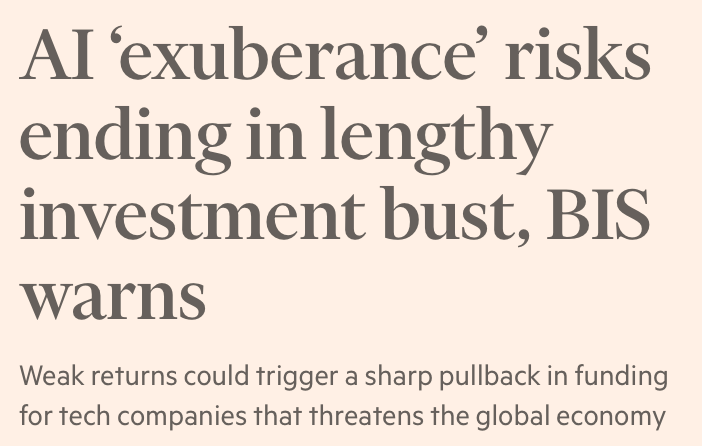
We have embedded the relevant excerpt from the BIS Annual Economic Report at the end of this post. The Financial Times featured it prominently:

And here’s the key chart from their analysis:

This graphic illustrates only technology-related bubbles, deliberately excluding real estate bubbles, which form a substantial part of collective wealth and are further amplified by leverage, leading to significant deflationary impacts during major declines. Notably, the dot-com bubble appears relatively benign in comparison to earlier economic peaks. Even though it sparked concerns at the time for its scale, the 1920 boom was far more severe. The significant use of leverage during this era exacerbated its aftermath, resulting in steep losses for banks amid high margin debt. Additionally, the stock market’s leveraged structures resembled today’s collateralized debt obligations from crisis periods.
Current levels of margin debt, despite existing securities laws meant to curtail it, are sounding alarm bells:
There hasn’t been a better time in a long while to review the quality of your portfolio.
History offers a clear verdict on rising margin debt.
Don’t let FOMO sway you. https://t.co/plx60LYayI pic.twitter.com/q0JXa7VvVE
— Thierry from arvy 🇨🇭 (@ThierryBorgeat) June 27, 2026
Valuation concerns also warrant attention:
🚨 WARREN BUFFETT WARNED ABOUT THIS TWICE.
2000:
“Nothing sedates rationality like large doses of effortless money.”2026:
“We’ve never had people in a more gambling mood than now.”The Nasdaq-to-M2 ratio has pushed ABOVE the peak of the dot-com bubble itself.
The AI… pic.twitter.com/JoC2AR6S1Y
— Crypto Rover (@cryptorover) June 28, 2026
Furthermore, regarding South Korea:
🚨 SOUTH KOREA JUST FLASHED A MAJOR WARNING SIGNAL FOR THE AI STOCKS
KOSPI erased nearly ₩100 trillion today.
KOSDAQ surged +7.5% and added ~₩150 trillion.
At first glance, that looks normal, but it’s NOT.
Money is rotating out of Korea’s biggest AI/memory winners like… pic.twitter.com/2o7NezaHUz
— Limitless Finance (@trylimitlessfin) June 29, 2026
In addition, the AI sector is characterized by circular financing, which mirrors the opaque structures of the 1920s but has led to similar levels of leverage and interconnectedness, making it susceptible to crises. Many hyperscalers face escalating financing needs that they cannot meet through equity, increasing their dependence on loans. High interest rates and a slow contraction in private debt markets further complicate their funding challenges.
According to the Financial Times’ assessment of the BIS report:
Big Tech’s current spending spree on AI poses a risk of leading to a protracted “investment bust,” potentially unsettling financial markets and impacting the global economy. The BIS has cautioned that if expected returns from the tech sector fail to materialize, investors may quickly withdraw funding from AI firms. This is concerning as the top five “hyperscalers” are projected to invest over $1 trillion from 2025 to the end of 2026.

The BIS has raised concerns over the magnitude of equity and debt issuance driving the AI advancement and the volatility this creates within global markets. Tech companies are aggressively tapping the global credit market, raising hundreds of billions to fund AI initiatives, capitalizing on corporate credit spreads that are nearing historic lows.
Major investors have cautioned that this surge in debt issuance may test their appetite, especially if the AI ventures do not yield satisfactory returns. Recently, Allianz’s investment chief remarked that SpaceX’s plan to launch a $25 billion bond sale so shortly after its IPO indicates that the markets may have entered “bubble territory.”
A significant correction in the equity market tied to AI could impact households more severely than in previous instances due to their substantial exposure to stocks relative to overall wealth and income. The BIS further warns that financial stability could be jeopardized given the amount of debt being accumulated by AI firms to finance their investments.
Despite these warnings, many readers have expressed optimism about AI in their remarks on the article, indicating that a considerable number of true believers remain undeterred.
In a vibrant analysis, Ed Zitron discusses how the postponed IPOs of OpenAI and Anthropic will not alleviate their funding challenges, as the sector appears increasingly unlikely to reconcile its vast monetary appetite with the slim prospects for sufficient returns.
The outlook appears grim, hinting at a troubling conclusion; however, powerful incentives persist to sustain the ongoing momentum.
00 Annual Economic Report 2026 – ar2026e


