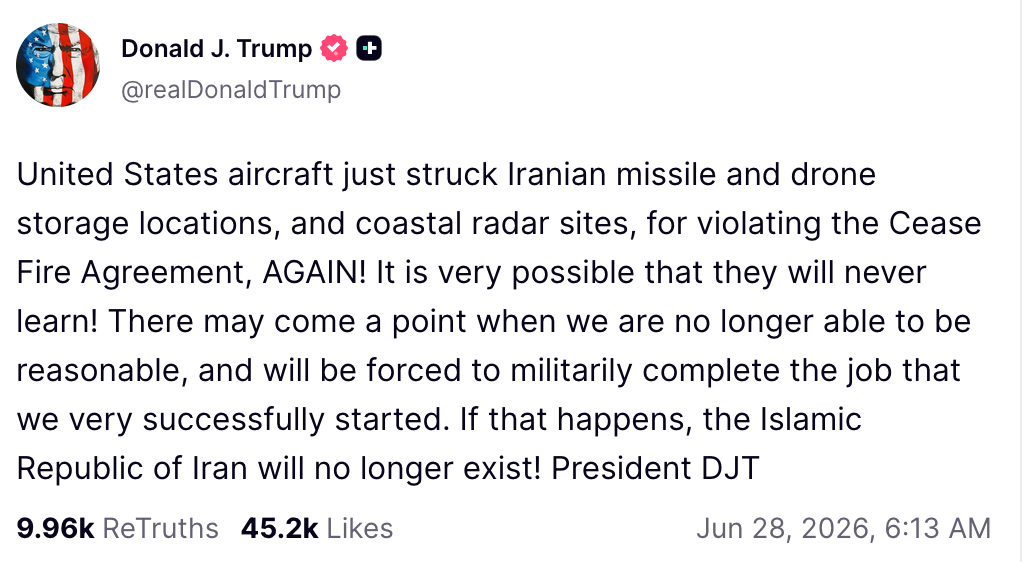
In the ongoing conflict related to Iran, tensions have escalated once again, prompting increased military actions between the US and Iran. Predictions made earlier about the absence of a negotiated settlement are appearing increasingly accurate. As the situation unfolds, both sides continue to engage in retaliatory strikes, complicating prospects for peace. In this post, we will explore recent developments, the responses from both nations, and the implications of these rising tensions.
We had previously stated that this conflict with Iran would not conclude through negotiation. This prediction appears to be materializing as both parties engage in progressively aggressive assaults. The escalating violence is reminiscent of Trump’s misguided handling of the Memorandum of Understanding (MOU) in Versailles. Many supporters of Iran were left disillusioned by the country’s lack of response to blatant violations of the MOU by Israel, which continued to devastate southern Lebanon with only stern admonishments from Iran.1
Furthermore, the US has made it relatively simple for Iran to abandon the MOU, should they decide that such a path is more beneficial. As strikes and counterstrikes continue, Iran maintains it holds exclusive control over the Strait of Hormuz, even while the US has initiated the escort of four tankers on the Omani side. Although it’s unlikely that the Navy can sustain this operation, it should stabilize the energy market for now.
For additional context regarding recent developments: While some argue that Iran lacked legitimate grounds for deploying a drone against a vessel traversing the Strait of Hormuz, especially given that it occurred within Oman’s waters without permission, David Pyne in a recent discussion with Nima proposed that the US retaliatory strikes against Iran were unjustified. The targeted ship was flagged from Singapore, thus the US bore no responsibility for its protection, and the damage was minor enough for the vessel to continue its journey.
The subsequent US response involved airstrikes on four locations within Iran, purportedly drone bases and storage facilities. Iran refuted claims that these sites were legitimate targets (noting they are subterranean), though it acknowledged that a communications tower had sustained damage. In retaliation, Iran struck US operations in Bahrain and set fire to a Panama-flagged very large crude carrier (VLCC). However, these exchanges appeared largely symbolic, albeit with some tangible consequences.
Trump, during a recent decision period, raised the stakes:

The latest round of US strikes on Iran was more intense than previous actions.
Fox reporting: The US is currently executing another wave of airstrikes against Iran. This escalation raises questions about the potential for a ceasefire to hold.pic.twitter.com/PORyarq2TG
— Acyn (@Acyn) June 27, 2026
US AND IRAN EXCHANGE STRIKES AS CEASEFIRE FRAYS
US CENTCOM targeted 10 Iranian military sites overnight, focused on drone storage, air defense, surveillance, and mine-laying infrastructure near the Strait of Hormuz.
The trigger was Iran’s drone attack on the MT Kiku, a Panama-flagged tanker carrying two million barrels.pic.twitter.com/4zx7SaQGQV
— Nabila Jamal (@nabilajamal_) June 28, 2026
Iran was quick to retaliate. According to Aljazeera’s latest update as of 2:00 AM EDT:

Aljazeera’s live feed notes the following:
- The US has bombed Iran for a second consecutive day, hitting areas in Qeshm Island as well as the cities of Sirik and Bandar-e Lengeh in retaliation for the drone attack on a vessel near the Strait of Hormuz.
- Iran has launched counterattacks on US forces stationed in Bahrain and Kuwait, threatening a “crushing response” to further assaults.
Regarding the navigational status of the Strait of Hormuz, here’s an analysis shared approximately eight hours before the initial posted update:
My analysis of the Strait of Hormuz over the last 24 hours:
If tankers take the Iranian route, they are mostly related to Iran. If they use the Omani route, they are not subject to the same restrictions.
I’ve heard from shipowners that most tankers cannot take the Iran route… pic.twitter.com/9LnQkGuBv4
— HFI Research (@HFI_Research) June 28, 2026
Recently, the US successfully escorted one tanker through:
One tanker passing with all those assets isn’t definitive proof of security. It’s just one successful transit. Unless Iran attempted to stop the vessel and failed, it shows only that Iran did not act against it.
This requires significant resources… https://t.co/ayTFx0zw6t
— Daniel Davis Deep Dive (@DanielLDavis1) June 27, 2026
Currently, four vessels are navigating inbound:
Two oil tankers and two LPG carriers are moving through the Strait of Hormuz **inbound** via the Omani route, monitored by heavy US Navy/Air Force presence. Washington is striving to maintain this Omani route.
— Javier Blas (@JavierBlas) June 28, 2026
We can expect further statements from US officials soon, particularly on Sunday, through political talk shows. Meanwhile, Iran’s Foreign Minister Abbas Araghchi asserted that Iran would retain control over the Strait of Hormuz, stating:
Iran’s Foreign Minister Abbas Araghchi (@araghchi):
🔹Under the memorandum of understanding, the Strait of #Hormuz will revert to its pre-war operating capacity within 30 days under Iran’s management.
🔹These arrangements are currently underway, and Iran alone bears responsibility for them.
🔹Any interference in this process will only escalate tensions and hinder reopening efforts.
🔹Past incidents in the Strait of Hormuz have demonstrated that external interference leads to rising tensions and confrontations.
🔹I urge all parties not to meddle in Iran’s management of the Strait or interfere with its reopening processes. Adherence to the signed memorandum is crucial to avoid deviations.
The IRGC has also reiterated fresh warnings. According to Aljazeera’s live updates:
IRGC warns of ‘even more forceful’ responses
The Islamic Revolutionary Guard Corps has pledged to retaliate against any US strikes with a more powerful counterattack, as the cycle of tit-for-tat violence persists in the Gulf.
“As we anticipated, the adversary is untrustworthy, deceitful, and quick to breach commitments,” stated IRGC spokesperson Hossein Mohebi during an appearance on state-run SNN TV. He further emphasized that they would respond strongly to any breach of the ceasefire.
A notable concern is that, in addition to US actions undermining the situation, the Gulf States are also opposed to Iran’s maneuvers, unwilling to become hostages to its agenda.2
Commodities expert Jeff Currie seems somewhat optimistic, albeit perhaps prematurely so, regarding the timing of an oil crunch, but his analysis is directionally sound:
Jeff Currie on the oil market and Strait of Hormuz navigation:
“There are merely two small shipping lanes open. Significant exports beyond a trickle are unfeasible.” pic.twitter.com/lrMwEnnlCb
— Steve Hanke (@steve_hanke) June 28, 2026
Strait of Hormuz, June 27.
Outbound: 18 vessels, 1 operating covertly. Inbound: 22.
Total outbound liquid cargo ~4.12 million barrels, ~3.91 million crude.@Vortexa.At dawn, a general cargo ship and a crude tanker initiated their transit but turned back. A sanctioned tanker entered inbound with its AIS activated.
— Windward (@WindwardAI) June 28, 2026
Just prior to the second round of Iranian retaliation, Anthony Aguilar analyzed the recent US strikes alongside Mario Nawfal, suggesting they appeared to be premeditated:
Following the second wave of US strikes, Daniel Davis raised questions about the US strategy, noting their inability to subdue Iran in previous confrontations and a now diminished arsenal:
This escalating conflict may stem from Trump struggling to manage his inability to impose dominance over Iran, leading to impulsive decisions. Historically, he has proven to be his own worst adversary.
However, it might also reflect a US awareness that their capacity to bombard Iran with conventional forces is as restricted as ever, due to both diminished supplies and what Davis describes as a psychological fatigue among frontline troops. Concern arises that the US and Israel might resort to alternative forms of attack, such as yet another ineffective decapitation campaign or a significant cyber offensive.3
Recent updates from Aljazeera confirm our initial assessments:
US attempting to navigate out of the MoU while holding Iran accountable.
Hassan Ahmadian, an academic at the University of Tehran, expressed that the current airstrikes may catalyze a series of retaliations between the US and Iran.
According to Ahmadian, Article 5 of the MoU stipulates that Iran would facilitate safe passage for commercial vessels for 60 days, post which arrangements are to be collaborated between Iran and Oman.
“Now, the United States wishes to disrupt these arrangements laid out in the MoU it itself ratified,” he remarked. “The US is striving to let go of the memorandum while expecting Iran to adhere to its terms.”
Ahmadian concluded that Iran will remain adamant about managing the Strait, restricting any potential military presence that could disrupt their shipping lanes.
While this assessment differs from the Iranian perspective, which suggests a stronger legal backing, it’s evident that negotiations can only occur given each party’s actual power. Iran’s arguments regarding Israel being a military extension of the US are acknowledged, as the US commitment to enforce the ceasefire and facilitate Israel’s withdrawal is critical. Conversely, Oman, being a neutral party uninvolved in the MoU, is different in this context. Iran’s assertion of rights over navigation in Oman’s territorial waters is a significant overreach, especially when considering their own obligation to ensure secure passage for commercial vessels. Acts of aggression towards commercial ships constitute violations of the agreement.
Moreover, we ought to consider the fraught negotiations involving the current Lebanese government and Israel, with Hezbollah stepping in to shoulder the responsibilities of protecting Lebanese citizens. The impact of US influence in stifling Lebanon’s military capacity cannot be underestimated, compelling Hezbollah to counteract in a vacuum left by ineffective government responses.
Araghchi has also commented on US failure to enforce compliance from Israel regarding the initial ceasefire clause of the MOU:
Araghchi warns against meddling in Strait of Hormuz reopening, reiterates US accountability for ending assaults on Lebanon.
——
In a joint statement with Iraqi Foreign Minister Fuad Hussein in Baghdad, Iranian Foreign Minister Abbas Araghchi called for a fresh regional security structure.— The Cradle (@TheCradleMedia) June 28, 2026
The Middle East Eye live feed reports the latest updates on ongoing hostilities, including Israeli bombings in southern Lebanon and the death of an Israeli soldier. Key points include:
- Lebanese President Joseph Aoun confirmed progress on the Lebanon-Israel framework agreement and ongoing efforts to reinstate governmental authority.
- Prime Minister Netanyahu announced a phased withdrawal from select villages in southern Lebanon.
- Israeli Defense Minister Israel Katz has ordered military preparations for a long-term presence in designated security areas in southern Lebanon.
- Hezbollah leader Naim Qassem sharply criticized the framework agreement, labeling it a surrender and insisting on the full implementation of the US-Iran memorandum.
On the energy front, Mario Nawfal had an engaging discussion with commodities expert Chris Martenson, who evaluated the impending US oil crisis, suggesting it could come in the near future as the Strategic Petroleum Reserve dwindles. Martenson stated that the US must maintain a 10% buffer above the operational minimum for crises and military needs, warning that Trump might risk compromising this buffer. Recent statements by Trump about an impending economic downturn further corroborate this urgency.
Martenson also elaborated on market manipulations in the paper oil sector, drawing parallels to historical attempts to suppress prices, which inevitably led to explosive price increases once the facade shattered.
Just two days ago, Larry Johnson shared a comprehensive expert assessment regarding the state of diesel supplies in the US, highlighting a critical supply shortage that could limit military operations. Diesel is crucial for the economy; hence, any disruptions could rapidly escalate, especially if one considers that the timeframe for potential remedies surpasses critical limits.
The national average of diesel supplies is misleading due to regional discrepancies; some zones are disproportionately reliant on vulnerable pipelines, amplifying the precarious nature of the situation. In a wartime scenario, increased demand for military-grade fuels would further complicate logistics, necessitating careful allocation among competing needs.
Ultimately, if the US resumes its bombing campaign against Iran, it is likely to trigger severe economic repercussions domestically due to energy supply constraints, suggesting that Trump, despite his bluster, may refrain from reigniting conflict in the region.
However, there exist possible pathways towards equitable resolutions—through concerted efforts in economic negotiations involving mutual incentives for both Iran and the Gulf states in exchange for relinquishing control over the Strait of Hormuz. Yet, given the complexities and deep-rooted animosity present, significant barriers remain in realizing these possibilities.
____
1 Iran may have suspended technical talks scheduled for June 28 due to the US’s failure to adhere to Article 1.
2 See discussion starting at 3:50:
3 From an American perspective, Admiral Montgomery claims that Iran is gradually losing its leverage while the US incorporates counter-drone systems, although these are costly and demand time for effective deployment among Gulf states that may desire them. He also argues that the Omani route and pipeline shipments can maintain sufficient oil supplies to the market, acknowledging that groups like Ansar Allah could disrupt shipments from Saudi pipeline routes to the Red Sea.


