The Dynamics of Trust and War in the Nuclear Age
As humanity progresses into an era rife with nuclear capabilities, the discourse surrounding war and conflict has evolved but remains strikingly similar to its ancient roots. Evaluations of warfare often focus on familiar metrics: territorial gains, the outcomes of battles, casualty counts, economic repercussions, and shifts in power structures. These concerns were relevant in historical contexts where military failures had limited and predictable consequences. However, the introduction of nuclear weapons has transformed the stakes entirely.
Nations now possess the unprecedented ability to annihilate not just armies or cities, but entire regions, risking catastrophic global consequences. Despite this, discussions of war and peace often cling to outdated frameworks that prioritize victory and military dominance. Yet the paramount question in the nuclear era transcends the binary of winning and losing; it centers on the potential for increased catastrophic escalation following any conflict. This essay posits that probing this probability involves examining a strategic element often overlooked in national security dialogues: trust.
Trust as a Strategic Component
Trust is frequently perceived as a moral quality, a diplomatic courtesy, or a psychological state. Today, however, it serves as a vital strategic asset. It facilitates negotiation, verification, crisis management, and the interpretation of intentions. When trust diminishes, uncertainty flourishes, and as uncertainty grows, so does fear. This fear nurtures political backing for confrontational policies.
- This dynamic fosters what can be termed the “War Power,” a political ecosystem that expands as societies perceive heightened external threats.
- It operates independently from conspiratorial motives; rather, it emerges organically from the political landscape shaped by fear.
The War Power is prevalent in states with advanced military capabilities and becomes more influential in times of perceived conflict. It doesn’t inherently require warfare to flourish, but rather a continuous sense of fear that justifies preparations for potential conflict.
The Cycle of Trust and Fear
At the core of this analysis lies the assertion that the erosion of trust triggers a perilous cycle. As trust diminishes, fear amplifies, which in turn fortifies the War Power. Escalating confrontations can cultivate a perception of existential threats, leading to repeated crises. This phenomenon can be conceptualized as the “War Power Cycle.” In scenarios involving nuclear nations, each crisis becomes a potentially catastrophic gamble.
The War Power Ecosystem
The War Power is not an isolated entity but rather an ecosystem intricately woven into the political, economic, bureaucratic, and cultural frameworks of society. It is comprised of military organizations, defense industries, intelligence services, political actors, and media narratives, all thriving on the perceived threat of external military aggression. Its existence does not imply malicious intent; rather, it reflects a structural reality in which fear drives behavior.
In times of increased public fear regarding security threats, political support for military expenditures escalates. This is exacerbated by confrontations that amplify security anxieties, thereby promoting narratives that favor military preparedness. Hence, the War Power flourishes not from direct combat, but from the anticipation of danger.
Trust as Strategic Infrastructure
Traditionally considered a moral imperative, trust is a crucial component of international relations that allows states to decipher intentions, negotiate effectively, and manage crises. Without trust, basic interactions deteriorate, leading to a breakdown in communication and an overwhelming increase in fear.
Trust should be regarded as vital strategic infrastructure akin to communications systems or road networks. It streamlines collaboration between states, enhancing their ability to navigate complex interactions without defaulting to mistrust.
The Trust Destruction Gradient
Trust destruction typically occurs incrementally rather than all at once, following a sequence known as the “Trust Destruction Gradient.” Consequently, rivalry can exist under a veneer of trust, but as that trust erodes, suspicion and fear expand, leading to hostility and eventually existential threat perceptions.
This progression can be summarized as follows:
- Rivalry
- Suspicion
- Distrust
- Hostility
- Existential Threat Perception
Each advancement in this gradient intensifies fear and expands the influence of the War Power ecosystem. This self-reinforcing cycle of distrust creates a foundation for an environment conducive to catastrophic escalation, particularly among nuclear powers.
The Existential Threat Plateau
At the apex of the Trust Destruction Gradient lies the Existential Threat Plateau, marked by the conviction that survival is at risk. Here, concerns about security overwhelmingly dominate other political priorities. The resulting mindset often exaggerates adversarial intentions, constraining diplomatic flexibility and promoting military expenditures as necessary defenses.
Nuclear Roulette
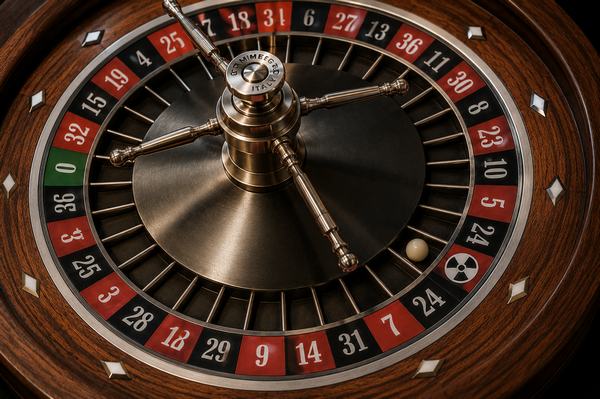
The reality of nuclear conflict is often misinterpreted as a series of isolated events. In truth, the ongoing threat arises from repeated crises that invite opportunities for catastrophic miscalculations. This cyclical nature can be likened to a high-stakes game of roulette, where each spin raises the risk of disaster, regardless of past outcomes.
Political leaders and institutions may mistakenly perceive positive outcomes as indicators of manageable risks. This survivor bias can lead to a dangerous complacency, as societies grow numb to the significance of potential nuclear dangers.
The Case of Israel and Iran
The ongoing tensions between Israel and Iran exemplify many of the dynamics explored in this essay. A history marked by distrust and repeated crises has evolved into an environment characterized by fear and minimal trust. Each side perceives the other as an existential threat, continuously feeding into the cycle of distrust and confrontation.
As fear escalates, so do military expansions and security measures, driven more by perceptions of danger than by objective realities. This not only heightens the possibility of miscalculation but also shapes an escalating cycle of confrontation.
Conclusion
The central thesis of this discussion emphasizes that the most significant threat of the nuclear era stems not from the existence of nuclear weapons themselves, but from the political landscape that perpetuates their potential use. Trust, when eroded, amplifies fear, which in turn sustains confrontations and increases the likelihood of catastrophic escalation. To break this cycle, we must commit to rebuilding trust in international relations with as much fervor as we currently invest in military power.
Addressing these underlying dynamics is critical. If humanity is to mitigate the peril of nuclear roulette, a concerted effort towards fostering trust will be essential, potentially surpassing our focus on militarization. Without such an approach, the dangers of confrontation will continually loom over our future.
