Many visitors to Barcelona are captivated by the awe-inspiring Sagrada Familia, a masterpiece of architecture that combines beauty with profound mathematical concepts. In this article, we will explore the remarkable numerical foundations that underpin Antoni Gaudí’s iconic basilica and delve into how these elements contribute to its stunning forms and spiritual significance.
By Sergi Muria Maldonado, Professor of Mathematics Education, Universitat de Barcelona; Anton Aubanell Pou, Professor at the Institut de Formació Continuada and retired professor of Mathematics Education, Universitat de Barcelona; and Jordi Font González, Professor of Mathematics Education, Universitat de Barcelona. Originally published at The Conversation

The year 2026 will mark a century since the passing of Antoni Gaudí, the visionary architect behind the Sagrada Familia. The temple’s extraordinary beauty remains captivating, but its allure deepens when one considers the mathematical principles that underpin its unique designs.
By examining these mathematical foundations, we gain insight into the visual symmetry and structural coherence of the basilica, revealing a vivid blend of form and function.
Mathematician Claudi Alsina i Català has extensively researched the mathematics embedded within the Sagrada Familia. He began his explorations at the University of Barcelona and oversaw the doctoral thesis of Jordi Faulí, the architect currently overseeing the ongoing construction of the temple.
Alsina reflected in his memoirs:
Many have questioned whether the design of the Sagrada Familia contains a specific module or proportional system that guides its metrics. After much contemplation, one Saturday afternoon, I uncovered it—the module of 7.5 meters and the ratios among the divisors of 12 (1:4, 1:3, 1:2, 3:4, 2:3, 1) appeared to provide significant clarity.
12: The Magic Number
The number 12 plays a pivotal role in the architectural structure of the church. Gaudí envisioned the Sagrada Familia as a harmony of architectural form and religious symbolism, where the idea of 12 predominates in biblical references: from Jacob’s 12 sons to the 12 tribes of Israel, the 12 apostles, and the crown of 12 stars described in the Book of Revelation.
The significance of the number 12 extends beyond symbolism. Mathematically, it is a versatile number for establishing proportions due to its multiple divisors. According to Alsina, the interplay between these divisors is fundamental to understanding the basilica’s proportional framework.
The 7.5-Metre Module
Following Alsina’s research, let us embark on a brief mathematical journey through the Sagrada Familia.
The church’s dimensions revolve around the number 12 and a fundamental module of 7.5 meters. The total length is 90 meters (7.5 × 12) and the width spans 60 meters (7.5 × 8). The main nave’s width measures 45 meters (7.5 × 6).
In terms of elevation, the tallest vault lies in the apse, reaching 75 meters (7.5 × 10), followed by the transept vault at 60 meters (7.5 × 8). The nave vault stands at 45 meters (7.5 × 6), while the side aisles reach 30 meters (7.5 × 4), and the choir is 15 meters (7.5 × 2).
The Tower of Jesus Christ is the central and tallest structure, ascending to 172.5 meters (7.5 × 23), nearly aligning with the height of Montjuïc hill. It is topped with a four-armed cross, measuring 17 meters high and 13.5 meters wide. Surrounding it are the four Evangelist spires, each reaching 135 meters (7.5 × 18).

The Star of the Virgin Mary adorns the tower dedicated to her. Canaan, CC BY
The second tallest tower, dedicated to the Virgin Mary, reaches 138 meters and is crowned with a 12-pointed star, supported by three arms. This star measures 7.5 meters in diameter and comprises a regular dodecahedron adorned with pyramid-shaped pentagonal points. Its interplay with both daylight and nighttime illumination renders it a remarkable sight.
Polyhedral Towers
Polyhedrons are also integral to the towers of the Sagrada Familia. The towers on the Glory façade are topped with dodecahedrons, those on the Nativity façade feature truncated irregular octahedrons, and the towers on the Passion façade are fitted with truncated cubes.
Each of the 12 towers is crowned with a spire. Those dedicated to the evangelists are topped with regular icosahedrons that house light fixtures to illuminate the large cross atop the Tower of Jesus Christ. Above each icosahedron, sculptures symbolizing each evangelist gracefully rise. Numerous star-shaped polyhedrons embellish the church, particularly noticeable on the Nativity façade.
A Forest of Towers
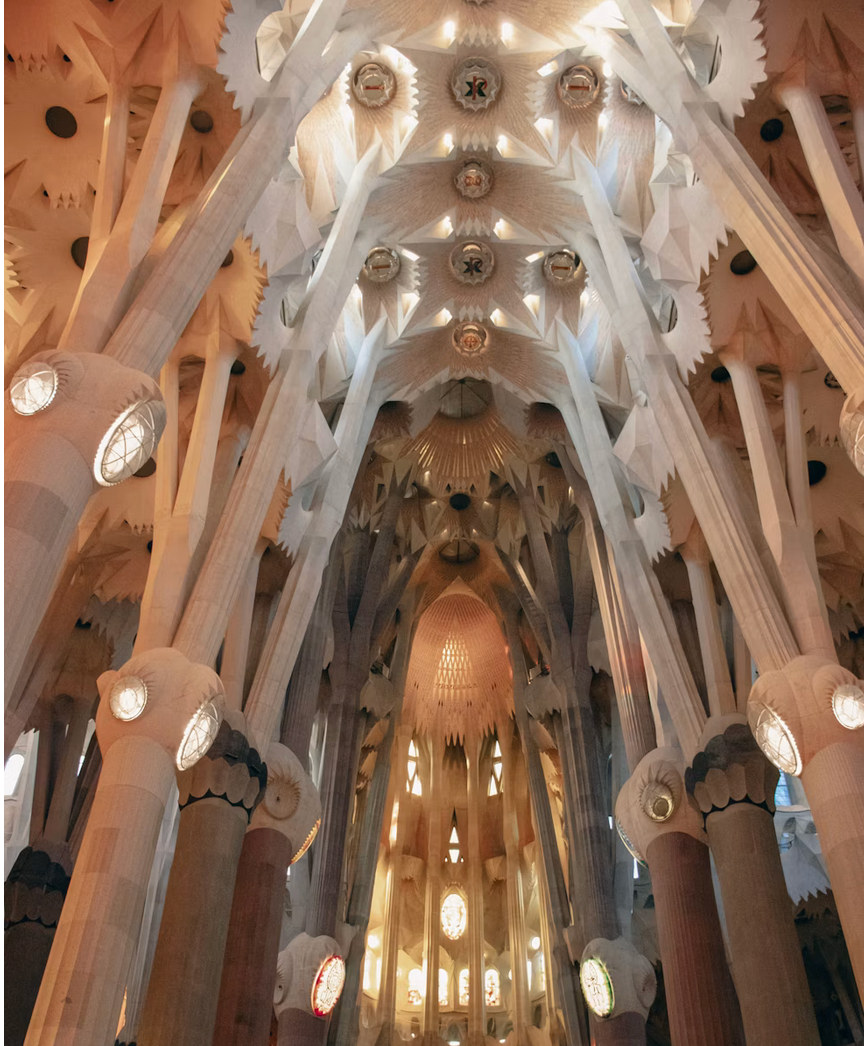
Catenary arches are essential structural components of the church, allowing for effective load distribution without the need for excessive support. These arches are evident in the sloping columns that support the interior naves, as well as in the vaults and ceilings, including the Nativity façade.
Inside the Sagrada Família, four distinct types of columns exist, each a double-helix torsion column. These columns feature rounded, star-shaped polygonal bases, formed by the intersection of two opposing Solomonic columns. At their tops, knots emerge from which branches unfurl, resembling a tree’s branches, effectively supporting the towers and roof of the church.
The skylights in the roof are also constructed as one-sheet hyperboloids. Their straight-line structures make them easy to construct while optimizing light capture and projection.
The Symbolism of 7 and 33
The church contains numerous hidden symbolic features. For instance, the canopy above the high altar forms a regular heptagon with a 5-meter diameter, representing the seven gifts of the Holy Spirit.

On the Passion façade lies a magic square in which the sum of each row, column, and diagonal totals 33. This design appears to be inspired by the magic square from Albrecht Dürer’s engraving Melancholia I.
The mathematics underlying the Sagrada Familia enhances its beauty. While the structure itself impresses, a deeper understanding of its mathematical principles fosters an even greater appreciation for the genius of Antoni Gaudí.


