As the situation in the Middle East escalates, the implications of the ongoing conflict involving Iran have become a growing concern. This article explores the potential consequences of renewed hostilities, drawing attention to the broader implications for the global economy and regional stability.
It would be regrettable if I were mistaken, but it appears that my initial prediction regarding the Iran conflict as a harbinger of destruction is increasingly valid. Sadly, the fallout seems poised to threaten the global economy and adversely impact the living standards of billions of people.
We believed from the outset that the chances for productive settlement talks were slim due to the vast gulf between the negotiating positions of both sides, compounded by Israel’s determination to undermine any nascent agreements.
The recent flare-up, where the U.S. concocted a justification to attack Iran—disingenuously branding the bombing as “self-defense” and “proportional”—and Iran’s swift retaliation underscores that all of Trump’s assertions about pursuing peace deals are mere political posturing, aimed at stabilizing oil prices. While some analysts, like Robert Barnes, suggest Trump desires a way out, his actions tell a different story. His support for ongoing attacks on Iran and insistence on unrealistic negotiation stances—like refusing to release Iran’s frozen assets initially and demanding Iran eliminate its nuclear capabilities—illustrate this.
Trump’s reliance on his own ego, combined with the incessant information churn from Fox News and insiders in the pro-Israel lobby, leaves little room for a negotiated settlement. This reality indicates that Trump will not declare victory and walk away from the situation.
We held out a sliver of hope that Gulf states would prioritize their economic well-being and distance themselves from the U.S., which could significantly constrain U.S. operations in the region. Unfortunately, the recent rash of U.S. attacks on Iran has elicited neither dissent nor refusal of airspace usage from these states.
The current U.S. strategy appears to revolve around persistent low-level harassment of Iran—a costly form of political theatrics that enables Trump to project a narrative of American strength against the “bad Iranian regime,” appeasing both Zionist factions and Christian evangelicals. Ironically, this is a conflict type that favors Iran, which has long prepared for a protracted engagement, recognizing that the U.S. and Israel are ill-equipped for such lengthy campaigns. Moreover, the American and Israeli tolerance for losses in this conflict leans heavily in Iran’s favor.
While there remains a substantial risk that the ongoing tit-for-tat exchanges could escalate dangerously, Iran has warned of severe repercussions if the U.S. or Israel strikes its energy infrastructure again. Such actions could roll back global development by taking out Gulf state energy capabilities and essential desalination facilities.
We will delve deeper into these issues soon, but one urgent concern persists: predicting the timeline for an oil supply cliff in the U.S.—the moment when inventories can no longer compensate for lost Middle Eastern energy supplies, leading to a sudden spike in gas and diesel prices. This cliff is critical, as not only would it impact the economy and financial markets, but it also has the potential to force Trump to acknowledge his failures in Iran.
Ultimately, Trump’s use of a dubious justification to attack Iran should leave no doubt about his lack of interest in resolving the conflict. Such a stance suggests that even if gas prices were to soar to $10.00 per gallon or if the U.S. economy were to buckle under high diesel costs and shortages, Trump would remain steadfast.
Recall the insight from reader Ben Panga, who noted that narcissists like Trump fear humiliation more than death. A retreat from the Iran conflict would crystallize his humiliation, undermining both his and the Zionists’ inflated assertions. In contrast, persisting in combat enables Trump to maintain the illusion of a possible victory—a narrative that continues to be pushed vigorously by networks such as Fox News.
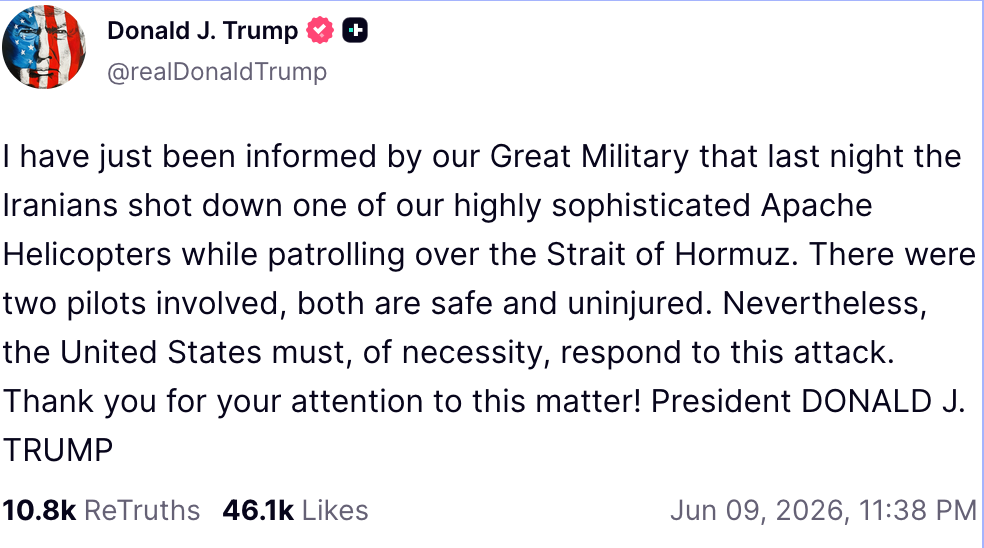
Against this backdrop, the latest developments in kinetic warfare deserve attention. We previously refrained from highlighting the downing of an Apache helicopter near the Strait of Hormuz, as the circumstances remained ambiguous, and both pilots emerged unhurt—a fortunate outcome given the helicopter’s vulnerability.
However, the narrative shifted quickly:

It is worth noting that despite the fragility of helicopters, the lack of casualties suggests that if Iran had genuinely aimed to destroy it, fatalities would have been expected.
The Islamic Revolutionary Guard Corps (IRGC) has denied involvement in the helicopter incident. Professor Mohammed Marandi, in a discussion with Daniel Davis, stated that he had consulted two senior military officials who both asserted that Iran had not attacked the Apache. He reiterated this stance on Twitter:
For the record, Iran did not shoot down the helicopter, and Trump is lying, but the Islamic Republic is more than prepared to teach the Epstein Coalition a lesson. pic.twitter.com/mb5sG4x24c
— Seyed Mohammad Marandi (@s_m_marandi) June 9, 2026
Davis further refuted U.S. claims, asserting their implausibility:
Plus, if a Shahid drone hit a helicopter, it would’ve blown it into a massive fireball, and no one would’ve survived. That both Pilots allegedly walked away without serious injury, implies this was a mechanical failure, or accident, not a shootdown. It is nearly impossible to…
— Daniel Davis Deep Dive (@DanielLDavis1) June 9, 2026
Davis elaborated further on his findings:
In a lightly cleaned transcript, he remarked:
During our show earlier this morning, it was reported that CENTCOM had no response. However, things took a strange turn when President Trump announced that the military informed him that Iranian forces shot down one of our Apache helicopters while patrolling over the Strait of Hormuz. Questions arose about whether it was shot down by small arms fire, machine guns, or an anti-aircraft missile. Initially reported by sources in the Pentagon, CNN and CBS later claimed it was a Shahed drone—an assertion that raised alarm bells. Shahed drones are designed for ground targets; they cannot navigate to engage moving targets like helicopters.
Larry Johnson also expressed skepticism regarding the claims of the helicopter being shot down. He highlighted the implausibility of the scenario, noting:
A truly bizarre series of events off the coast of Iran today that in my opinion were entirely provoked, if not staged, by the U.S. The AH-64 Apache is primarily designed for anti-armor warfare; the fact that its pilots emerged unharmed raises further questions regarding the U.S. narrative.
Despite Trump’s tenuous justification, CENTCOM provided further dubious claims:

Indeed, CENTCOM’s assertion that the attacks were “proportional” raises serious questions about the definition of proportionality, especially with reports indicating that the U.S. struck twenty targets in response.
In the aftermath of the attack, the IRGC reaffirmed that they would respond with further strikes if U.S. aggression continued. President Trump alleged that the Iranian action constituted a significant provocation, and the IRGC announced drone attacks on U.S. assets across the region as a response.
Reports suggest that during the U.S. attack, two MQ-9 Reaper drones, valued at approximately $80 million, were lost—an unexpected cost to the U.S.
Furthermore, Iranian missile and drone operations were reportedly intercepted, indicating the potential for impact on U.S. naval assets in the region:
The New York Times reports that “nearly all” Iranian missiles and drones were intercepted, suggesting there were some impacts. pic.twitter.com/QCZyRbocy3
— AMK Mapping 🇳🇿 (@AMK_Mapping_) June 10, 2026
In a broader context, Iran has communicated that they will pursue additional retaliatory measures if the U.S. strikes persist. The IRGC has confirmed drone attacks on American installations, indicating that this conflict may further complicate the region’s stability.
Despite the severity of the situation, many experts viewed Iran’s responses as proportional rather than escalatory. Some commentators have criticized Iran for not taking a firmer stance against U.S. and Israeli forces, suggesting that a slower, sustained approach may serve Iran’s strategic interests better than a rapid escalation.
Additional statements from both Russia and China called for restraint among the combatants, with indications that these nations seek to prevent the conflict from spiraling further out of control. Thus, the potential for negotiation persists, albeit under strained circumstances.
The ongoing volatility within the Strait of Hormuz has led to the consideration that, while both nations engage in a tit-for-tat strategy, the escalating conflict could decimate the global economy by choking maritime trade routes crucial for energy supplies.
Douglas Macgregor, who has insights into Trump’s operations, noted that the current situation presents an intractable dilemma for U.S. leadership. In his view, neither the U.S. nor its allies can afford to lose face at this juncture, which could lead to prolonged engagement in a conflict that shows no signs of resolution.
As the U.S. and Iran continue to exchange blows, tensions also remain high in Lebanon, where Hezbollah and Israeli forces are engaged in active combat. Heavy fighting and air strikes have characterized the situation, signaling that regional dynamics are becoming increasingly dangerous.
In summary, the intricate web of alliances, retaliations, and the strategic posturing in the Middle East portends a grim outlook for diplomatic resolution. As hostilities intensify, the overarching impact on the global economy and security will require careful scrutiny in the days and weeks to come.


