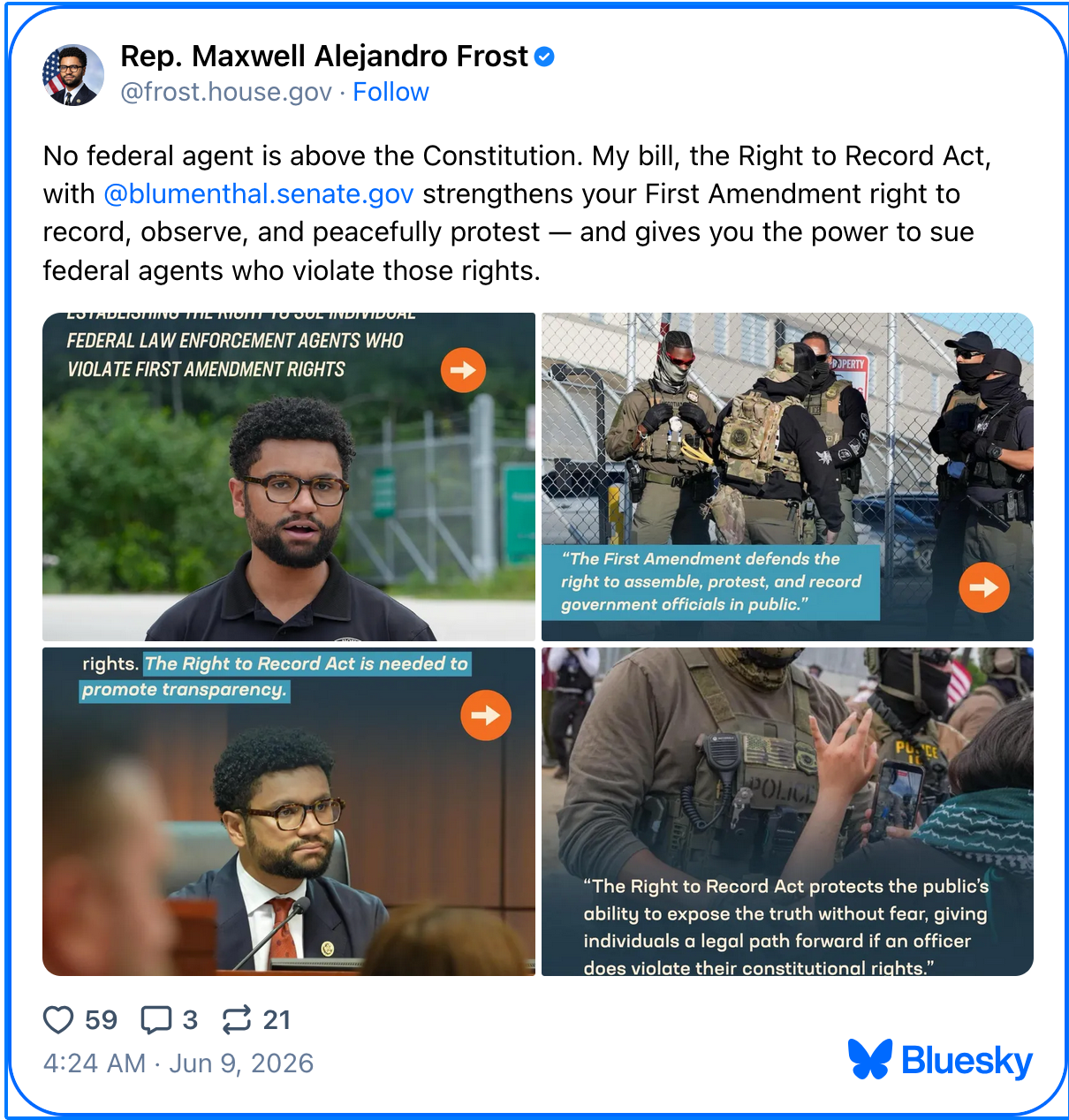
Yves here. It is unfortunate that we find ourselves in a position where legislation like this is necessary in America. Established legal precedent indicates that individuals have no reasonable expectation of privacy in public spaces, including areas visible from the street, such as one’s front yard. Consequently, capturing photographs or videos of individuals in these settings is also protected under the First Amendment.
Nonetheless, I appreciate the provision holding federal employees individually accountable. Although the government may cover their defense costs, these employees would still face discovery proceedings and the stress associated with litigation. This aspect could effectively deter misconduct.
Of course, it seems unlikely that this bill will pass before the upcoming midterms. However, depending on the outcomes of those elections, the dynamics could shift significantly.
By Brett Wilkins, staff writer at Common Dreams. Originally published at Common Dreams
A pair of Democratic lawmakers introduced a new bill on Monday aimed at safeguarding the constitutional right to lawfully record federal agents, as well as providing civil recompense for individuals whose rights have been infringed upon.
Congressman Maxwell Frost from Florida and Senator Richard Blumenthal from Connecticut unveiled the Right to Record Act, which, according to Frost’s office, “establishes the right to sue individual law enforcement agents if they violate First Amendment rights, including the right to record, observe, or peacefully protest.”
“The First Amendment protects the rights to assemble, protest, and document the actions of government officials in public spaces,” Frost stated.

“This right has never been more critical. In cases like the murders of Alex Pretti and Renee Good, officials and their allies attempted to characterize the victims as threats, even with plenty of evidence disproving their claims,” he continued, referring to two individuals fatally shot during the Department of Homeland Security’s (DHS) Operation Metro Surge anti-immigration operation in Minneapolis.
“Without firsthand recordings, those misleading narratives may have become the accepted version of events, which underscores the importance of the Right to Record Act,” Frost emphasized. “It would ensure the public can reveal the truth without fear, providing a legal pathway for individuals if an officer breaches their constitutional rights.”
In the same statement, Blumenthal noted that “over the past year, I’ve looked into numerous cases of Americans mistreated by government agents, and consistently, video footage has confirmed their accounts—shed light on their experiences and helped ensure justice was served.”
“Without recordings, we wouldn’t know the truth of what happened to Renee Nicole Good, Alex Pretti, Marimar Martinez, George Retes, and countless others,” the senator remarked.
Martinez, a U.S. citizen, was shot five times by a U.S. Customs and Border Protection agent last October in Chicago while en route to donate clothing to her church. Body camera footage revealed that DHS officials—who labeled Martinez a “domestic terrorist”—had fabricated a narrative about the circumstances leading up to the shooting.
Retes, another U.S. citizen, is an Iraq War veteran who experienced a violent arrest last July during an immigration raid at his workplace, which led to his detention for three days.
“The right to bear witness has never been more significant,” Blumenthal emphasized in his statement on Monday. “I am proud to collaborate with Congressman Frost on bipartisan legislation that will fortify the right to record, observe, and peacefully protest—establishing real enforcement mechanisms for the protections enshrined in the First Amendment, which serve as the foundation of our democracy.”
Recording federal law enforcement officers in public spaces is considered a First Amendment activity, provided the recorder does not interfere with the officers’ duties. Federal courts have consistently upheld this fundamental right.
“The ability to observe and record law enforcement is essential to our democracy,” asserted Jenna Leventoff, senior policy counsel with the ACLU, which has endorsed the Right to Record Act. “We cannot hold our government accountable if we cannot see what is occurring in our communities.”
“Observing and recording empowers people to create an independent record, disseminate information within their communities, and demand greater accountability from our government,” she added. “Protesting for our beliefs is a fundamental American value, and capturing government activities can fuel the protest movements that drive meaningful change.” Leventoff expressed hope that Congress will formalize these rights into law by passing the Right to Record Act.