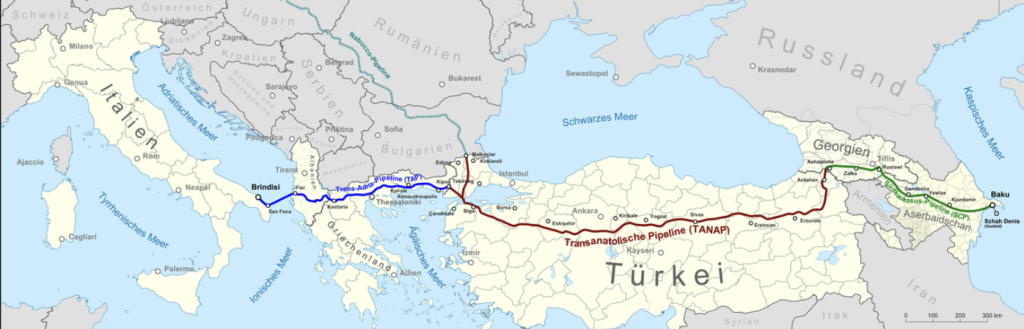
The United States is poised to become the European Union’s largest gas supplier this year, surpassing Norway, as reported by the Institute for Energy Economics and Financial Analysis. This shift is part of a broader trend that could see the US solidifying its influence over Europe’s energy landscape in the coming years.
Last year, the EU mandated that all member states must eliminate their dependency on Russian energy by 2028 at the latest. Consequently, nations like Slovakia, which are tied to long-term contracts with Russia, are increasingly turning to Southeast regions such as Turkey, the Caucasus, and the Caspian area for alternative energy sources.
The United States is playing a crucial role in this transition, controlling a vital corridor through southern Armenia and enhancing its influence in Azerbaijan. This raises the question: where will the gas supply come from?
Before reaching the EU, gas supplies will first transit through Turkey, which primarily sources its gas from Russia and Azerbaijan via existing pipelines, along with smaller contributions from Iran and liquefied natural gas (LNG) shipments. Unless unexpected developments occur in Iran, resulting in a lucrative resurgence in American interest, reliance will increasingly fall on Azerbaijan, which has already committed to boosting gas supplies to Slovakia, Hungary, and other countries.
Simultaneously, the United States is deepening its involvement in Azerbaijani production and delivery. As noted by Euronews, Assistant Secretary of State for Economic, Energy and Business Affairs Caleb Orr commented at the inaugural Azerbaijan–US Economic Dialogue in Baku:
“The United States wants a greater role in the pipeline infrastructure and the other energy infrastructure that Azerbaijan is building,” he stated.
Baku’s rising status as a transit hub was emphasized, particularly mentioning the Middle Corridor that connects Asia and Europe via the Caspian region. “We expect to help Azerbaijan grow its role as the central node of the Middle Corridor for energy transit, going to Europe and the rest of the world,” he explained.
The US is already entwined in Azerbaijan’s energy sector through companies like ExxonMobil and Chevron.
Orr added that ExxonMobil had signed a memorandum of understanding for new exploration projects during last year’s Baku Energy Week, while Chevron also struck a new agreement at this year’s event. “We believe Azerbaijan is a critical energy producer globally,” he continued, expressing optimism for significant growth in this relationship over the coming years.
Turkey is also proposing a “military” pipeline to Europe aimed at supplying NATO’s eastern flank, likely involving Azerbaijani resources. Such an announcement could grab headlines during the upcoming NATO summit in Ankara this summer.
It is conceivable—if not probable—that this supply route will follow the Trump Route for International Peace and Prosperity (TRIPP), a 43-kilometer corridor through southern Armenia that would connect Azerbaijan to its autonomous Nakhchivan exclave adjacent to Turkey. Recent elections indicate a strong backing for TRIPP after Prime Minister Nikol Pashinyan’s party secured a solid victory, setting the stage for a one-party government.
Turkey and Azerbaijan are already endeavoring to establish an electricity corridor to Europe via TRIPP. It is likely that pipelines will follow the same route given the long-standing interests of both Turkey and Azerbaijan. However, work on the Armenian segment has not yet commenced, with all developments designated for a US-Armenian joint venture, where Washington holds a 74 percent controlling stake. This entity was recently established by the U.S. International Development Finance Corporation Board.
It’s noteworthy that the EU’s heightened focus on importing more gas from Azerbaijan—and hence the interest in TRIPP—stems largely from its decision to phase out TurkStream. An EU decree issued last year set an expiration on the previously accepted practice of labeling Russian gas as Turkish. The regulation outlines:
“The Regulation should therefore presume that natural gas imported into the Union… arriving via TurkStream… originates in or is exported, directly or indirectly, from the Russian Federation, thus replacing the requirement to submit proof of the country of production.”
TurkStream has a yearly capacity of 31.5 billion cubic meters (bcm) of natural gas, with about half remaining in Turkey, while the rest is routed to the Balkans and Central Europe. Serbia and Hungary are the primary European importers. Recently, Turkmenistan’s exports to Europe have been at record highs.
Although it’s uncertain how robustly these regulations will be enforced, if they are applied strictly, the EU’s goal of eliminating Russian gas by the end of 2028 essentially aligns with longstanding US interests.
TurkStream emerged after the US disrupted the Russia-Bulgaria South Stream pipeline initiative in 2014. This project aimed to transport Russian gas under the Black Sea to Bulgaria and beyond into Serbia, Hungary, and Austria. Consequently, Russia redirected its efforts to Turkey, where President Erdogan proved less susceptible to American pressure, resulting in the launch of TurkStream at the beginning of 2020 despite US sanctions applied on firms involved in its construction.
In recent efforts, the US attempted to utilize Bulgaria to obstruct Russian gas exports from Turkey to Europe, but Hungary thwarted that strategy by threatening to veto Bulgaria’s integration into the Schengen area.
While the pieces for a new energy landscape are falling into place, numerous challenges persist.
Short on Supply, In Need of Infrastructure
Azerbaijan was initially expected to export 20 bcm of gas to the EU by 2027, but that timeline has already been postponed. Several challenges hinder progress toward that goal.
The first issue lies in the fact that the pipelines currently delivering Azerbaijani gas to Europe are already operating at full capacity.

Even with potential expansions, additional compressor stations, and new pipeline proposals from Turkey, uncertainties remain about upstream production in Azerbaijan.
The key problem is that production levels are struggling to keep pace with both domestic needs and EU demands. There is limited information on confirmed reserves and future production potential, but it is evident that Azerbaijani exports to the EU saw a slight decline in 2025, totaling 12.8 bcm—a 1 percent decrease from the previous year’s figure. This drop likely resulted from decreasing gas transit from Russia through Azerbaijan due to geopolitical tensions encouraged by Western nations.
Thus, while there may be hopes that Azerbaijan is on the brink of tapping into promising Caspian energy fields and that exciting pipeline projects are about to be announced, one might wonder why such developments have not already materialized given the extensive time since the onset of Project Ukraine.
This situation compels Assistant Secretary Orr, Turkey, and European officials to look further east across the Caspian Sea to Turkmenistan for alternative gas supplies. However, Turkmenistan presents its own set of complications.
Turkey previously engaged in a limited gas swap arrangement with Turkmenistan and Iran, whereby Iranian gas was sent to Turkey in exchange for Turkmen gas directed to Iran. Expanding such deals could provide a sensible route for augmenting gas supplies to Europe. However, considering this scenario, one could argue that it would make more sense to revive the Nord Stream pipeline or maintain TurkStream.
Furthermore, the prospects for Iranian involvement in energy integration are bleak. Turkmenistan and Turkey halted their gas exports via Iran, particularly following the US decision that prohibited Iraq from importing Turkmen gas through Iran via a swap deal.
Given that Iran is excluded, discussions about the Trans-Caspian Pipeline have resurfaced, which would extend from Turkmenistan across the Caspian Sea to Azerbaijan, subsequently channeling its gas supplies to Turkey and Europe. Supporters of this project, including Orr, often highlight its potential connection to the China-backed Middle Corridor.
However, such a narrative will likely face skepticism in Moscow and Tehran—and even in Beijing.
As momentum builds for the Trans-Caspian project, it is crucial to remember the reasons that have historically obstructed its development, primarily due to unresolved disputes over submarine cables and pipelines as established by the 2018 Convention on the Legal Status of the Caspian Sea involving Azerbaijan, Iran, Russia, Kazakhstan, and Turkmenistan.
Those matters are governed by the 2003 Tehran Convention, which sets environmental parameters. Russia and Iran have frequently cited this Convention to obstruct the establishment of pipelines linking Azerbaijan to Kazakhstan and Turkmenistan.
Is there any compelling reason to believe that Russia and Iran would reassess their stance at this juncture? Therefore, any prospects for the Trans-Caspian pipeline involve disregarding the Tehran Convention and navigating the fallout from the nations whose interests were overlooked.
The US may find itself amidst a paradoxical situation: strengthening divides in the Caucasus-Caspian region, thus raising the likelihood of conflict, which would further complicate Eurasian integration efforts and bolster Europe’s dependency on US LNG imports. Conversely, Washington could also end up controlling the transit of vital resources through the region to Europe. A favorable scenario for American interests, indeed.
Yet, it is probable that the Trans-Caspian Pipeline remains a distant ambition, while the EU struggles to manage marginally increased supplies from Azerbaijan. Meanwhile, LNG continues to cross the Atlantic, a stark reminder that this crucial transatlantic relationship comes at a high cost in both financial terms and environmental impact.
Amidst all of this, another potential outcome looms:
“Are we really such idiots already?”
Slovak PM Fico concerning the EU’s decision to cut off direct Russian energy to the EU in 2027, only to then purchase the same energy from America at a premium.
Full statement
10 May 2026
Slovakia’s Prime Minister Robert Fico:… pic.twitter.com/ulamZnjdMY— the Lemniscat (@theLemniscat) May 10, 2026
Transatlantic Stockholm Syndrome
Currently, Europe finds itself at a crossroads, especially with the Hormuz Strait closed.
Libya remains mired in turmoil, and Algeria is operating at maximum capacity. There are hopes for a revival of the proposed EastMed pipeline to transport natural gas from the eastern Mediterranean to European markets, but Washington has historically opposed this project. Former Undersecretary of State Victoria “F**k the EU” Nuland offered her perspective:
“Honestly, we don’t have a decade to spare, but in ten years, we aspire for a greener and more diverse energy mix.”
This statement was made over four years ago, and it has been more than twelve since the infamous leaked call that revealed complex transatlantic dynamics.
Logic would suggest that at some point, a significant portion of the European populace might recognize that the political trajectory towards increasing dependency on the US and antagonism towards Russia and China is detrimental to the interests of ordinary Europeans. However, historical trends show that political figures advocating nationalistic platforms—like euroscepticism and anti-NATO sentiment—often yield to pressure once they assume power.
Despite this, public sentiments appear to be shifting. Recent polling indicates potential resentment brewing among Europeans, though it can be challenging to determine whether this is more directed at American policies or the current European leadership that occasionally embarrasses itself on the global stage.
A Politico European Pulse survey from April revealed rising concerns about US actions, with a growing number of Europeans perceiving the US as a threat—more so than China. In Italy, for instance, American influence is rapidly closing in on that of Russia. This is especially noteworthy given the relentless anti-Russian narrative that has dominated mainstream media for years.

Politico’s survey results mirror findings from the European Council on Foreign Relations, which showed a steep decline in the favorability ratings of the US from the previous year reported.

These trends may shift should a charismatic Democrat emerge victorious in the 2028 elections, championing a return to the so-called liberal rules-based order. However, the ramifications of Europe’s dependencies will likely persist long after.
For years, the US has aimed to undermine Russian influence in the Black Sea and Caucasus regions while controlling—or at least influencing—energy flows to Europe.
American policymakers have frequently articulated their strategic objectives for the Black Sea area. James O’Brien, former Secretary of State for European and Eurasian affairs, explained in a Senate Foreign Relations Committee meeting years ago that one of the key goals behind using Ukraine to weaken Russia is to bolster NATO and foster American business interests in the Black Sea region. What does this entail?
The Atlantic Council succinctly captures Washington’s viewpoint, stating, “Türkiye can become an energy hub—but not by going all-in on Russian gas.” The underlying message carries an implicit warning:
“Exploring ghost opportunities for energy collaboration with Russia, amidst risks of US and EU sanctions, will not transform Türkiye into an energy hub; instead, it will undermine this aspiration outright.”
One of the top priorities for the US—if not the pinnacle objective—is to displace Turkstream with energy solutions more aligned with American interests.
This mission is indeed successful, as it appears that Europeans are complicit in their own energy dilemmas fueled by the narrative that “Russia is bad, and America is good.”

