[This post is currently in progress. Please check back at 8:00 AM EDT or refresh this page for the completed version.]
Bloomberg serves as a valuable source for investors seeking daily updates on the evolving situation in Iran. However, it notably avoids addressing Israel’s role in complicating efforts toward a resolution in the ongoing conflict. Israel continues its military operations in Southern Lebanon despite Hezbollah’s rejection of a ceasefire proposal favoring Israel. Additionally, Iran is demanding that Israel cease its military actions in Gaza and the West Bank.
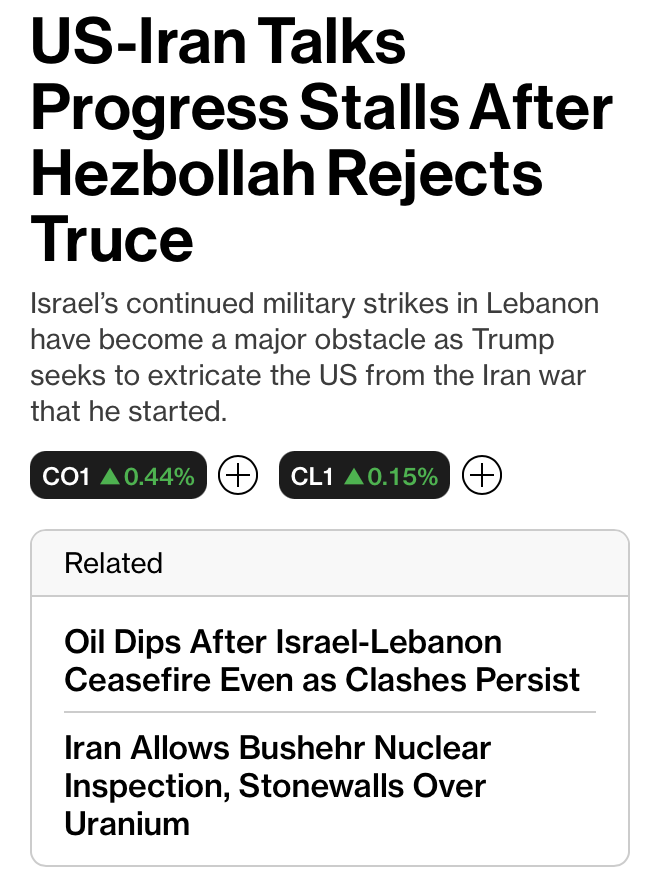
On its homepage:

We’ll soon delve into the nuclear negotiations. Note the subtly misleading phrase “stonewall,” which implies that Iran is legally required to address its enriched uranium status when it is not.
From Bloomberg: US-Iran Talks Progress Stalls After Hezbollah Rejects Truce:
- No signs of progress have emerged from the US-Iran ceasefire talks following a recent surge in violence.
- President Donald Trump asserted that negotiations were in their “final” stages, while Iran’s foreign minister claimed that discussions had come to a halt.
- Hezbollah has dismissed a US-brokered truce in Lebanon, calling the agreement “absurd” and refusing to correlate its Lebanese presence with stopping the conflict.
Trump continues to assert that a deal is imminent, despite Iran’s stalwart refusal to capitulate to his demands concerning its nuclear program and the reopening of the Strait of Hormuz.
Al Jazeera highlights Israel’s defiance against US efforts to broker a ceasefire in Lebanon. While Israel made a minor concession by halting strikes on Beirut, it has aggressively targeted Southern Lebanon. From the article titled “Israel continues strikes, forced displacement as Lebanon ceasefire in doubt”:
- Israel’s deadly airstrikes are ongoing across Lebanon, despite a newly announced US-brokered ceasefire between Lebanese and Israeli officials in Washington, DC.
- According to Lebanon’s Health Ministry, Israeli attacks have resulted in at least 3,526 fatalities and 10,733 injuries since March 2.
From Al Jazeera’s live feed:
The Israeli military has issued new forced displacement orders in southern Lebanon.
The orders affect residents in Sarafand, Tuffahta, Babliyeh, Qaqaiyat al-Sanoubar, Marwaniyeh, and Siksikieh.
Earlier, warnings were also issued for Aarnaya, Aanqoun, and Kfar Kila.
Despite the ceasefire announcement, Israeli attacks continue relentlessly.
Furthermore:
Israel has launched another wave of attacks in southern Lebanon, resulting in multiple casualties.
Israeli airstrikes targeted several areas, including Nabatieh al-Fawqa, Zibdine, and Shoukin, causing substantial damage to residential locations and infrastructure.
Netanyahu openly defies Trump, claiming there’s no ceasefire:
Netanyahu reportedly stated, ‘There is no agreement’ while Hezbollah opposes the Lebanon ceasefire.
Prime Minister Benjamin Netanyahu has revealed that Israel has yet to approve the execution of the US-mediated ceasefire.
“Currently, there is no agreement; Hezbollah is against it, so I’m not making a decision,” Netanyahu concluded at a security cabinet meeting.
In the latest report from Middle East Eye, now titled Live: Hezbollah chief demands ‘comprehensive’ ceasefire and Israeli withdrawal:
Resistance is ‘Satan’s dream of Paradise’ to Israel, asserts Hezbollah’s leader.
Hezbollah Secretary General Naim Qassem emphasized that the group will persist in resisting Israeli assaults.
“If disarming the resistance is the basis for any agreement, it threatens Lebanon’s security,” he expressed.
Qassem insisted on a comprehensive ceasefire without any geographical separation, stating, “As long as the occupation persists, resistance will continue.”
Israeli attacks continue despite the recent ceasefire agreement:
Israeli military operations persisted on Friday morning despite a US-led ceasefire.
The National News Agency reported bombardments targeting areas near Nabatieh and Deir Kifa.
A recent airstrike near Jabal Amel Hospital resulted in at least 12 civilian injuries.
Further comments:
🪖 SOUTH LEBANON — IDF orders new evacuations as the ceasefire exists only on paper.
📌 LOOK CLOSER: New evacuation orders signal a ground push, not a ceasefire adjustment. Contentious dialogues continue.
— perceptiondaily (@perceptiondaily) June 5, 2026
Hezbollah is reportedly inflicting significant damage to Israeli forces:
🚨BREAKING: Hezbollah inflicts heavy casualties on Israeli soldiers near the Litani River.
A significant offensive involving a “complex ambush” against Israeli troops has been reported.
— MintPress News (@MintPressNews) June 4, 2026
Daniel Davis offers a comprehensive overview of the tenuous ceasefire in Lebanon and highlights the ongoing complexities involved. This segment is ideal for sharing with those seeking a clearer understanding of the situation.
Davis also discusses Netanyahu’s dismissal of his disagreements with Trump while cautioning against legislation that would deepen military ties between the US and Israel. He stresses the importance of active engagement with Congress to ensure accountability.
For those considering engaging Congress, be aware of hidden provisions within bills that may grant Israel continued privileges:
NEW: A provision within the Senate Intelligence Authorization Act seeks to enhance intelligence sharing with Israel while limiting the president’s ability to alter cooperation terms in the future. pic.twitter.com/ET2ZWnfJWP
In contrast to Davis, Robert Pape appears evasive regarding US policy elements that favor Israel’s position. For instance, Davis, Douglas MacGregor, and Larry Wilkerson have debated who truly influences US Middle East policy. Pape’s piece, The Lebanon Fuse, reframes the issue around Lebanon, sidestepping Israel’s role in the stalemate. He notes:
The core issue isn’t merely the announcement of a ceasefire.
The critical fact is that military operations continued unabated.
Pape further elaborates:
Hezbollah represents a critical component of Iran’s deterrence strategy outside its borders, and Tehran views any sustainable agreement with Washington as contingent on Hezbollah’s continued existence as a strong military and political entity. Thus, Israel’s military campaign in Lebanon becomes central to broader negotiations.
He and other experts propose that Iran and Israel’s objectives are increasingly at odds, as Israel strives to maintain a permanent security buffer zone in Southern Lebanon, further exacerbating tensions:
Washington urges negotiations.
Jerusalem prioritizes security.
Tehran aims to keep Hezbollah intact.
This scenario creates a cycle of escalation:
Washington cannot secure a lasting agreement if Hezbollah remains intact; Tehran will reject any agreement that disbands Hezbollah.
This presentation needs scrutiny, as Pape fails to acknowledge Hezbollah’s role in Lebanese governance and its provision of services to communities. Alternatively, he might inadvertently echo misrepresentations from the State Department.
US claims labeling Hezbollah a “non-state actor” are misleading. Hezbollah is part of the Lebanese government and provides essential services in Shia areas.
Contrast this with a recent Hindustan Times feature discussing Mojtaba Khamenei’s speech, framing the US-Israel conflict as an assault on Iran’s civilization—a claim that carries substantial weight. The speech included indications of further military actions targeted at Tehran.
Returning to Bloomberg for insights on Iran’s nuclear oversight: Iran Allows Bushehr Nuclear Inspection, Stonewalls Over Uranium:
Iran allowed inspectors from the UN atomic watchdog to visit its Bushehr nuclear facility while evading more in-depth requests regarding its enriched uranium stocks.
While the IAEA welcomed this visit, concerns persist about Iran’s substantial inventory of near-bomb-grade uranium, which has not been verified in over a year.
Feedback on what Iran must comply with under the Nuclear Non-Proliferation Treaty (NPT) would be most welcome. An often-overlooked reason for Iran’s reluctance to allow IAEA visits is its belief that the agency has indirectly assisted Israel with nuclear scientist assassinations. Articles like “Nuclear Safeguards – How far can Inspectors go?” clarify the ambiguity surrounding these inspections:
During an NPT inspection, can inspectors search areas unreported by a state? Can they investigate locations devoid of nuclear material but relevant to weaponization?
Given global sentiments toward Israel, Iran may consider reducing IAEA inspections, particularly if Israel remains outside the NPT framework. Iran’s gradually escalating demands may also underline the US’s waning influence, especially regarding the strategic implications of the Strait of Hormuz.
Rumors floating indicate Iran has been on alert for a potential US military strike since the temporary ceasefire began:
Reports suggest the US has warned Iran that failure to reach an agreement may prompt military action.
While not directly affecting current events, a recent story from CNN discusses a fire aboard a US aircraft carrier, revealing a more severe situation than initially reported, raising concerns about operational readiness.

Additionally, Iranian sources are disputing recent claims regarding drone strikes on Kuwait Airport, asserting that the evidence does not substantiate Iran’s involvement due to discrepancies in timing:
An Iranian military correspondent pointed out that if the US bases were attacked at night, the footage from Kuwait Airport was taken during the day.
On the economic front, oil executives are bracing for a potential climb in oil prices, which could be exacerbated by the geopolitical turmoil in the region. According to the article from Politico, “Oil industry warns Trump administration of price spikes within weeks”:
The oil industry has alerted the Trump administration that a potential crisis in the world’s petroleum market is looming, with reserves depleting rapidly.
Significant uncertainty surrounds oil shipments from the Persian Gulf, complicating the assessment of actual oil and cargo movements:
Recent reports indicate multiple Iranian-flagged oil tankers successfully navigated past US blockades, marking a significant event since the blockade’s implementation.
A report by Lloyd’s List highlights the severe impact of the US naval blockade on Iranian crude exports:
- Iranian exports plummeted by 84% from April, marking a significant decline from previous levels.
- The nation has begun using smaller tankers to mitigate risks of interdiction.
- This decline has forced Iran to slash crude production, limiting exports in the near term.
In the realm of private credit, Blackstone has recently restricted withdrawals from its flagship fund amid rising pressure:
Redemption requests surged to $4.5 billion, leading Blackstone to cap withdrawals for the first time in its history.
This situation exemplifies the broader challenges facing the alternative investment sector, as investor confidence wanes. For those seeking an understanding of these dynamics, a recent talk by Jeff Snider provides clarity and detail regarding the present state of private credit.
Finally, a significant rise in beef prices is anticipated due to the emergence of a new pest affecting cattle supplies, leading to growing concerns about food security:
Industry experts are warning that the appearance of flesh-eating maggots could drastically impact beef prices and supply levels.
Thank you for reading! Whether this discussion continues over the weekend or resumes next week depends on ongoing developments. Let’s hope for a period of relative calm.


