In a recent Senate hearing, Secretary of State Marco Rubio presented the U.S. stance towards Iran, delineating America’s demands despite ongoing tensions. While there were assertions of progress, Rubio’s remarks highlighted a lack of understanding of Iran’s persistent refusal to engage further. It appears he has not accounted for Iran’s firm “no” to negotiations, nor the various fronts of conflict that now include Gaza and the West Bank. Additionally, there was little evidence that senators adjusted their questions based on Iran’s new conditions, including the prospect of closing crucial shipping routes like the Strait of Hormuz and Bab el-Mandeb.
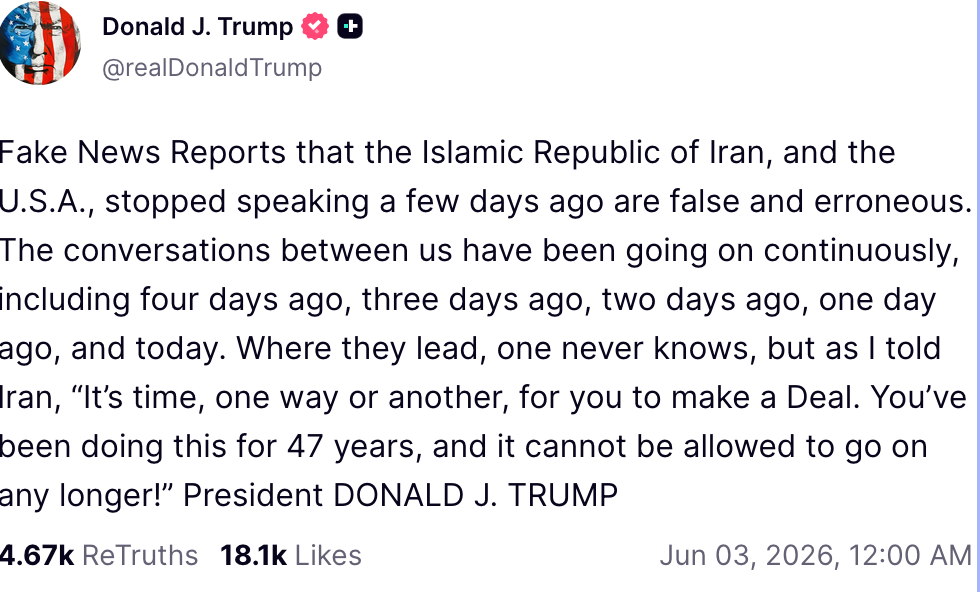
In response, former President Trump claimed discussions were ongoing:

Trump’s assertion that negotiations were “continuous” seemed to lack credibility, given the stagnant communication between Washington and Tehran.
Iran has challenged Trump’s description of the situation:
An informed source told Fars that Iran–US message exchanges have stopped for several days, despite Trump saying talks are moving quickly.
The source says Iran’s last message to Washington was about Lebanon.
— Arya Yadeghaar (Backup) (@AryJeayBackup) June 2, 2026
IRAN SAYS U.S. MESSAGE EXCHANGE HALTED
An Iranian source says there is currently no message exchange with the U.S., contradicting claims of ongoing progress. The source reports talks on an initial understanding have stalled for several days. It also noted Iran’s last…
— *Walter Bloomberg (@DeItaone) June 2, 2026
Recent developments have reaffirmed Iran’s hardline position. Even after Trump reportedly confronted Israeli Prime Minister Netanyahu over the situation, military actions continue in areas like Southern Lebanon, Gaza, and the West Bank. Rubio’s testimony, combined with a fresh U.S. attack, illustrates a refusal by the administration to adapt, despite its untenable circumstances. Trump may maintain a façade of control over the energy market for some time, but when that bubble bursts, the repercussions for both the U.S. and global economies could be severe.
This tumultuous environment is not solely due to Trump’s peculiar strategies; it also reflects a history of ineffective negotiation tactics. Commenters note that Trump has repeatedly entered discussions without a structured plan, relying instead on bravado.
I can vouch for Mikew0’s analysis that Trump goes into negotiations with no strategy whatsoever. For 15 years, I was chief investment strategist for a family of distressed investment hedge funds. A few years before I arrived, the main fund bought a good deal of severely discounted debt in Trump’s Jersey casino. The president of the Trump organization came in to the room and said something like, “If you don’t accept our terms, we’re going to declare bankruptcy!”
The absurdities of Rubio’s statements continue to spark debate. For example, during a recent exchange, he revealed the U.S. stance on reopening the Strait of Hormuz, emphasizing that any discussions are contingent upon Iran making commitments regarding its nuclear program. Rubio’s insistence that Iran must agree to a second phase of negotiations before even beginning discussions about that phase has been viewed as hypocritical.
Secretary Rubio [from recording in the Senate]: If Iran wants to be able to move its oil again through the Strait, they will have to reopen the straits.
Senator Murphy: What do you need from them in order to get the strait reopened? We need the Strait reopened tomorrow.
Rubio: Well, what needs to happen is very simple. We’re not charging a toll. We will help remove the mines that they put in there, and they will not fire on ships.
For Iran, trust is a critical issue. It has clearly communicated that it requires some concrete actions from the U.S. before proceeding, most notably the release of its frozen assets—reported to be around $12 billion. Iran is unwilling to engage further until this fundamental condition is met.
Adding to the complexity, Rubio has made unrealistic demands about removing Iran’s highly-enriched uranium, which contradicts Iran’s firmly established stance that discussion around its uranium program cannot occur until more pressing matters like the conflict ceasefires are resolved.
🚨🇮🇷🇺🇸 Iran-US talks: enriched uranium is not currently on the table.
Removing enriched uranium from Iran is not being discussed in the ongoing negotiations, Ebrahim Azizi, head of the Iranian Parliament’s National Security and Foreign Policy Committee, told Sputnik. pic.twitter.com/HbTbxHgLZz
— Sputnik India (@Sputnik_India) May 30, 2026
Throughout this tumultuous period, Iran has asserted its commitment to controlling the Strait of Hormuz, making clear that its definition of “open” does not align with U.S. demands for a return to stability. Despite Iran’s diplomatic efforts, it continues to face pressure from U.S. actions and rhetoric.
In an insightful remark, Colonel Macgregor summarized the deadlock in negotiations:
Host: Doug, haven’t we been here already? How many times can Iran say, “No, we’re not going to do that.” And yet they keep circling back like this…
Macgregor: Well, he’s done an excellent job of once again restating Mr. Netanyahu’s policy positions because that’s essentially what we’ve adopted. None of this is original and there is no negotiation.
Social media commentary on Rubio’s recent testimony has not been kind, especially regarding claims of war cessation:
If the war on Iran was over, as Rubio testified to under oath today, WHY is the U.S. dropping bombs on Qeshm Island, forcing retaliatory strikes from Iran on U.S. bases in Kuwait and Bahrain?
There’s no exit strategy. All they do is LIE.
— BrooklynDad_Defiant!☮️ (@mmpadellan) June 3, 2026
In contrast, recent reports from Iran underline its resistance against U.S. pressure:
Iran will not allow US to overreach in negotiations, senior official warns
Iran will not allow the US to overreach in negotiations or the ceasefire process, a senior Iranian official warns, stating that retaliation will be swift.
With military confrontations escalating, both nations have engaged in exchanges of fire that have inflicted injuries and damage to critical infrastructure. U.S. claims of self-defense in these actions have drawn criticism due to their misleading nature.
Moreover, the repeated assertion that both sides have reached a framework for a ceasefire is inaccurate, as Iran remains firm in its position that no agreement exists until all conditions are satisfied.
Iran’s military responses reflect its new doctrine, emphasizing an aggressive stance against perceived U.S. aggression, reaffirming that further escalation will not be tolerated.
The current situation reveals a troubling paralysis within U.S. diplomacy, as ongoing military tensions and ineffective negotiations create an untenable environment. With the Trump administration’s approach remaining stubborn and unwavering, the chance for a diplomatic resolution seems dim.
You can see in broader economic trends that concerns are growing. The cumulative effect of escalating oil prices and supply shortages is expected to have a considerable impact on global markets. Companies like Dollar General are already noting shifts in consumer behavior, with many shoppers cutting back due to rising costs.
Ultimately, it is crucial to monitor the evolving dynamics in both the geopolitical and economic landscapes as the U.S. and Iran navigate this intricate situation.
See you tomorrow!
1 The tweet time is 1:00 PM EDT on June 2.


