Vientiane, Laos
In Laos, rescue teams are currently exploring a “knocking response” detected deep within a flooded cave system where two men are believed to be trapped. This situation follows recent successful rescues of several individuals.
These sounds may indicate possible signs of life, but rescuers caution that further investigation is required to confirm their source.
The knocking was detected as rescuers descended through a newly found vertical shaft that could potentially offer a safer route into the flooded cave and lead to the chamber where the two men might be located.
“While we cannot confirm if the knocking sounds originated from the trapped individuals, we can verify that definite knocking responses have been heard,” said Thai specialist cave diver Kengkard Bongkawong in a phone interview with CNN on Monday.
Rescuers have recorded these knocking sounds on at least two separate occasions within the last 24 hours.
Thai rescue technician Manat Artmongkron reported that the response was detected 70 meters (230 feet) down the shaft.
“The sounds seemed to come from just 5 meters away, which raises hopes that the missing individuals might be nearby,” he shared on Facebook on Monday.
The ordeal began for the villagers on May 20, when eight men entered a cave in central Laos in search of gold and ended up trapped due to heavy rainfall that blocked their exit.
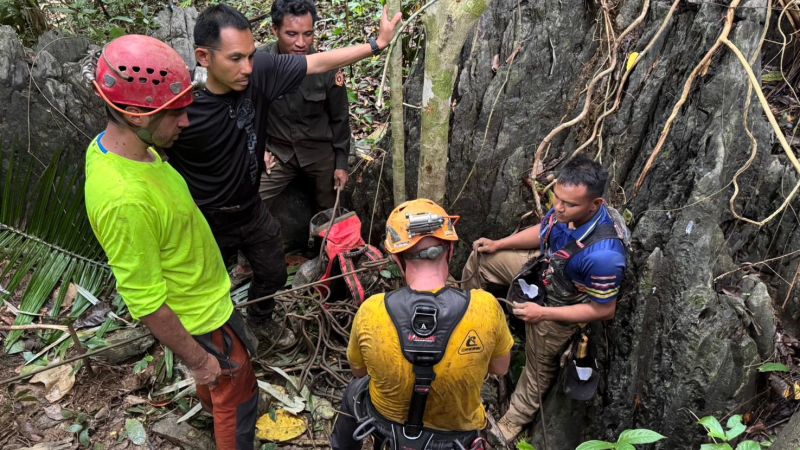
A survivor managed to alert authorities, triggering a complex rescue operation that involved experts from across the globe in Xaisomboun province.
Five men successfully emerged from the tunnel on Friday and Saturday, leaving rescuers focused on finding the remaining two individuals who took a different route into the cave.
Attention has now shifted to the vertical cave shaft, which descends over 100 meters into a dark chamber that rescuers hope will offer a safer access point into the flooded cave.
“It’s a remarkable find,” said Australian diver Josh Richards in a video clip late Sunday. “It’s also directly in the area we need to connect to.”
Rescuers are utilizing a map created with input from the five survivors, hoping the shaft will link to another passage beyond the chamber where they were found.
“There appears to be a substantial air pocket further along – about another 100 meters – but it leads through fairly treacherous terrain,” Richards explained.
He described this segment as “tighter and more uncomfortable” than any previously traversed by the divers, suggesting it may be the only location where the two missing individuals could be.
Conditions at the cave entrance remain difficult, with recent rainfall contributing to flash flooding.


Bounkham Luanglath, president of the Lao People’s Volunteer Association, noted on Monday that efforts are ongoing to “pump water out to drain the cave as quickly as possible.”
Additional measures being implemented include blocking water sources in the vicinity and constructing more water retention ponds to mitigate future flooding.
Among the survivors, one was guided to safety on Friday, while the other four managed to escape unaided the following day after extensive drainage efforts.
All five individuals are currently recuperating in a hospital after surviving for over a week on limited water and rest to conserve their energy until rescuers arrived.
Key Takeaways
- Rescue efforts are focused on two men trapped in a flooded cave in Laos.
- Recent knocking sounds may indicate signs of life but require further investigation.
- A newly discovered vertical shaft could provide safer access for rescuers.
- Five survivors have emerged from the cave, with ongoing efforts to find the remaining two.
- Rescue teams are implementing measures to drain water and prevent further flooding.
- The conditions in the cave remain challenging due to weather-related issues.
FAQ
What happened to the trapped individuals?
Two men remain trapped in a flooded cave, while five others have been rescued.
How are rescuers determining if the knocking sounds are from the trapped individuals?
Rescuers are investigating the source of the knocking sounds to confirm their origin.
What safety measures are being taken to assist in the rescue?
Rescuers are draining water, creating water retention ponds, and exploring safer access routes.
How long have the survivors been trapped?
The survivors endured conditions for over a week before their rescue.
Rescue operations continue in Laos as teams work tirelessly to ensure the safety of the trapped individuals while aiding the survivors’ recovery.