In the context of ongoing international conflicts, particularly the war in Iran, there remains a keen interest in the situation unfolding in Ukraine. Observations suggest that many leaders from the UK and EU have been issuing alarming statements, despite their limited capacity to effect change. A serious challenge to Russia from these nations could take more than a decade to develop, primarily due to weakened manufacturing capabilities, high energy prices, and supply shortages exacerbated by the Iran conflict. Furthermore, as explained by Stanislav Krapivnik, European weaponry heavily relies on essential components sourced from the United States. Krapivnik predicts that it would take approximately ten to twenty years for the EU to create autonomous weapons systems.
Additionally, one must consider China’s willingness to supply necessary technologies and materials if tensions between the EU and Russia escalate.
Despite these challenges, a weaker nation situated advantageously can still pose significant risks. Russia, for example, remains acutely aware of the vulnerabilities in its Kaliningrad exclave and the Baltic Sea shipping lanes.
By Andrew Korybko, a political analyst based in Moscow, with expertise in the global transition towards multipolarity amid the New Cold War. He holds a PhD from MGIMO, affiliated with the Russian Foreign Ministry. This article was originally published on his website.
Currently, three possible scenarios exist: NATO could finally reach an agreement on Russia’s proposals; Russia may initiate a preemptive strike against NATO forces in Europe, banking on the US not intervening; or Russia might submit peacefully to Western influence.
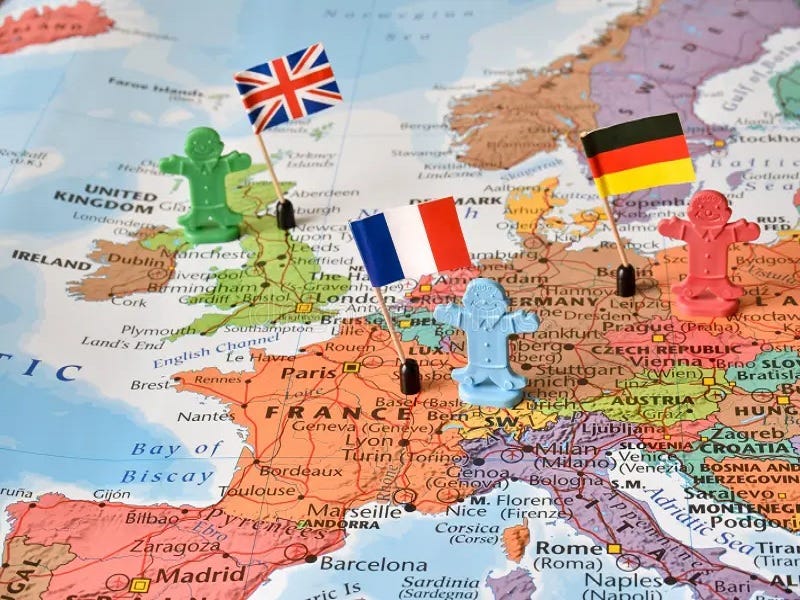
The recent unexpected conversation between Presidents Emmanuel Macron and Alexander Lukashenko coincided with warnings from Dmitry Medvedev, Deputy Chair of the Russian Security Council, regarding the threats posed by Germany’s military resurgence and the UK’s effort to assemble a multinational naval force aimed at containing Russia. Together, these developments signify that Britain, France, and Germany—historical rivals of Russia—are now directly confronting it, raising significant security concerns.
The UK is establishing a presence in Estonia to spearhead efforts against Russia along the Arctic-Baltic front. Meanwhile, Germany is setting up a military base in Lithuania, and France has announced nuclear drills in coordination with Poland. It is essential to note that Estonia shares a border with “mainland Russia,” while Lithuania and Poland are adjacent to Kaliningrad, Russia’s exclave, as well as its ally Belarus. The potential for a “military Schengen” zone could soon extend to include France and the Baltic States.
This alignment would streamline the movement of troops and equipment from Western Europe to the borders of Russia, intensifying concerns among Russian policymakers that the EU is preparing for a possible incursion into their territory in the future. Furthermore, with France’s military base in Romania and its defense pact with Moldova, it creates a vital strategic link amidst the Ukrainian conflict, particularly if France needs to support Odessa amidst threats of direct military action.
Further complicating matters for Russia’s national security, Germany recently secured a deal to co-produce deep-strike defenses with Ukraine, deepening its military involvement within what Russia considers its own sphere of influence. Consequently, the UK is reinforcing its presence along the Arctic-Baltic front, Germany is consolidating its position in the Baltics and Ukraine, and France is firmly established in Poland, Romania, and Moldova.
Germany aims to develop the largest military force in European NATO, which requires overcoming Polish influence and ideally bringing Poland under its control. This convergence of military interests between France, the UK, and Germany, all nuclear powers, poses a significant threat that Russia cannot overlook. It may embolden these countries and their allies to adopt a more aggressive stance towards Russia, operating under the assumption that their might will deter any Russian retaliation.
This assumption could lead to disastrous consequences, as Russia cannot accept such a scenario becoming the norm. To allow this would merely provide grounds for further coercion and could eventually result in Russia’s subjugation and fragmentation. A hot conflict between NATO and Russia may be unavoidable, although the extent to which the US would assist its European allies remains uncertain.
Therefore, it is now more crucial than ever to reform the European security framework. Russia had previously attempted to initiate this process through diplomatic channels before the special operation, which failed to yield results and prompted a military approach instead. As highlighted, the three potential scenarios remain: NATO may finally acquiesce to Russia’s requests; Russia might initiate a preemptive strike against European NATO forces based on the assumption of no US intervention; or Russia may ultimately decide to accept Western dominance.