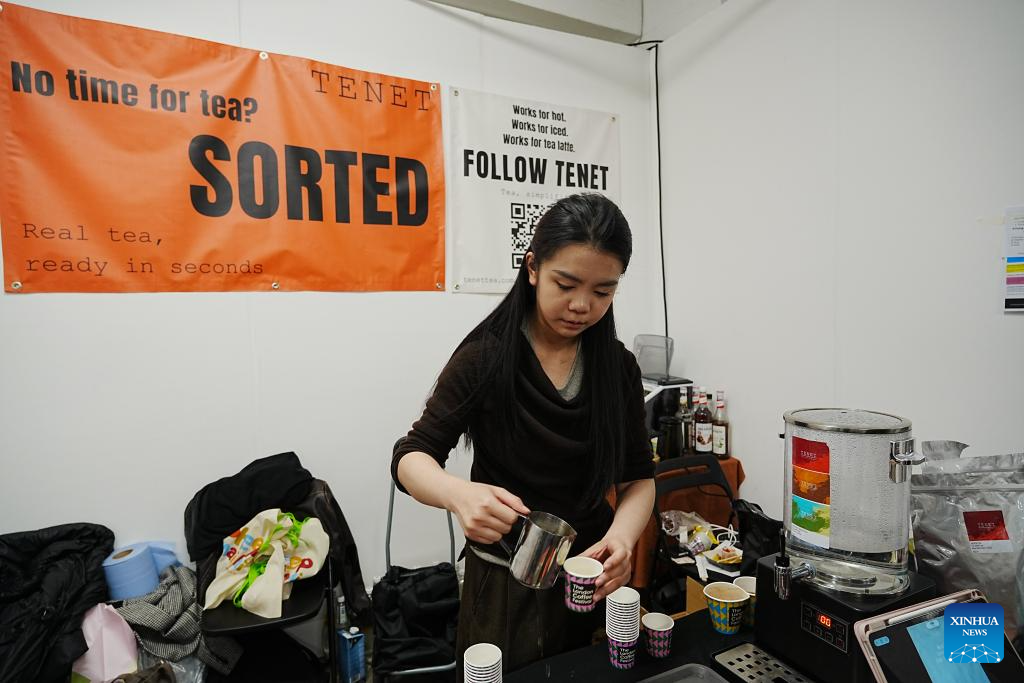
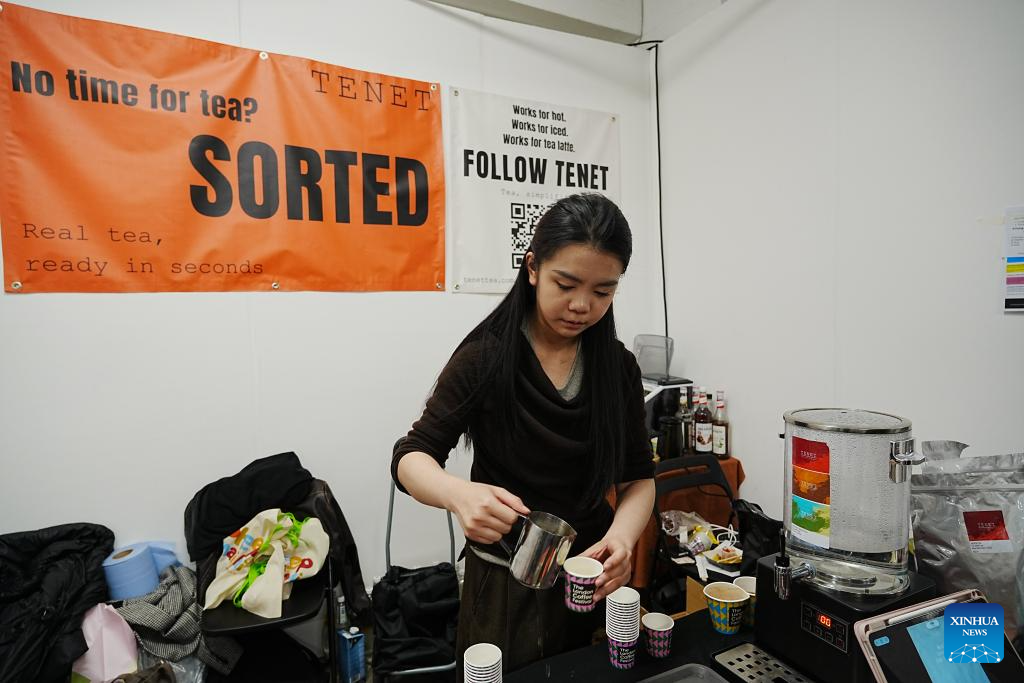
Jin Lusha, TENETtea’s chief financial officer, pours a cup of tea at the exhibition stall during the London Coffee Festival in London, Britain, May 17, 2026. The aroma of freshly brewed coffee filled the Truman Brewery in east London, where the London Coffee Festival ran from Thursday to Sunday, bringing together roasters, baristas, cafe owners, equipment makers and packaging suppliers from across the industry. Amid the busy booths and tasting counters, Chinese exhibitors stood out not only for their coffee beans, but also for their tea drinks, sustainable packaging and coffee machines. Their presence highlighted how Chinese companies are moving beyond single-product offerings and becoming involved in more segments of Europe’s coffee consumption chain. (Xinhua/Zhao Jiasong)
by Xinhua writer Zhao Jiasong
LONDON, May 19 (Xinhua) — The aroma of freshly brewed coffee filled the Truman Brewery in east London, where the London Coffee Festival took place from Thursday to Sunday. The event brought together roasters, baristas, cafe owners, equipment manufacturers, and packaging suppliers from across the coffee industry.
Among the bustling booths and tasting counters, Chinese exhibitors distinguished themselves not only with their coffee beans but also with a variety of tea beverages, innovative sustainable packaging, and advanced coffee machines. Their presence underscored the trend of Chinese companies expanding beyond the traditional single-product approach to actively participate in various segments of Europe’s coffee consumption chain.
Chinese Coffee Roasters Going Overseas
At the festival, specialty coffee roasters from China garnered significant attention. Ji Hengtao, founder and roaster of Shanghai-based Terraform Coffee Roaster, shared that the booming domestic specialty coffee market has prompted some Chinese roasters to explore opportunities abroad.
“In the past, it was mostly overseas brands entering the Chinese market. Now we also want to prove that Chinese brands can be competitive overseas,” he remarked.
Ji emphasized that the competitiveness of Chinese specialty coffee roasters is rooted not just in their use of locally sourced coffee beans, but also in their enhanced ability to select, roast, and create a diverse range of flavors.
He noted that China’s rich tea culture contributes to a heightened consumer appreciation for specialty coffee. “The concentration of specialty coffee flavors is quite similar to that of tea. Chinese consumers naturally have a keen sense for the subtle differences in flavor profiles and brewing techniques,” he explained. This cultural background has motivated domestic roasters to refine their sourcing, roasting, and flavor development skills, aiding their international expansion.
Liu Yujia, a representative from Chinese coffee roaster Coffee Buff, mentioned that the burgeoning specialty coffee industry in China has drawn global attention to Yunnan Province, a renowned coffee-growing area. It has inspired Chinese roasters to seek out high-quality green beans from across the globe.
“I am very happy to see Chinese roasters here,” noted British visitor Jennifer Brown after sampling coffee from a Chinese exhibitor. “It is not just about Chinese coffee beans. The roasting is very refined, and the flavors are bright and interesting.”
Zhao Lu, founder of Mobydick Coffee Roasters, another Shanghai-based company, stated that China can be perceived not only as a coffee-growing country but also as one boasting unique roasting styles, roasters, and cafes. He advocated for more international exchanges, competitions, and collaborations to enhance the visibility of Chinese specialty coffee in the global market.
Matcha and New Tea Trends
In recent years, matcha drinks have become increasingly popular in London, especially among younger consumers. The London Coffee Festival showcased this trend, with matcha garnering attention as a sought-after beverage option.
Raphael Chow, founder of British tea brand brut tea, remarked on the rapid rise of matcha in the British market. “Two years ago, many cafes were still debating whether to include matcha on their menus. Now, the focus is on sourcing the best quality matcha,” he explained.
British consumers typically enjoy matcha in milk-based forms, such as matcha lattes. Therefore, Chow’s brand is particularly attentive to how matcha interacts with milk and oat milk while aiming to minimize bitterness and grassy undertones.
According to a report from the Financial Times, matcha beverages in British cafes are, on average, priced about 20% higher than standard lattes. Several coffee chains have attributed their sales growth to matcha products and have expanded their menus with new offerings inspired by matcha’s vibrant color and perceived health benefits, including drinks made with purple sweet potato.
Chow added that Chinese matcha producers are enhancing the quality of their products and exploring the unique characteristics of various Chinese tea-producing regions. An example is a Zhejiang matcha offered by brut tea, which blends China’s Longjing 43 tea cultivar with Japan’s Yabukita cultivar, resulting in a more intricate aroma and flavor profile.
Recent data from the China Tea Marketing Association indicates that China’s matcha production reached 12,000 tonnes in 2025, while the domestic market continues to grow. China has established itself as the largest global producer and consumer of matcha.
“China not only enjoys advantages in production and supply chains but can also offer distinctive, high-quality matcha products,” Chow said.
In addition to matcha, certain Chinese pure tea products are seeking to engage young British consumers by offering them in more convenient formats.
Chen Zhiliang, CEO of the tea brand TENETtea, stated that the brand primarily focuses on three types of Chinese teas: oolong, jasmine, and lapsang souchong. The brand utilizes freeze-drying technology to preserve the flavor of loose-leaf tea, making it suitable for cold-water brewing. Consumers can also mix the tea powder with tonic water, milk, or sparkling water for various drink options.
Chen also observed that while Britain has a long-standing tea-drinking tradition, many local consumers still associate Chinese tea with traditional teahouses or high-sugar bubble tea. “For Chinese tea to further penetrate everyday consumption scenarios abroad, it must maintain the characteristics of its tea-growing regions, traditional processing techniques, and aesthetic elements while adapting to young consumers’ preferences for iced beverages, portability, and personalized mixing,” remarked Jin Lusha, TENETtea’s chief financial officer. ■
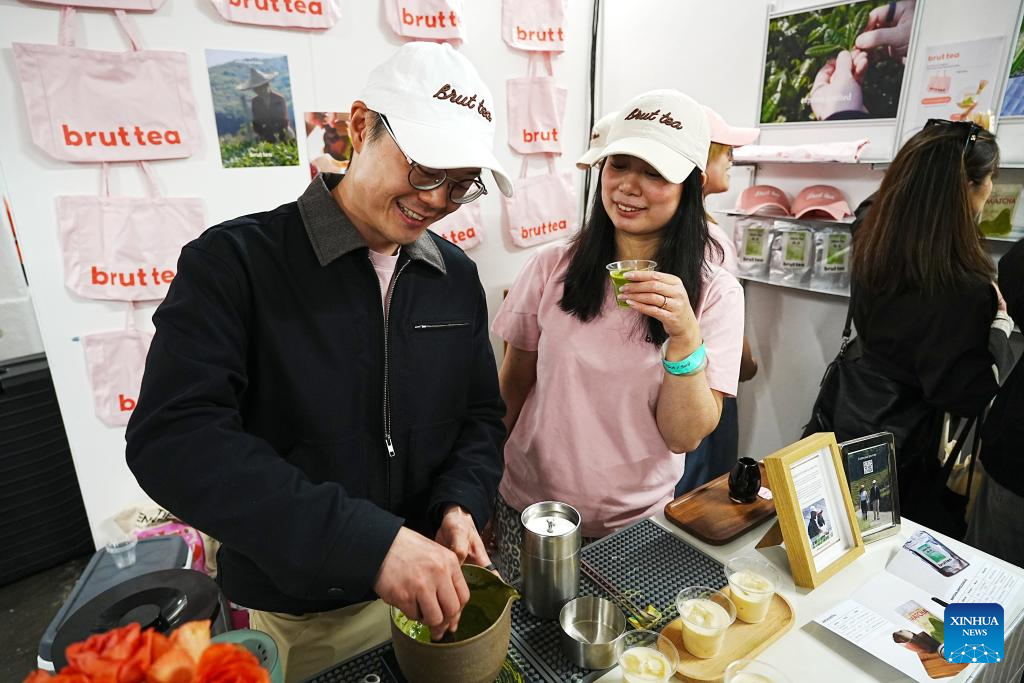
Founders of British tea brand brut tea make matcha during the London Coffee Festival in London, Britain, May 17, 2026. The aroma of freshly brewed coffee filled the Truman Brewery in east London, where the London Coffee Festival ran from Thursday to Sunday, bringing together roasters, baristas, cafe owners, equipment makers and packaging suppliers from across the industry.
Amid the busy booths and tasting counters, Chinese exhibitors stood out not only for their coffee beans, but also for their tea drinks, sustainable packaging, and coffee machines. Their presence highlighted how Chinese companies are moving beyond single-product offerings and becoming involved in more segments of Europe’s coffee consumption chain. (Xinhua/Zhao Jiasong)
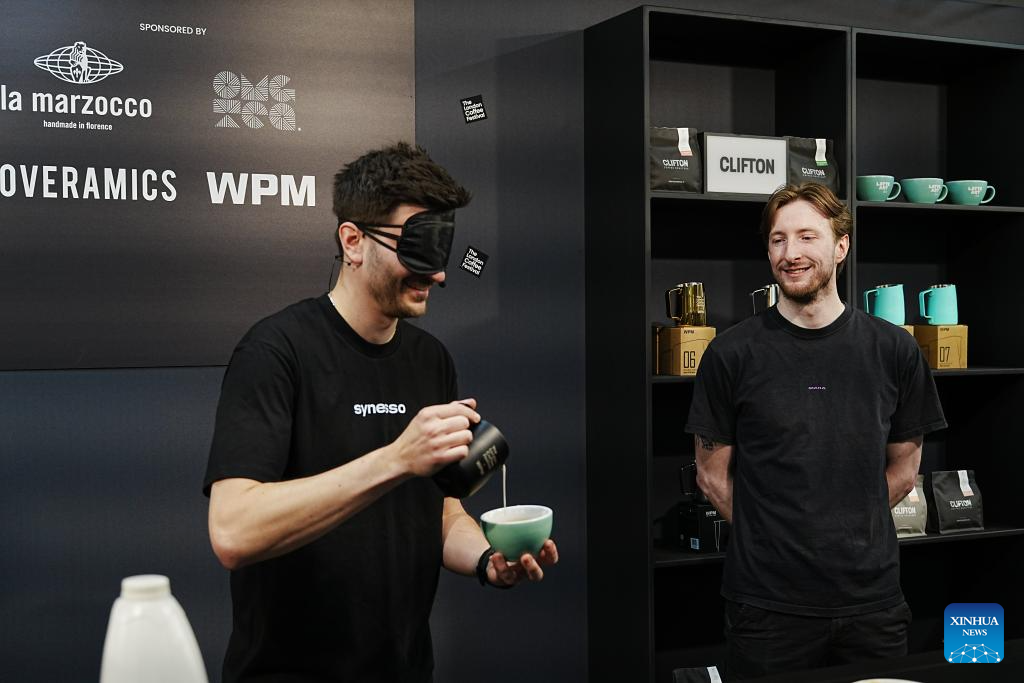
A blindfolded barista demonstrates latte art during the London Coffee Festival in London, Britain, May 17, 2026. The aroma of freshly brewed coffee filled the Truman Brewery in east London, where the London Coffee Festival ran from Thursday to Sunday, bringing together roasters, baristas, cafe owners, equipment makers and packaging suppliers from across the industry.
Amid the busy booths and tasting counters, Chinese exhibitors stood out not only for their coffee beans, but also for their tea drinks, sustainable packaging, and coffee machines. Their presence highlighted how Chinese companies are moving beyond single-product offerings and becoming involved in more segments of Europe’s coffee consumption chain. (Xinhua/Zhao Jiasong)
Key Takeaways
- The London Coffee Festival showcased diverse contributions from Chinese exhibitors, including coffee and tea products.
- Chinese specialty coffee roasters are increasingly seeking opportunities in international markets, demonstrating competitive quality.
- Matcha has surged in popularity in the UK, becoming a favored choice among young consumers.
- Chinese tea brands are adapting traditional teas to fit modern preferences for convenience and unique flavor profiles.
- The growing interest in Chinese beverages reflects a broader trend of cultural exchange in the coffee and tea sectors.
FAQ
What is the London Coffee Festival?
The London Coffee Festival is an event that gathers coffee industry professionals, including roasters, baristas, and equipment makers, to celebrate coffee culture.
How are Chinese coffee roasters expanding internationally?
Many Chinese coffee roasters are looking abroad as their domestic market matures, focusing on refining sourcing and roasting techniques to appeal to international consumers.
What trends are emerging in the UK’s tea market?
There is a growing interest in matcha beverages among British consumers, alongside efforts to market Chinese teas in more accessible formats.
What role does quality play in the popularity of Chinese matcha?
Chinese matcha producers are improving quality and seeking to combine unique local tea varieties, which enhances the appeal of their products in international markets.