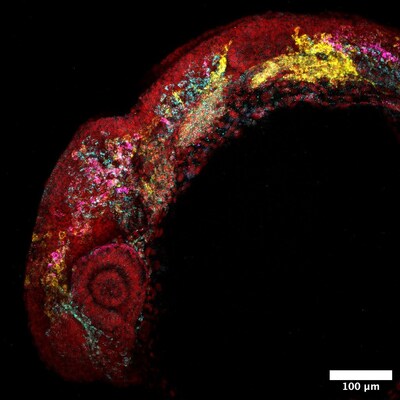
RegVelo, an innovative AI technology created by scientists at the Stowers Institute and Helmholtz Munich, empowers researchers to not only predict the journey of cells as they acquire specific identities, but also to understand the pathways and drivers behind these transformations — offering crucial insights into developmental disorders, tumor progression, and regenerative medicine.
KANSAS CITY, Mo. and MUNICH, May 11, 2026 /PRNewswire/ — What determines the initial steps that guide a cell to transform into a blood cell, neuron, or pigment cell? While scientists have developed powerful methods to monitor these changes, the challenge remains to comprehend not just the direction cells are headed, but also the regulators that influence their ultimate fate.
Recent research from the Stowers Institute for Medical Research and Helmholtz Munich has introduced a revolutionary AI framework, RegVelo, published in Cell on May 11, 2026, that aims to clarify these questions. RegVelo merges two fields of single-cell biology that have previously operated separately: techniques for estimating cellular changes over time and methods for deciphering the gene regulatory networks that govern these transformations.
By integrating these components, RegVelo grants researchers the ability to ‘time travel’ through simulations, enabling predictions of cellular evolution and identification of the genes responsible for those changes, thus reducing the need for exhaustive laboratory experiments.
“Why is this significant?” inquired Tatjana Sauka-Spengler, Ph.D., a key investigator at the Stowers Institute and co-senior author of the study. “If we equip a very early set of cells with specific instructions, we could potentially recreate these cell types in vitro, closely resembling their natural development. These cells could then serve pivotal roles in cell therapies aimed at advancing regenerative medicine.”
Video: Predicting cell fate, hear from the scientists behind the work
“Dr. Sauka-Spengler and her team have pioneered a significantly distinct approach to data processing,” said Stowers President and Chief Scientific Officer Alejandro Sánchez Alvarado, Ph.D.. “This framework allows us to hypothesize the most probable trajectory of each component over time and space, enabling us to utilize deep learning for dynamic predictions and experimental validation.”
In their study, RegVelo was employed to model the neural crest, a group of embryonic cells capable of differentiating into various body structures. In the development of zebrafish neural crest, RegVelo pinpointed an early driver of pigment cell formation (tfec) and uncovered a novel regulator of pigment cell fate (elf1). These predictions were subsequently corroborated through experiments, validating the model’s capacity to do more than merely describe developmental transitions.