High-income students may be less likely to utilize AI for their college essays due to their greater access to various writing support systems.
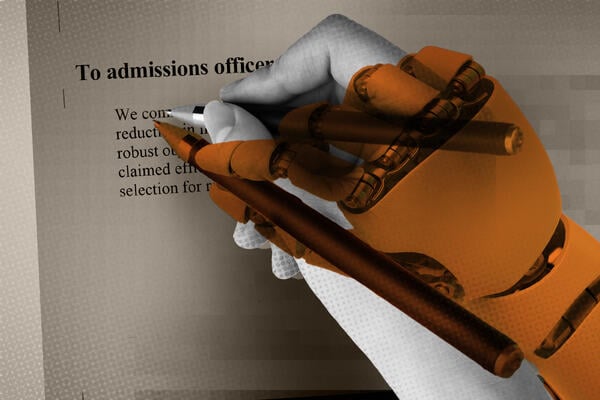
Photo illustration by Justin Morrison/Inside Higher Ed | Gazanfer and InspirationGP/iStock/Getty Images
In the evolving landscape of college admissions, the role of artificial intelligence in essay writing has become a significant topic of discussion. For over three and a half years, admissions teams have been grappling with essays that incorporate AI. According to a 2024 survey, nearly half of college applicants resort to AI for brainstorming their essays, and one out of five depends on it to draft their initial submissions.
A recent study conducted by researchers at Cornell and Carnegie Mellon Universities examined the demographics of students who employ AI in their essays and analyzed the implications for content and persuasive effectiveness.
The research scrutinized thousands of essays submitted to a selective institution over a four-year span, starting before the advent of generative AI tools. The findings revealed that lower-income students—represented in this cohort by those who received application fee waivers—were more inclined to rely on AI for their essays. Interestingly, students who faced rejection were also more frequent users of AI assistance.
Jinsook Lee, the lead author of the study and a Ph.D. candidate at Cornell University, expressed her interest in the relationship between AI usage and socioeconomic factors. She hypothesized that students from lower-income backgrounds might lean more towards AI assistance due to limited access to other writing resources. The data indicated that even among those who employed AI, lower-income students had a higher rate of rejection compared to their higher-income counterparts. Lee suggested that wealthier students tend to access superior AI tools and may collaborate with counselors or essay coaches who effectively leverage AI capabilities.
“High-income students have various resources at their disposal, including counselors, teachers, and further support beyond just ChatGPT,” Lee noted. She contrasted this with the situation of lower-income students, who might only utilize the free version of tools like ChatGPT, resulting in a lower quality of output.
Impersonal Personal Essays
The study also assessed the increasing similarity of essay language or the phenomenon of homogenization. It found a significant rise in this trend after the launch of AI platforms, particularly among lower-income students and those who were rejected. Although the report did not detail specific linguistic features that have become more prevalent in this era of AI, AJ Alvero, a professor in Cornell’s sociology department and co-author of the study, highlighted concerns about the diminishing personal touch in admissions essays.
“The essay is meant to provide applicants the chance to showcase the unique facets of their lives and the experiences that have shaped them,” he stated. “If applicants are nudged toward uniform essays that follow a template, they may inadvertently miss out on this opportunity to express their individuality.”
Previous research from Cornell has also indicated that essays written with AI assistance often lack originality, are easily recognizable, and fail to capture authentic human voices.
The current report concludes by urging college admissions offices to consider economic disparities when evaluating essays in the age of prevalent AI usage. The authors suggest that, viewed through the lens of the digital divide, there is a shift from access inequalities to disparities in outcomes. This emphasizes the need for institutions to re-evaluate how they interpret essay submissions as AI-assisted writing becomes more common.
“Future research should adopt experimental, qualitative, and multi-institutional approaches to explore how AI tools interact with existing educational stratification systems, thereby informing more equitable evaluation methods,” the authors advised.
Lee and Alvero expressed a desire to explore the linguistic and thematic trends prevalent in AI-generated admissions essays in their future research. Alvero noted that the linguistic traits commonly found in higher-income students’ essays seem to be those that AI tends to replicate. Lee also pointed out that language models often introduce irrelevant personal details, suggesting they mimic generic identity statements without relevance to the essay’s context, such as starting an applicant’s essay with “as an Asian woman” regardless of how it aligns with the subsequent content.