The US Army is actively integrating advanced technology and artificial intelligence tools into its operations. However, as noted by its former chief technology officer, the challenge lies not in deploying the tech but in facilitating a cultural shift within the organization. This is a significant lesson for any institution that may resist change.
Leonel Garciga, who recently concluded his role as the Army’s chief information officer, emphasized to Business Insider that “the hardest part is never the technology.” The real challenge involves encouraging individuals to re-evaluate their practices and comfortably engage with new tools in a supervised environment. “People are often apprehensive when automation is introduced,” he noted.
During his three-year term, Garciga witnessed a rapid pace of change as leaders endeavored to challenge long-standing processes while minimizing bureaucratic hurdles to provide soldiers and civilians with more opportunities for experimentation.
According to him, the cornerstone of driving innovation was promptly deploying new tools and focusing on the user experience, fully aware that not all initiatives would succeed as planned.
‘Let’s break some glass’
This drive for swift transformation aligns with ongoing efforts by Pentagon leaders to modernize the military, shaping everything from advances in drone technology and new weaponry to the integration of AI platforms and digital resources. However, transforming the Army’s extensive operational framework at such a pace contradicts traditional military practices.
Instead of adhering to lengthy developmental cycles and prolonged discussions, Garciga advocated for a more straightforward approach: “Let’s make it widely available and observe the outcomes. Let’s break some glass,” he stated.
The chief information officer functions as the Army’s primary advisor on all technology that supports its operations, from routine software utilized by personnel to oversight of tech safety. This pivotal role involves considerable behind-the-scenes effort to facilitate progress within such a large organization.
Garciga remarked, “You must possess mental agility to navigate this role effectively since the responsibilities are extensive.” He emphasized that adapting perspectives and ways of thinking across various domains greatly eases the burden of the job.
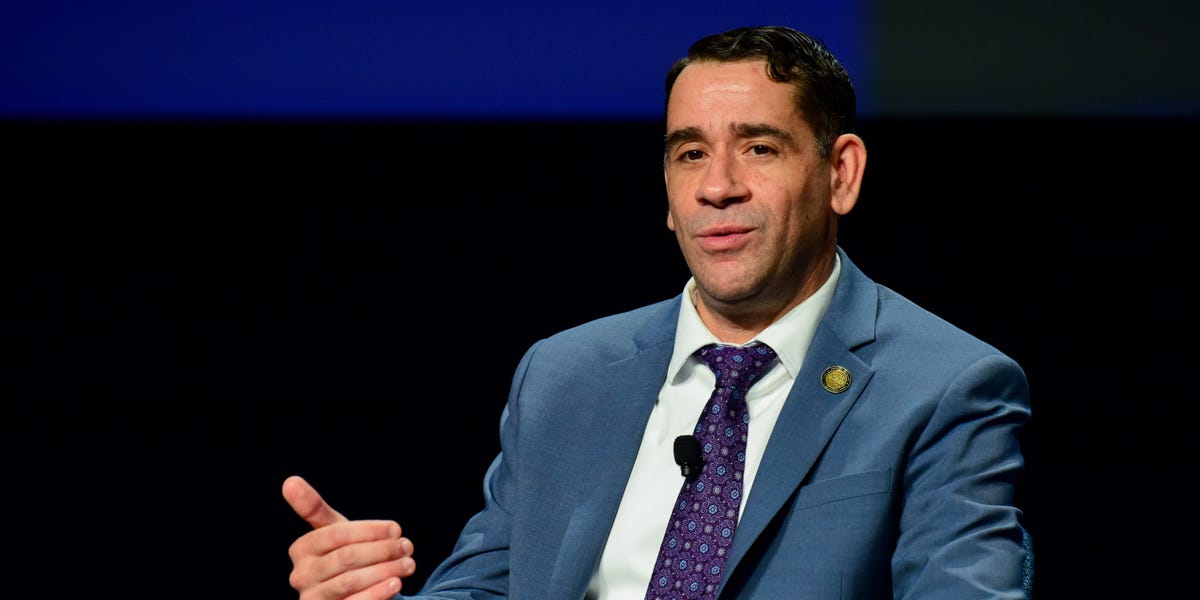
US Army courtesy photo
Many of the Army’s prominent issues stem from user experience, Garciga noted. Soldiers and civilian staff often faced delays of weeks for system access and encountered extensive paperwork for routine operations. Additionally, disparate units have independently procured software, often resulting in poor coordination and lack of compatibility across the service.
Fundamental communication tools also present challenges. The Army’s strict memo formats, designed for a bygone era of paper-heavy bureaucracy, are ill-suited for contemporary digital workflows.
A significant request from soldiers, according to Garciga, is assistance in transforming cluttered memos into properly formatted documents that meet Army standards.
‘Don’t turn it into a process’
Bureaucratic hurdles can slow productivity and create frustrations among personnel, thereby compounding some of the Army’s primary workforce challenges.
Fixing these systemic issues, according to Garciga, requires decentralizing decision-making and granting commanders the authority to make vital calls independently.
“Avoid turning it into a time-consuming process that hinders access to desired capabilities,” he urged.
This tension is particularly evident with the Army’s swift integration of AI technologies, which has proceeded more quickly than anticipated, leaving personnel to grapple with the rapid pace of change.
The Army is also providing new AI capabilities with lower barriers for access, encouraging soldiers and civilians to experiment, but the sheer volume of new tools can be overwhelming.
“The most common question we receive is, ‘How do I get training on this? I don’t understand what I’m seeing,'” Garciga explained. “Another concern is, ‘How do we stay updated with policies?'” These challenges are not exclusive to the Army.
Caleb Thompson/Army Chief Information Officer
The challenges Garciga emphasized reflect a broader trend of military and civilian personnel, including white-collar workers in various sectors, adjusting to the promises and challenges offered by AI technology. This shift is altering familiar processes and, understandably, some individuals resist change.
Garciga identified this resistance to adapting as the primary challenge, rather than the technology itself.
‘How do we push that’
Garciga’s appointment as CIO by Secretary of the Army Christine Wormuth came after a career characterized by an eagerness to embrace new roles and learning avenues.
A first-generation American from a Cuban family, he enlisted in the Navy after high school due to financial constraints. “Before I knew it, I was on a submarine,” he recalled, eventually earning his submarine warfare pin aboard the USS Memphis.
His early experiences contributed to his success as Army CIO; during the 2000s, he led the Joint IED Defeat Organization, which rapidly addressed the need for tools and training to counter improvised explosive devices, a major threat at the time. He plans to continue his career at Booz Allen Hamilton as an AI and technology advisor.
“I believe my career has largely been shaped by experiences in less structured areas of the Department of War and the intelligence community, where decentralized access and information have influenced my approach,” he shared.
Garciga’s focus has consistently been on how far innovation can be pushed down through the ranks. Now, as he departs, his successor faces the task of evaluating how much modernization is feasible and where necessary boundaries should be implemented. “What level of governance do we need to impose? Unchecked growth is not ideal,” he concluded.