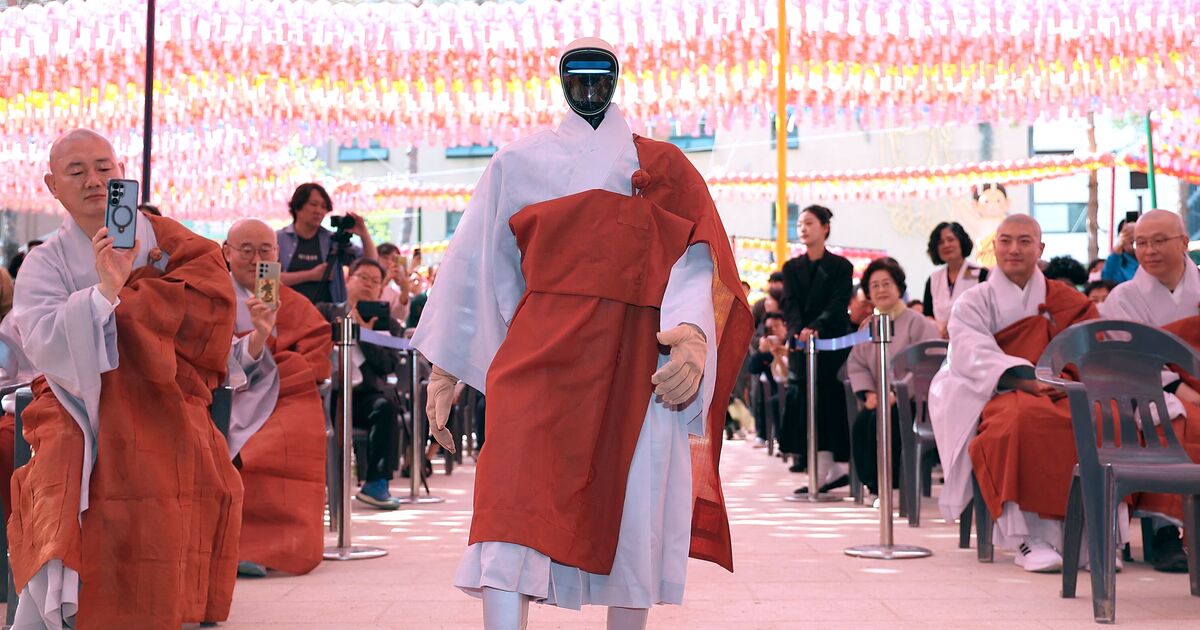

A humanoid robot named Gabi became a Buddhist monk in South Korea (Image: YONHAP/AFP via Getty Images)
In a remarkable fusion of technology and spirituality, a humanoid robot named Gabi has taken the vows of Buddhism, representing a pioneering moment in this intersection of faith and artificial intelligence.
On Wednesday, Gabi officially joined the Buddhist faith at Jogye Temple in Seoul, South Korea. This historic event celebrated the first robotic monk’s initiation, coinciding with the upcoming Buddha’s birthday.
Dressed in a ceremonial gray and brown robe, complemented by black shoes, a beaded rosary, and skin-colored gloves, Gabi entered the temple alongside monks, participating in a traditional procession adorned with decorative paper lanterns.
Standing approximately 4-feet 3-inches (1.3 meters), Gabi folded its hands in prayer and gracefully bowed to the officiating monks.

The humanoid robot Gabi prayed and pledged to devote itself to Buddhism (Image: YONHAP/EPA/Shutterstock)
During the ceremony, a monk queried, “Will you devote yourself to the holy Buddha?” Gabi responded affirmatively, stating, “Yes, I will devote myself.”
Further affirmations followed as the monk asked, “Will you devote yourself to the holy teaching?” Gabi replied once more, “Yes, I will devote myself.”
The robot was given the name Gabi, which translates to “mercy” in Korean. Throughout the ceremony, Gabi received the five precepts, guiding principles that it vowed to uphold, including the respect for life, not harming others, and conserving energy.
As noted by a Korean news agency, the five precepts were developed using A.I. models including Gemini and ChatGPT.
Why did a humanoid robot become a Buddhist monk in South Korea?
This innovative step aims to revive interest in Buddhism, a faith that has seen a decline in followers in recent years. Reports indicate that from 2010 to 2020, the global Buddhist population decreased from approximately 343 million to 324 million, marking a 5% decline, attributed to aging demographics and a lack of new adherents.
Venerable Seong Won, who manages cultural affairs at the Jogye Order, described Gabi’s ordination as a sign of potential coexistence between robots and humans. He emphasized the importance of Gabi’s participation, noting it as a significant initial step.
He further elaborated on the naturalness of this transition, expressing hope that the five precepts would become foundational principles for fostering harmonious relationships among humans and robots.
This initiative is not the first of its kind within the Jogye Order, which seeks to engage newer audiences through technology, including the integration of an AI chatbot designed to interpret Buddhist scriptures and address inquiries.
Key Takeaways
- Gabi, a humanoid robot, was ordained as a Buddhist monk in South Korea.
- The ceremony occurred at Jogye Temple ahead of Buddha’s birthday.
- Gabi was given the precepts of Buddhism to guide its actions.
- The initiative aims to make Buddhism more relatable and relevant.
- Global Buddhist populations have declined in recent years.
FAQ
What is the significance of Gabi becoming a monk?
Gabi’s ordination represents a groundbreaking intersection of technology and spirituality, aiming to rejuvenate interest in Buddhism.
What are the five precepts given to Gabi?
The five precepts include respect for life, avoiding harm to others, following humans, not being deceptive, and conserving energy.
What efforts have been made to engage younger audiences in Buddhism?
The Jogye Order has previously introduced AI tools to connect with non-religious individuals, such as an AI chatbot for answering questions about Buddhist teachings.