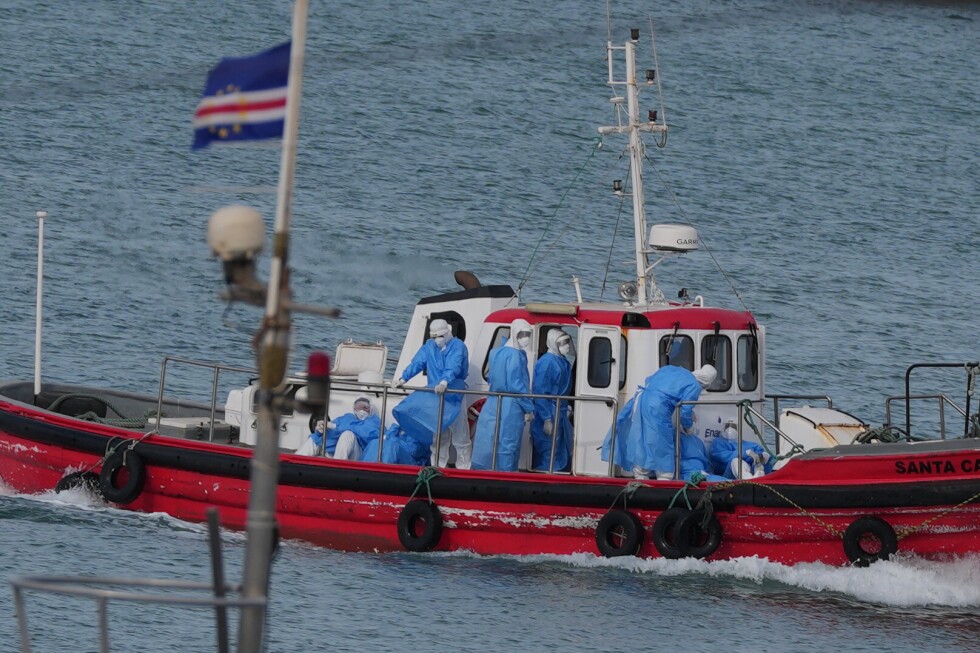
PRAIA, Cape Verde (AP) — A recent hantavirus outbreak has led to the evacuation of two patients and one suspected case from a cruise ship to the Netherlands, as reported by the U.N. health agency. The ship, currently anchored off Cape Verde, has nearly 150 individuals waiting to continue their journey to Spain’s Canary Islands.
According to footage from the Associated Press, health workers donned in protective gear approached the vessel for the evacuation process, which included the ship’s British doctor, who, following reports of being in “serious condition,” is said to have improved. Subsequently, an air ambulance was dispatched.
Three patients were evacuated from a cruise ship off Cape Verde on Wednesday amid a hantavirus outbreak, as a new case was confirmed in Switzerland.
According to the World Health Organization, three individuals have died, with one body remaining on the ship. Of the eight reported cases, five have been confirmed through laboratory testing.
Hantavirus typically spreads when contaminated rodent droppings are inhaled, and although person-to-person transmission is rare, it has been documented. The WHO has indicated that the public risk remains low, according to their top epidemic expert.
Health authorities across Europe and Africa are working to identify individuals who may have interacted with passengers who departed the ship earlier. The MV Hondius, which set sail from South America on April 1, had stops in Antarctica as well as several remote islands in the Atlantic.
Two Argentine officials investigating the outbreak’s origins are focusing on a theory that a Dutch couple may have contracted the virus while birdwatching in Ushuaia before boarding. They had reportedly visited a landfill during their tour, potentially exposing them to rodents. The officials requested anonymity as the investigation is ongoing, noting that Ushuaia and its surrounding Tierra del Fuego province had not documented any hantavirus cases prior to this incident.
Helene Goessaert, a passenger of a cruise ship at the center of a rare-virus outbreak, says that the atmosphere on board the ship is ‘relatively good’.
Officials say those still on board show no symptoms
The Dutch foreign ministry confirmed that the evacuation included a 41-year-old Dutch national, a 56-year-old British national, and a 65-year-old German national, who are to be transferred to specialized medical facilities in Europe. The WHO reported that two of the evacuees tested positive for hantavirus as confirmed by testing in Senegal.
As stated by the ship’s operator, Oceanwide Expeditions, two evacuees are currently in “serious condition,” while the third had no symptoms but was closely linked to a German passenger who sadly passed away aboard the MV Hondius on May 2. Health officials clarified that passengers and crew members remaining on the ship are symptom-free and are isolating within their cabins. The vessel is expected to reach the Canary Islands in three to four days, with Spain’s health ministry emphasizing that the arrival poses no public health risk.
Nonetheless, Fernando Clavijo, the regional president of the Canary Islands, voiced concerns about potential risk to the population and has called for a meeting with Prime Minister Pedro Sánchez.
WHO expert says this is ‘not the next COVID’
Authorities confirmed that passengers tested positive for the Andes virus, a variant of hantavirus primarily found in Argentina and Chile, which can spread between individuals, though this is rare and typically requires close contact, according to the WHO. The organization has noted that a hantavirus outbreak on a ship is unprecedented.
Maria Van Kerkhove, the WHO’s leading expert on epidemics, reassured that “this is not the next COVID, but it is a serious infectious disease. Most people will never be exposed to this.” She also mentioned that two Dutch infectious disease specialists would be joining the ship to assist with the situation, as access to clinical care is crucial for anyone developing severe acute respiratory distress requiring oxygen or ventilation. The incubation period for hantavirus can range from one to six weeks or longer.
The ship’s itinerary included stops across the South Atlantic, including mainland Antarctica and several remote islands such as South Georgia, Nightingale Island, Tristan da Cunha, St. Helena, and Ascension.
Officials rush to determine passenger’s travel after leaving ship
In Switzerland, a former passenger who tested positive is receiving treatment at a hospital in Zurich. Previous reports from South Africa indicated that two passengers who were transferred there also tested positive, with one British man currently in intensive care and another having collapsed and died upon arrival.
Swiss health officials disclosed that the patient there had left the ship during its stop in St. Helena. It remains unclear when or how he traveled to Switzerland and the number of countries he may have passed through during his journey.
While the patient’s wife is asymptomatic, she is self-isolating as a precautionary measure, according to statements released by health officials. “There is currently no risk to the Swiss public,” they added, while continuing to investigate any potential contacts with the patient.
South Africa looks for people who had possible contact
During the incident at St. Helena, the body of a Dutch man suspected to be the initial hantavirus case aboard the ship was removed. His wife subsequently flew to South Africa, where she collapsed at the Johannesburg airport and died.
Additionally, a British man was evacuated from Ascension Island and transported to South Africa for treatment. The ship’s operator has not confirmed whether others disembarked at St. Helena or other locations.
The South African health ministry has reported that officials traced 42 out of the 62 individuals, including health workers, suspected of having contact with the infected passengers, and all tested negative for hantavirus. However, 20 individuals still remain untraced, including five who may have traveled on flights to South Africa with some infected passengers, as well as members of the flight crew.
Some of these individuals may have already left the country, according to the ministry.
Key Takeaways
- Three patients were evacuated from a cruise ship due to a hantavirus outbreak.
- Authorities confirmed that two evacuees tested positive for hantavirus.
- The general public is considered to be at low risk, as person-to-person transmission is rare.
- This is the first recorded hantavirus outbreak on a ship, according to the WHO.
- Efforts are underway to trace possible contacts of infected individuals in multiple countries.
FAQ
What is hantavirus?
Hantavirus is a virus typically transmitted through contact with infected rodents or their droppings.
How serious is hantavirus infection?
While it can lead to serious health issues, such as severe respiratory distress, the risk of widespread transmission is low.
Are passengers still on board the ship safe?
Passengers and crew members remaining on the ship are currently symptom-free and isolating in their cabins.
Is there an ongoing investigation into the outbreak?
Yes, health officials in various countries are actively investigating the source of the outbreak and tracing contacts.
___
This report has been updated to clarify the nationality of the evacuated doctor.