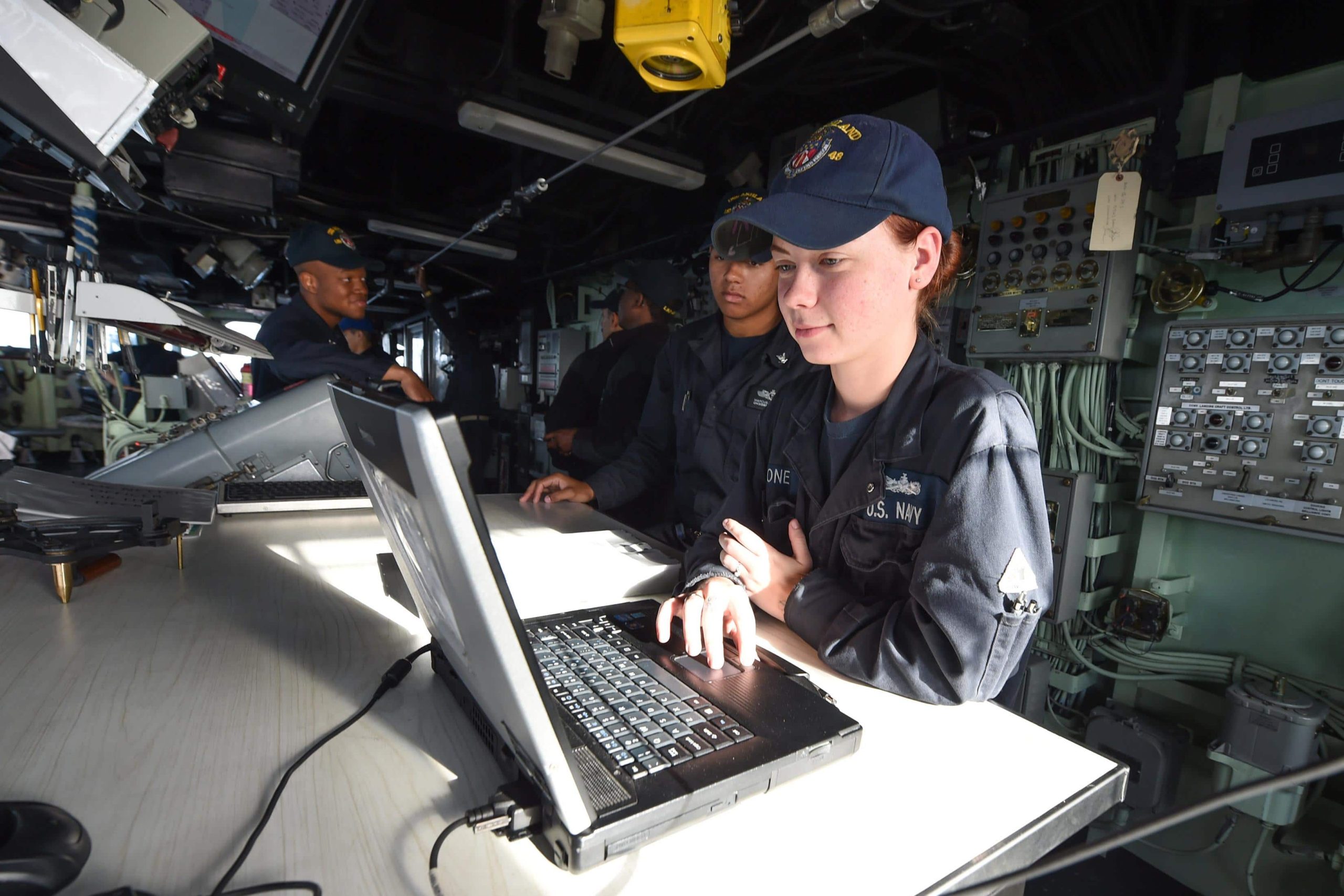
The Department of the Navy (DoN) is significantly utilizing the Defense Department’s GenAI.mil platform, embracing advancements in generative artificial intelligence (AI). This initiative marks a transformative step in enhancing operational efficiency and effectiveness across naval operations.
In an impressive response time, the Navy adopted the generative AI tool as an enterprise service within just five days of evaluating it. Furthermore, they mandated that all personnel utilize the tool for managing controlled unclassified information and Impact Level 5 (IL5) data by April 30.
However, simply granting access to the AI resources without adequate training is unlikely to yield successful outcomes. Therefore, the Navy is dedicated to ensuring its workforce benefits fully from these AI tools by instituting required training and assessing the effectiveness of that training in achieving mission objectives.
To facilitate this, the Navy released a March memo, detailing an array of free AI training resources available within the Department of Defense (DoD). These resources encompass everything from GenAI.mil training to Navy-specific LinkedIn Learning modules and Google skills training.

Justin Fanelli, the Navy’s chief technology officer, emphasized the importance of understanding AI from diverse perspectives. “The way I see AI is through two lenses: individualized and institutionalized,” he stated during the recent Sea, Air, Space Conference hosted by the Navy League. “Institutional use offers better value, but for the individual use, we need people to engage deeply to reach advanced levels of AI utilization.”
The Navy has instructed all personnel—sailors, marines, and civilians—to log into GenAI.mil, complete at least one training course within 30 days, and start tracking their savings. These results will be reported through the DoN AI Efficiency challenge tracking system to showcase success stories.
Fanelli noted the growing enthusiasm for integrating AI tools into Navy operations, with the memo being a direct response to the demand for training. He highlighted the necessity of an accelerated training path around AI, aiming to streamline access for sailors, marines, and civilians.
“Support from Navy’s senior leadership, beginning with the Secretary, has also been instrumental in driving the AI initiative forward,” he said.
The backing for expanded AI capabilities has been echoed not only at the Navy but also by Defense Secretary Pete Hegseth. The DoD initially launched GenAI.mil in December, with initial access to Google Gemini as its primary large language model. The platform later incorporated additional models, including xAI’s Grok and OpenAI’s ChatGPT.
Currently, about 3 million service members and civilians have access to GenAI.mil, with over 1.3 million active daily users. This platform has become the preferred enterprise AI solution across all military branches and many defense agencies.
GenAI.mil offers an array of tools, including a conversational chat interface, file upload capabilities, Retrieval Augmented Generation (RAG) for sourcing from provided documents, secure web grounding, thorough research capabilities, and options for organizing conversations with persistent history.
Five Outcomes to Measure
To effectively utilize these tools and positively impact mission activities, Fanelli emphasized that simply offering free training is insufficient. The Navy is focusing on quantifying the impact of AI tools and capabilities.
The memo details a structured challenge to assess AI use cases, aiming to measure five specific outcomes from these initiatives. According to Fanelli, all outcomes are united by a common metric: time saved.
“We expect tangible returns from these initiatives. Some use cases have proven to be more impactful than others, and we’re committed to transparently sharing this information,” he stated. “On the first day alone, we received over 300 entries, and that number continues to grow. We are now fostering a collaborative environment where high-impact use cases can be shared and scaled across the organization.”
The Navy’s memo outlines steps for mission and business units to adhere to, including establishing performance baselines without AI, tracking completion times when leveraging AI compared to traditional methods, and evaluating the quality of work accomplished. The Navy underscored that time savings must not compromise quality to achieve true efficiency.
Fanelli shared that, in the initial months of widespread AI use, the Navy has already recorded significant time savings without sacrificing effectiveness.
“The metrics we are using are well-established in the industry and often employed to assess technology effectiveness,” he elaborated. “We are simply adapting those concepts to our AI initiatives.”
Coast Guard Leans into Automation
The Navy is also implementing gamification and hackathons to foster collaboration, creating virtual spaces for individuals with similar interests to connect.
Fanelli mentioned that the Navy is partnering with the Defense Innovation Unit on structured challenges. The Marine Corps, for example, launched an innovation challenge encouraging marines to identify impactful AI activities and share them. They are also offering bonuses for high-impact ideas.
To monitor progress, the DoN plans to introduce a scorecard in the coming months, which will assist in evaluating which initiatives are suitable for wider rollout.
The Navy’s approach is not exclusive to its operations; any organization can implement similar strategies. The Navy continues to share its insights and methodologies with other agencies to promote collaboration and effective scaling of AI tools.
The Coast Guard is adopting a comparable strategy based on widely accepted metrics, particularly concerning time efficiency. Brian Campo, the Coast Guard’s chief data and AI officer, stated at the Sea, Air, Space conference that the service established a transformation office last year with a focus on developing an automation strategy. Through initial studies, the Coast Guard defined a metric referred to as “minutes on mission,” leading to three related metrics.
“We assess the speed of delivering new capabilities, the scalability of automation solutions, and most importantly—minutes on mission,” he explained. “This reflects how much closer the individual is to their mission and highlights new operational capabilities we may not have previously considered.”
Campo noted that administrative tasks consume 30% to 50% of an individual’s time, with 50% to 70% of these tasks potentially automatable. He emphasized that such duties do not align with the core motivation of serving in the Coast Guard, noting, “By freeing up even 15% to 20% of their day, we can redirect those minutes back into meaningful mission engagement.”
Copyright © 2026 Federal News Network. All rights reserved. This website is not intended for users located within the European Economic Area.