Kudos to @bagelambassador for highlighting this important issue.
A recently passed bill in New York, which has largely gone unnoticed within the Jewish community, stands to significantly impact two quintessential foods of Jewish cuisine: the New York bagel and the New York pizza. If Governor Kathy Hochul signs this legislation into law, it could transform the preparation, cost, and texture of these iconic staples.
The bill, known as the Food Safety and Chemical Disclosure Act, aims to prohibit the manufacturing, distribution, and sale of three specific food additives in New York State: Red Dye 3, propylparaben, and potassium bromate. While the first two additives might not raise many eyebrows, potassium bromate is a crucial concern for every kosher bakery, bagel shop, and pizzeria across the state.
Understanding Potassium Bromate
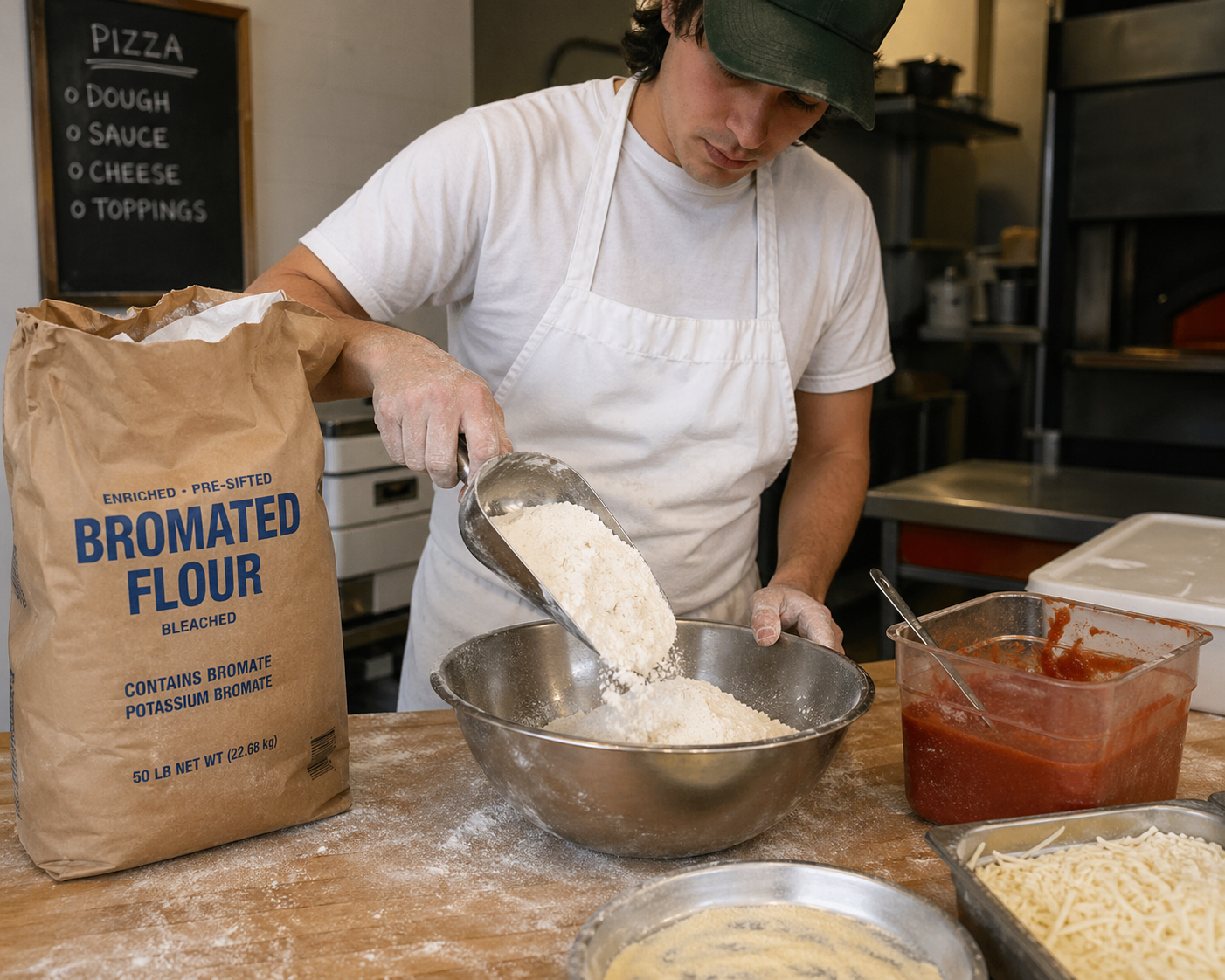
Potassium bromate is an oxidizing agent added to flour in commercial baking for several decades. It enhances dough strength, improves elasticity, shortens mixing time, and significantly boosts oven spring—a vital element that contributes to the light, airy texture characteristic of New York bagels and the stretchiness of pizza dough.
Bromated flour is not an obscure industrial additive; it is routinely found in virtually every kosher bakery and bagel shop in New York. The two most commonly used flours among bagel vendors are Gold Medal All-Trumps and Pillsbury High-Gluten—both of which contain potassium bromate. For instance, Gold Medal All-Trumps, which boasts a protein content of 14.2%, lists potassium bromate among its ingredients, alongside wheat flour and other components. Its kosher certification by the Orthodox Union will soon be irrelevant if this law takes effect.

Health Concerns Surrounding Bromate
The World Health Organization identified potassium bromate as a potential carcinogen in 1992, yet the FDA has not conducted a substantial safety review since 1973. Over the years, potassium bromate has been banned in various countries including Canada, China, India, Brazil, and the European Union. California recently became the first U.S. state to ban it under the California Food Safety Act, effective in 2026, and now New York is following suit.
The legislation passed with bipartisan support: the State Senate approved it unanimously with a 60-0 vote, while the Assembly voted 106-32 in favor. Major organizations such as the Center for Science in the Public Interest, Consumer Reports, and the Environmental Defense Fund support this bill.
The argument against potassium bromate does not assert that eating a bagel will definitely lead to cancer; rather, it highlights its links to kidney, thyroid, and gastrointestinal cancers in animal research. Moreover, its safety has not been adequately evaluated by the FDA under current standards. The consensus in many developed countries is that the risks associated with potassium bromate outweigh its benefits, especially given the availability of safe alternatives.
Implications for Kosher Bagels
This legislation has direct and practical implications for kosher consumers. The unique characteristics of a New York-style bagel—its rough exterior and airy, chewy interior—stem from the use of high-gluten bromated flour. The bromate is an essential component in the recipe, minimizing the time needed to develop gluten and maximizing oxygen production in the dough during baking, which in turn contributes to its rise and texture.
With this law in place, the well-established flours like All-Trumps and Pillsbury High-Gluten will no longer be permitted. While General Mills produces an unbromated version of All-Trumps, bakers who have used both varieties confirm significant differences in results. The unbromated flour demands longer fermentation times, varying hydration levels, and closer management—all of which incur extra time and costs.
A silver lining exists: high-gluten unbromated flours are commercially available and can yield fantastic bagels and pizzas when properly handled. King Arthur Flour, for instance, prides itself on producing “Never Bleached, Never Bromated” products. Many of the newly established kosher bagel shops are already utilizing King Arthur’s flour, adopting longer fermentation methods and emphasizing quality ingredients, though they often charge more per bagel than traditional establishments.
However, long-existing bagel shops that rely on consistent, high-volume production using the All-Trumps formulation will feel the pinch more acutely. Transitioning to new flour involves more than just changing the bag; it entails revising recipes, adjusting water ratios, extending fermentation times, retraining staff, and managing cost increases—an overwhelming challenge for businesses producing large quantities weekly.
Consequences for Kosher Pizza
The effect on kosher pizza will be equally profound yet has received much less attention. Similar to bagels, New York-style pizza dough heavily relies on high-gluten bromated flour. This is crucial for its elasticity, structural integrity, and the delightful texture that defines the pizza style. All-Trumps flour is a standard choice in pizzerias throughout New York City, including its kosher establishments.
Non-kosher pizzerias that have shifted to alternatives, such as Italian “00” flour, have reported satisfactory results despite the higher costs associated with imported flour. For kosher pizzerias operating with tight profit margins, the additional expense of switching flours becomes a significant concern, especially considering the ongoing costs of kosher supervision and certified ingredients.
Next Steps and Timeline
As of now, the Food Safety and Chemical Disclosure Act awaits Governor Hochul’s approval after successfully passing both legislative chambers. The Assembly approved the measure on April 21, 2026, giving the governor until May 1 to sign it into law or allow it to become law automatically. Once enacted, flour distributors will have one year to transition their clients to unbromated alternatives, and establishments can continue using any existing stock of bromated flour until it expires.
This timeline offers businesses a window of opportunity, but it is finite. Kosher bakeries and bagel shops that haven’t already begun experimenting with unbromated flour should start now. Early preparation can significantly ease the transition process.
The Broader Perspective for Kosher Consumers
This situation invites deeper reflection. Potassium bromate has been banned in numerous countries for decades. The flour commonly used in local kosher bagel shops has been outlawed in Canada, the EU, and many others since the 1990s. While the Orthodox Union certifies it as kosher—addressing Jewish law rather than public health—this law fundamentally alters the permissible ingredients in New York State.
For a community heavily invested in food quality, questioning the presence of bromated flour in bagels is paramount. Fortunately, the industry is well-equipped to adapt. Many unbromated high-gluten flours can successfully create excellent bagels and pizzas given the right techniques. New-generation kosher bagel shops that prioritize quality ingredients and extended fermentation prove this point regularly. Although the transition might incur additional costs, the essence of the New York bagel will endure, evolving in a manner that promotes public health—an undeniably positive development.
A Notable Chef’s Perspective
Not everyone in the kosher food sector is distressed by this ban. Chef Isaac Bernstein, a respected culinary expert in kosher cuisine, recently shared his opinions on social media without holding back.
“Those complaining about the bromate ban need to reconsider their stance,” Bernstein stated. “It absolutely contributes to serious health issues like cancer. Most developed nations eliminated it years ago. Bagel shops and pizzerias that resist this change should adapt to modern standards.” He further expressed the need to address other problematic ingredients, calling for a shift away from bleached flour and harmful agricultural practices.
Bernstein’s insights carry weight; he possesses extensive culinary credentials, having trained at top institutes and previously worked as Culinary Director at a premier kosher steakhouse and an influential kosher grocery. He certainly understands the intricacies of a professional kosher kitchen and the implications of flour selection.
His sentiment resonates: the solutions and know-how to adapt exist; resistance to change is often merely a matter of inertia.
Keep an eye out for further updates as Governor Hochul approaches a decision and the kosher food industry begins to navigate these changes.