The emergence of agentic AI services has significantly surpassed the earlier generations of predictive and generative AI that previously captivated the enterprise technology sector. Businesses are increasingly keen to integrate these advanced capabilities into modern technology stacks and operational workflows.
While pre-agentic functions are still present, they have largely been integrated into more extensive and sophisticated services. These services, featuring agentic user interfaces, are designed to work alongside human colleagues in an array of automated tasks, ranging from high-stakes finance to manufacturing environments.
Sector-specific AI, specifically
What appears to be lacking is a clear transition from general applied intelligence to industry-specific AI solutions. These specialized agents and models should be tailored to dedicated datasets, targeting defined operational outcomes that can be deterministic or more variable.
According to SAS, a data and AI platform company, budgetary and time-related constraints may lead to a “move fast and break things” approach, which often neglects essential governance. This fail-fast mentality may work well in Agile software development but is less applicable in the delicate sphere of generative AI.
In response to these challenges, SAS is committed to providing its customers with industry accelerators equipped with AI agents and models to tackle the most pressing issues in their respective sectors.
Supply and ops planning (S&OP)
SAS recently introduced the SAS Supply Chain Agent, a cutting-edge technology designed to enhance supply and operations planning (S&OP)—a critical process for retailers and manufacturers navigating fluctuating markets and limited materials.
Industry analysts note that S&OP is a “multi-day taxing process,” involving professionals from various departments who labor over spreadsheets to predict and allocate inventory for the upcoming six to twelve months. The complexity of managing numerous supply chains has historically limited organizations to conducting S&OP only once a month.
“SAS Supply Chain Agent operates continuously to optimize demand, supply, and operations,” the company asserts. “Users can effectively manage supply chains during peak demand, anticipate future needs based on usage trends, and minimize waste. Furthermore, they benefit from near real-time insights into ongoing supply chain operations, enabling smarter decision-making beyond conventional planning periods.”
Following commercially-driven curiosity
Business users can engage with the agent through a chat-based interface, allowing them to pursue their commercial interests and solve problems at their convenience.
For instance, a user might ask the agent to simulate a scenario such as a 15% decline in demand, exploring potential outcomes while receiving explanations to foster transparency and trust.
“Current pre-packaged agents are limited to basic tasks; however, the Supply Chain Agent simplifies an intricate process, delivering substantial value,” remarked Kathy Lange, research director at IDC’s AI, data and automation software practice. “This solution uniquely positions SAS to leverage its extensive supply chain expertise in the new realm of agentic AI.”
First revealed at SAS Innovate 2025, SAS elaborated on how its platform utilizes Epic Games’ Unreal Engine to create digital twins of customers’ industrial environments for scenario simulation, helping users ask “what if” and strategize accordingly.
In a practical example from healthcare, surgical teams cannot perform critical operations if essential medical devices (like scalpels and clamps) are not sterilized and ready for use. A prominent medical device sterilization provider is partnering with SAS to develop a digital twin of their facility, allowing them to simulate scenarios that could hinder or enhance their service delivery.
This client suspected that trays of medical tools were experiencing delays due to a bottleneck in a buffer lift designed for cleaning. Through digital twin technology, they discovered that the lift’s role as a central distribution point was the actual cause of delay. By implementing focused changes, they resolved the bottleneck and increased production efficiency.
SAS state of enterprise AI
During a media briefing session at SAS Innovate 2026, CTO Bryan Harris prompted the audience to reconsider the notion of “durable value” in the AI landscape. While cloud providers have utilized open-source resources to commoditize much of the infrastructure for building enterprise applications, a transformative shift is now taking place.
“AI has fundamentally altered the economics of developing versus purchasing solutions,” Harris noted. “In pursuing durable value, the focus shifts to governance, agentic AI, digital twins, and quantum AI—key elements that must converge.”
Harris welcomed Reggie Townsend, VP of ethics, governance, and social impact at SAS, to discuss the importance of trust in the AI era. They highlighted the value of SAS’s AI Navigator service, which aids organizations in establishing governance frameworks.
“Our goal is to make governance irresistible, accessible, intuitive, and actionable,” Townsend stated. “AI governance should be viewed as a growth driver rather than an obstacle. By empowering teams to explore AI safely within a clear structure, we can alleviate fears regarding shadow AI endangering organizational integrity.”
The SAS AI Navigator offers a cohesive overview of all models and tools a team utilizes, including large language models, AI agents, and either in-house or third-party solutions. It supports the journey from experimentation through deployment to retirement, ensuring all governed assets remain visible.
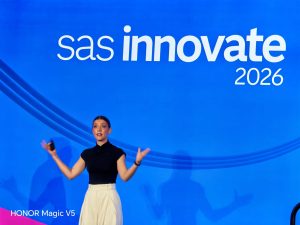
SAS’ Profi: We’re at the point of working with AI that ‘acts’ in tools, systems, and workflows.
Jared Peterson, SVP of global engineering, led an extended section of the SAS Innovate media session. He welcomed several guest speakers, including Marinela Profi, who discussed the evolving role of agents within tools, systems, and workflows.
“This is what I refer to as ‘AI that acts,’” Profi explained. “We recognize that users may not be challenged by the models themselves but by the environment surrounding language, image, and other models, particularly when agents are positioned to influence decision-making within an organization’s data.”
Safeguarding with synthetic data
Expanding into additional toolsets, SAS Worker Safety addresses workplace hazards through the innovative use of digital twins, synthetic data, and computer vision.
Using this solution, clients can produce realistic training footage for computer vision models that prepare for high-risk situations. This method allows for virtually unlimited variations in simulated environments, capturing essential factors such as equipment color and lighting conditions that might influence accidents.
“By leveraging synthetic data and computer vision, organizations can simulate rare but possible events, such as forklift collisions, for which actual footage may be unavailable. This enables organizations to repeatedly run through crucial action sequences without involving real personnel or risking any personal information,” noted SAS in a technical briefing.
Once the models are trained, they can be implemented across facility cameras to provide real-time alerts, ensuring that workers are equipped correctly and adhering to safety protocols. In a factory setting, this could involve checking that helmets are appropriately positioned, while in medical environments, it might mean identifying a misaligned mask or glove before a procedure.
SNAP struggles
When administering Supplemental Nutrition Assistance Program (SNAP) benefits, U.S. states often grapple with evolving regulations, heavy workloads, and labor-intensive manual tasks. Recent federal regulations impose financial penalties on states that exceed thresholds for payment error rates—an issue that leads to millions in lost federal funding and prevents families from receiving the full benefits they qualify for.
Several states are leveraging SAS Payment Integrity for Food Assistance to tackle this challenge and better serve their communities.
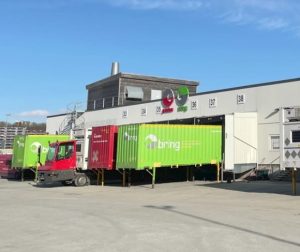
Posten Bring utilized SAS Viya and SAS SingleStore to support real-time parcel tracking, route optimization, and customer communications.
GLOBAL NOTE: Although this segment primarily highlights the U.S. situation, SAS showcased global customer stories during its SAS Innovate 2026 keynote session, particularly spotlighting Posten Bring—a logistics provider based in the Nordics.
“When organizations attempt to stitch together ad-hoc AI frameworks, they often struggle to achieve the competitive advantage they seek,” stated Manisha Khanna, SAS’s global market strategy lead for applied AI. “Our industry accelerators are designed with purpose, addressing real-world challenges within highly regulated sectors. By deploying production-ready agents and models using existing data, our clients can achieve remarkable results.”
SAS models are trained on extensive datasets contributed by major global financial institutions, ensuring that their industry accelerators are thoroughly vetted for designated tasks. Additionally, these solutions can seamlessly integrate with an organization’s current workflows, empowering specialists to enhance their analytics and AI capabilities.
50 years – and then AI
Perhaps one of the most intriguing aspects of SAS’s ongoing work is the company’s remarkable longevity. Celebrating its 50th anniversary this year, SAS stands as a rare example in the tech industry. Few firms can boast such a legacy, particularly ones engaged with neural networks, modern governance challenges, synthetic data, and various forms of agentic AI services.
The current evolution of SAS illustrates a significant transformation. Originally launched as a government-funded project at North Carolina State University to analyze vast amounts of agricultural data, SAS has continually pivoted and evolved. Today, it is firmly positioned to tackle the data science challenges of the present and is well-prepared to navigate the post-cloud era with agentic AI capabilities across diverse industries.