Recently, European Commission President Ursula von der Leyen sparked significant debate when she remarked that if the EU does not pursue expansion, neighboring countries may fall under the influence of Russia or China. While such statements have been common among EU leaders for years, von der Leyen’s inclusion of Türkiye as a potential “nefarious influencer” was particularly striking.
In response, the Commission hastily reassured that Türkiye is an “important partner” and remains a candidate for EU membership. However, these comments have ignited renewed EU internal disputes, with former European Council President Charles Michel publicly confronting von der Leyen. Cypriot President Nikos Christodoulides, during a meeting with EU leaders, criticized Michel, pointing out that Turkish President Recep Tayyip Erdoğan was not invited to attend, despite Türkiye’s official candidate status. In contrast, NATO Secretary-General Mark Rutte praised Türkiye during his visit.
Ankara has chosen to overlook von der Leyen’s comments.
Some observers misinterpret this controversy as a sign that Türkiye is shifting its allegiance towards BRICS. However, Politico merely labels von der Leyen’s statement as a “gaffe.” This incident occurs at a pivotal time, with the conflict involving Iran at a standstill, the longstanding US influence in the Middle East waning, and Israel intensifying rhetoric against Türkiye. Yet, underlying these tensions, Türkiye appears to be more aligned with Western interests than ever. In this context, von der Leyen’s comment may carry more weight than a simple mistake.
To understand Türkiye’s current positioning, it’s crucial to examine its role in the Iran conflict and its broader ambitions.
Türkiye has avoided openly taking sides against Tehran, instead adopting the role of a “good cop.” Ankara continues to collaborate with the US and Israel while publicly attributing the war’s impetus solely to Israel, aiming to remain in Washington’s favor. The rationale?
This approach is primarily driven by Türkiye’s economic struggles in recent years, necessitating a cordial relationship with the West.
Since the onset of the Iran conflict, Türkiye has expended nearly $60 billion from its reserves to stabilize its currency. Like many nations, Türkiye is grappling with rampant stagflation, with inflation rising again alongside a slowing economy.
The Central Bank of Türkiye maintained a steady policy rate of 37% during its recent meeting, yet it stated:
“If there is a significant and prolonged deterioration in the inflation outlook, the monetary policy stance will be more stringent.”
This marks a stark departure from earlier years, when Erdoğan advocated for lower rates to stimulate growth. Post-2023 elections, he appointed neoliberal economist Mehmet Şimşek as Treasury and Finance Minister, who quickly began raising rates and striving to attract Western capital to Türkiye, which relies on amicable relations with the US and Europe.
Economists suggest that the West has reclaimed some control over Türkiye. According to political economist Umit Akcay:
“From 2021 to 2023, Ankara experimentated with unorthodox monetary policy, reducing interest rates despite soaring inflation due to powerful business lobbies. Although this approach generated short-term growth and aided government re-election efforts, it ultimately failed amidst inflation and drained reserves. Since 2023, Türkiye has reverted to orthodox policy under Finance Minister Şimşek.”
“Similar to Argentina, Türkiye’s financial experiment collapsed without structural transformation, constraining both countries back to orthodox practices and deeper external dependency.”
Together, the US and Europe account for approximately 82% of foreign direct investment in Türkiye. Ankara continually seeks relief from the “Countering America’s Adversaries Through Sanctions Act,” imposed after its acquisition of the Russian S-400 missile system in 2019. These sanctions hinder vital imports such as semiconductors and microchips, stifling Türkiye’s defense industry ambitions, including plans for its own air defense project and domestically produced fighter jets, with the S-400s remaining inactive as the US and Türkiye negotiate potential resolutions.
Erdogan strives to make Türkiye economically and militarily essential to the US-NATO alliance.
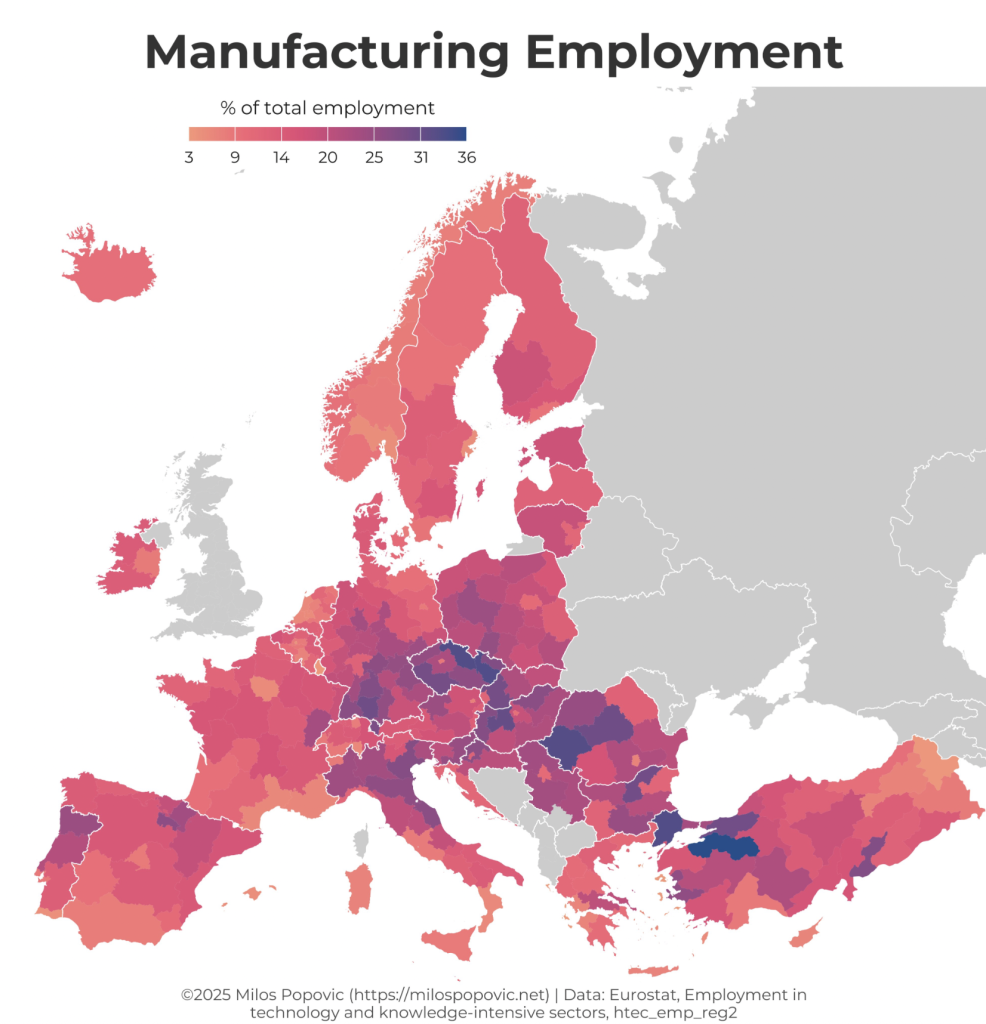
Türkiye boasts a significant manufacturing sector aimed at the European market, bolstered by its customs union with the EU.

This sector is increasingly shifting towards defense manufacturing as the EU embarks on a significant rearmament effort in response to perceived Russian threats. Ankara is eager to gain access to the EU’s substantial $170 billion defense fund. Several EU officials have even remarked on the necessity of Türkiye’s assistance in their rearmament efforts. Paradoxically, much of Türkiye’s defense manufacturing relies on Russian gas, which constitutes over 40% of its energy needs, and Ukraine has made attempts to damage the TurkStream pipeline delivering this gas across the Black Sea.
A recent joint venture between Turkish drone manufacturer Baykar and Italian defense firm Leonardo, along with other Turkish contributions to NATO’s defense initiatives, indicates promising growth in this sector.
Rutte was not merely visiting Türkiye to address von der Leyen’s comments; he also advocated for a leading role for Türkiye in NATO’s layered defense strategy.
During his visit to ASELSAN, Türkiye’s top defense company and Europe’s fifth most valuable defense entity, Rutte acknowledged Türkiye’s critical role within NATO’s upcoming layered air and missile defense architecture in collaboration with US systems.

ASELSAN asserts its importance in supporting NATO’s logistical security and serves as a reliable production center, thoroughly integrated with NATO’s common data links and command-control systems.
The Turkish government and ASELSAN are actively striving to position Türkiye as a key production hub for NATO. Furthermore, Türkiye is enhancing its partnerships in other domains; last month, the Turkish defense ministry announced that NATO plans to establish a multinational corps in Türkiye, situated in Adana, near the Incirlik Air Base that houses US nuclear weapons.
If any doubts linger regarding Türkiye’s alignment with Western financial interests, consider this:
Earlier this month, Erdoğan welcomed 40 global CEOs to Istanbul for a meeting organized by the World Economic Forum (WEF). Interestingly, Erdoğan has not attended the WEF’s Davos summit since 2009, following a well-publicized confrontation with then-Israeli President Shimon Peres over the Gaza conflict.
Larry Fink, chair of the WEF’s board and CEO of BlackRock, the largest global asset manager, played a key role in arranging this Istanbul event.
Türkiye analyst Ceren Kenar reported to Middle East Eye (MEE) that the WEF aimed to mend ties between Erdoğan and the Davos platform.
Türkiye, Israel, Iran, and Competing Visions for the Middle East
As previously discussed at the onset of the US-Israel aggression, Türkiye’s proposed role as a mediator appears deceptive. Here’s Ankara’s perspective on conflict resolution:
“A new leadership structure may reshape Iran’s decision-making and create an opportunity to halt the war,” [Fidan] shared in a live broadcast on TRT Haber. “The new leadership in Iran may exhibit greater flexibility at this stage… This could represent a window of opportunity if harnessed wisely.”
Setting aside the absurdity of expecting an attacked nation to demonstrate flexibility, what precisely is Fidan advocating?
Discussions among Saudi Arabia, Pakistan, Türkiye, and Egypt are underway about establishing a “Muslim” alternative to the US-led Gulf security architecture. According to The Cradle:
A quadripartite meeting held alongside the Antalya Diplomacy Forum, from April 17-19 in Türkiye, reportedly focused on reducing tensions and building a new regional security framework. According to sources, there is widespread support for an “internal security apparatus” rooted in economic collaboration and defense coordination.
Türkiye has proposed an “organized regional security platform” that emphasizes regional governance over external influences in West Asia.
However, one might question the accuracy of this claim. As noted earlier, Türkiye (along with the other nations in this proposed security coalition) is closely tied to Western capital and military integration. How independent can this new alliance genuinely be?
Nevertheless, Ankara hopes that this arrangement could result in a more peaceful integration of Iran, in stark contrast to Israel’s approach. These competing strategies may explain the growing antagonism directed toward Türkiye from Israel.
Many speculate that this implies Türkiye could become Israel’s next target. Someday, perhaps, but it seems unlikely in the immediate future.
As highlighted earlier, Türkiye’s strategic importance to the US’s broader objectives—extending influence through the Black Sea to the Caspian—sets it apart from other nations. Indeed, Türkiye’s role is pivotal in increasing Turkish-American clout in Central Asia.
While I rarely concur with US envoy Tom Barrack, I believe he is accurate in describing the animus toward Türkiye as mere “rhetoric.” Barrack faces criticism from neoconservative Zionists for his remarks, yet his perspective reveals Türkiye’s significance to imperial interests. More about this:
“Everything originates from Türkiye. From fiber optics to oil, gas, information, data, and materials flowing between Azerbaijan and Armenia. How does this connectivity occur?” he mused.
“Consequently, Israel has aligned itself with Türkiye, much like it has with Abu Dhabi. Saudi Arabia could also align with Israel for the benefit of its citizens, which to me is the logical solution.”
And beneath the surface, these countries have indeed collaborated.
Türkiye has facilitated the transmission of oil and essential minerals to Israel, which supports its military actions. Additionally, Türkiye has indirectly aided in Israel’s ethnic cleansing initiatives in Lebanon by undermining Syrian opposition. The jihadists supported by Erdoğan’s administration failed to defend against Israel, redirecting their attacks toward Hezbollah instead.
Despite some confrontations in Syria, recent developments there further illustrate the underlying collaboration. At a January meeting in Paris, which involved undermining Kurdish interests, the US, Israel, and Türkiye reached an understanding. As detailed by The Cradle:
Turkish Foreign Minister Hakan Fidan attended the Paris meeting and actively participated in negotiations, making clear demands for US support for the SDF to cease, while also insisting on blocking the “David Corridor.” In return, Türkiye would refrain from hindering Israeli initiatives in southern Syria.
This arrangement reflects a transactional alliance that succeeded mutually.
While these covert dealings thrive amid favorable circumstances, the tricky part will arise as desperation mounts in Iran. Facing crises in both Ukraine and Iran, the West finds itself cornered without viable options.
Likewise, Erdoğan’s predicament mirrors this, forced into compliance with Western demands for economic survival. The risks of escalating demands loom ever larger. If Türkiye is engaging in a good cop-bad cop dynamic concerning Iran, it could find itself trapped in its own web of obligations.
Returning to von der Leyen’s “gaffe,” her remarks, among other threats from Zionists, may carry implicit warnings of economic repercussions if Türkiye fails to comply with certain expectations.
Türkiye now finds itself pulled in multiple directions. Von der Leyen, representing the Russophobic wing within the EU, likely harbors intentions regarding Russia. Meanwhile, hardline Zionists might demand further action against Türkiye, while others may seek more support against Iran.
With questions around alliances and intentions swirling, the ultimate question remains: what do they truly want from Türkiye?
Here is why I believe Israel is inciting Western animosity towards Türkiye:
It’s not strictly about Türkiye, which they often underestimate and disparage; it’s fundamentally about Iran. They are pressuring Türkiye to facilitate actions against Iran, but Türkiye is resisting…
— Alon Mizrahi (@alon_mizrahi) April 21, 2026
In trying to maximize profits, Erdoğan and his family have amassed substantial wealth over the years through various means, but maintaining such a balancing act could become increasingly tenuous.

