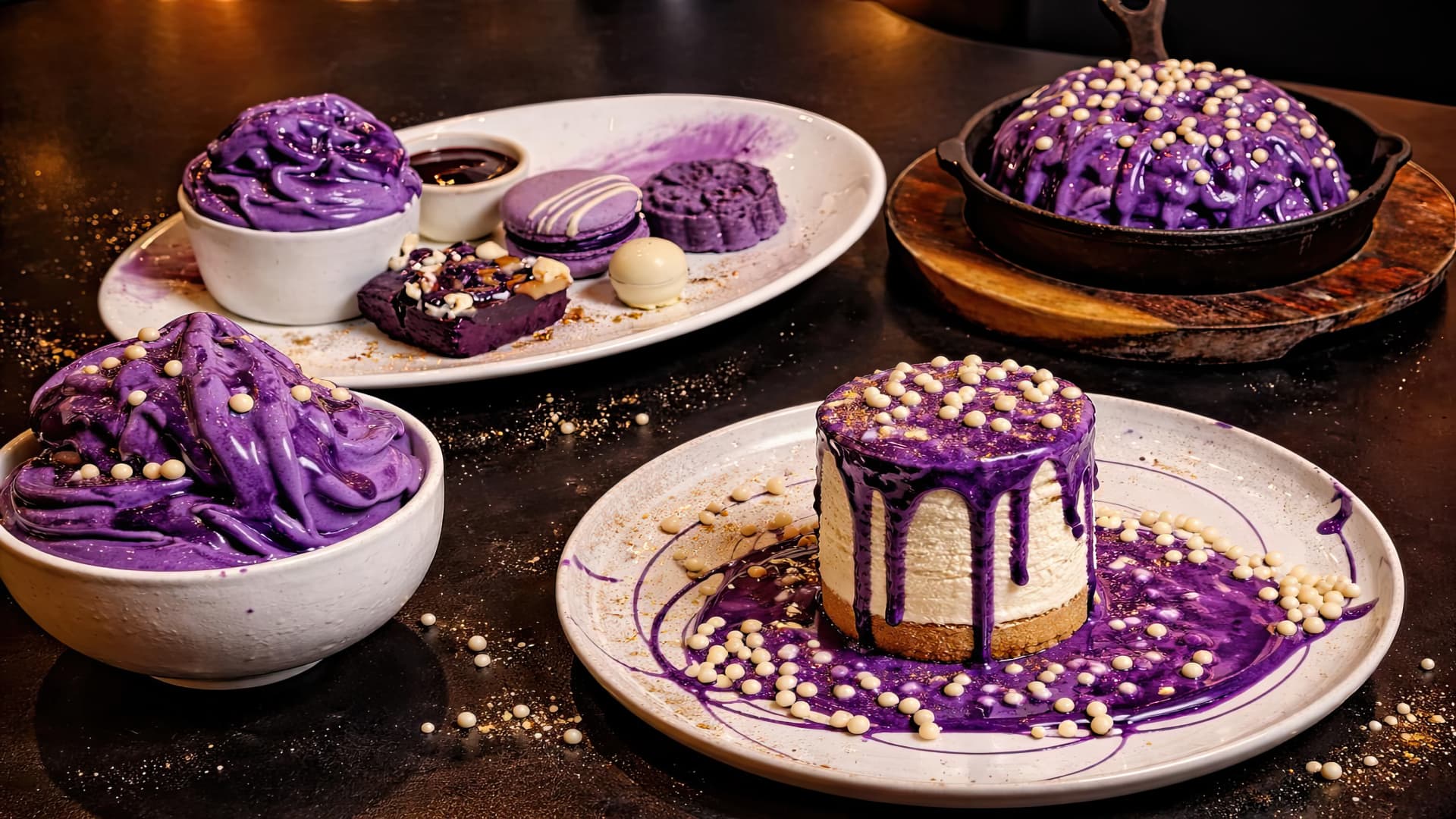
Filipino restaurant Kasa and Kin in Soho, London, offers a selection of drinks and desserts made with ube, a root vegetable from the Philippines that has gained popularity among younger consumers due to its vivid color and sweet flavor.
Kasa and Kin
Chris Joseph, a veteran Filipino restaurateur, has featured ube in his London establishments for the past decade. However, interest in ube-based drinks and desserts has soared in the last year.
Ube, a naturally sweet and starchy vegetable cultivated by farmers in the Philippines, is at the center of Joseph and his wife Rowena Romulo’s Soho eatery, Kasa and Kin, which opened in 2021.
“Ube was flying off the shelf from the very beginning,” Joseph shared in a CNBC interview.
The couple’s previous restaurant, Romulo Café, which opened in 2016 but has since closed, also showcased ube dishes. At Kasa and Kin, guests can choose from an ube latte, an ube martini, an ube tsunami cheesecake (topped with a flood of purple sauce), and an ube cream cheese bread, among other imaginative options.
Ube has grown 230% across restaurant menus in the U.S. in the past four years, according to food and beverages analytics firm Datassentials.
The Washington Post | The Washington Post | Getty Images
Initially, Joseph’s customers were primarily nostalgic Filipinos looking for a taste of home. “Now, we see new faces walking in, curious about ube. They browse our bakery case and pick up items like an ube brownie or ube ice cream,” he noted.
In the past year, ube has crossed cultural boundaries, becoming widely recognized as coffee shops and restaurants seek the next viral food trend.
Starbucks contributed to this trend in 2025 with temporary offerings such as the Ube Iced Coconut Latte and Ube Espresso Martini, further enhancing its spring menu in 2026 with an Ube Matcha Latte and Ube Vanilla Macchiato. Similarly, U.S. chain Peet’s introduced an Iced Vanilla Latte with Ube Dream Top for the season.
Ube options have skyrocketed by 230% across restaurant menus in the U.S. in the past four years, according to Datassentials. It now appears on the menus of 95 chains across the U.S., with anticipated growth of 74% in the coming four years.
Exports of ube from the Philippines have seen a significant rise recently. In 2025, the Philippines exported approximately $3.2 million worth of ube—nearly 1.7 million kilograms—marking a roughly 20% increase from the previous year, based on data from the Philippine Statistics Authority (PSA) shared with CNBC.
The United States was the leading importer, accounting for about $1.6 million, roughly half of the total exports. Canada, Australia, and the U.K. followed as the next primary markets.
Joseph has noted that the growing visibility of ube has positively impacted Kasa and Kin’s sales, particularly in their dessert offerings.
Emily Tang, chief product officer at Datassentials, commented that ube is “accessible from a flavor perspective,” making it easy to innovate.
“It pairs well with popular items like coffee, beverages, desserts, and pastries,” she explained. “Its mild nutty flavor creates a low barrier for trying it. It’s not an intimidating flavor; it’s a safe bet for experimentation, plus it’s visually striking.”
‘The perfect trend’
Ube is currently enjoying its moment in the spotlight, though its rise to fame has been gradual. Datassentials has tracked this flavor since 2017, when it was mainly available at Filipino bakeries and family-owned eateries in the U.S.
This flavor’s introduction to international popularity is linked to the broader acceptance of Asian culture, encompassing foods and drinks like Korean fried chicken and boba tea, alongside media influences like K-pop and K-drama, according to Tang.
A landmark event was in 2022 when Baskin-Robbins presented its Ube Coconut Swirl ice cream as a limited-time treat.
“March saw the highest number of limited-time ube offerings we have ever tracked at leading chains, so it has really entered the mainstream,” Tang remarked, attributing its surge to social media.
“It’s visually vibrant and highly Instagrammable, making it perfect for social sharing,” she added, highlighting the trend’s alignment with social media habits.
A search for the ube hashtag reveals 120,000 posts on TikTok and over 750,000 on Instagram, showcasing ube’s captivating purple coloration.
The fascination with ube largely stems from a global craving for more exotic flavors in beverages and desserts, as restaurants replicate the success of Japanese matcha and Dubai Chocolate, both of which have been adapted into various products from cakes to milkshakes.

“It’s now an integral part of eating and drinking culture, as the demand for visually appealing food is just as crucial as flavor,” stated Andrew Freeman, founder of the hospitality consulting firm AF&Co.
In particular, coffee has become a focal point for social media among younger consumers as they move away from alcohol, Freeman noted.
Ube latte at Kasa and Kin restaurant in Soho, London.
Kasa and Kin
“As people drink less, there’s a resurgence of coffeehouse culture,” he commented.
“This year, we examined coffee trends and discovered a shift from functionality to an experience-centered focus, asking, ‘What can I enhance my coffee with? How can I make it visually appealing?’ It reflects a desire for photography and virality,” he added.
Tightening supply
While ube is currently enjoying a surge in demand globally, Filipino farmers are facing challenges keeping up, as climate change complicates weather patterns and affects the availability of quality planting material, according to the Philippine Root Crop Research and Training Center.
The total production volume of purple yams in the Philippines has seen an annual decline, dropping 1.63% from 13,381 metric tons in 2024 to 12,483 metric tons in 2025, as reported by PSA. In 2021, the Philippines produced 14,150 metric tons of purple yams.
Farmer Felisa Ap-ap harvests purple yams from the side of the mountain in Bayabas, Sablan, Philippines, on February 13, 2026.
Ezra Acayan | Getty Images News | Getty Images
The country has even started importing some ube from Vietnam to meet local demand.
“When demand surges at first, the supply chain needs time to adapt and understand the landscape,” Joseph remarked.
While prices for ube have risen, Joseph expresses optimism, viewing it as a chance for farmers in the Philippines to receive higher compensation.
“A humble crop like a tuber didn’t receive much credit, so it’s encouraging for them. If they can earn a fair price, they can invest in more production. I welcome the world’s growing interest in ube,” he stated.
Key Takeaways
- Ube, a sweet purple yam from the Philippines, is surging in popularity, particularly among younger consumers.
- Chris Joseph’s Kasa and Kin restaurant in London is a notable establishment featuring ube in various dishes and drinks.
- The demand for ube has increased substantially, with a reported 230% growth on U.S. restaurant menus in the last four years.
- Starbucks and other chains are drawing attention to ube with limited-time offerings.
- Filipino farmers are struggling to meet the heightened demand due to unpredictable climate challenges.
- Ube’s visually striking appearance and versatile flavor make it ideal for innovation in food and beverages.
FAQ
What is ube?
Ube is a purple yam native to the Philippines known for its sweet flavor and vibrant color.
Why is ube becoming popular?
The growing interest in ube is due to its unique taste, visual appeal, and its adaptability in various culinary creations.
How has the market for ube changed recently?
Ube has experienced a significant rise in popularity, with a 230% increase in U.S. restaurant menus over the last four years.
Are farmers able to meet the demand for ube?
Currently, farmers in the Philippines are facing challenges due to climate change and are struggling to keep up with the increasing demand.