This week marked a critical moment for crypto security as the landscape faces unprecedented challenges. CertiK, a leading name in blockchain security, issued a chilling warning: over $600 million has already been lost to hacks in 2026. Notably, this surge in thefts stems from two major exploits linked to North Korea—April alone saw the $293 million Kelp DAO breach and the $280 million Drift Protocol attack. Concurrently, the rise of agentic AI tools capable of swiftly scanning smart contracts for vulnerabilities and crafting exploit code is unfolding at an alarming pace, according to CertiK’s senior investigator, Natalie Newson.
Thus, Web3 developers, wallet providers, and cryptocurrency holders must ask themselves: what if the same AI advancements used by attackers could be redirected towards enhancing our defenses?
Introducing Anthropic’s Claude Mythos—an AI model reputedly designed to detect vulnerabilities in major operating systems, now being cautiously rolled out to select tech firms in a defensive capacity. Coupled with the Mythril ecosystem, which previously powered the MythX security suite before its closure on March 31, 2026, and the emergence of cutting-edge AI-native auditing tools such as Octane Security, ContractScan, and ChainGPT’s Smart Contract Auditor, a new paradigm of AI-driven security is coming into focus.
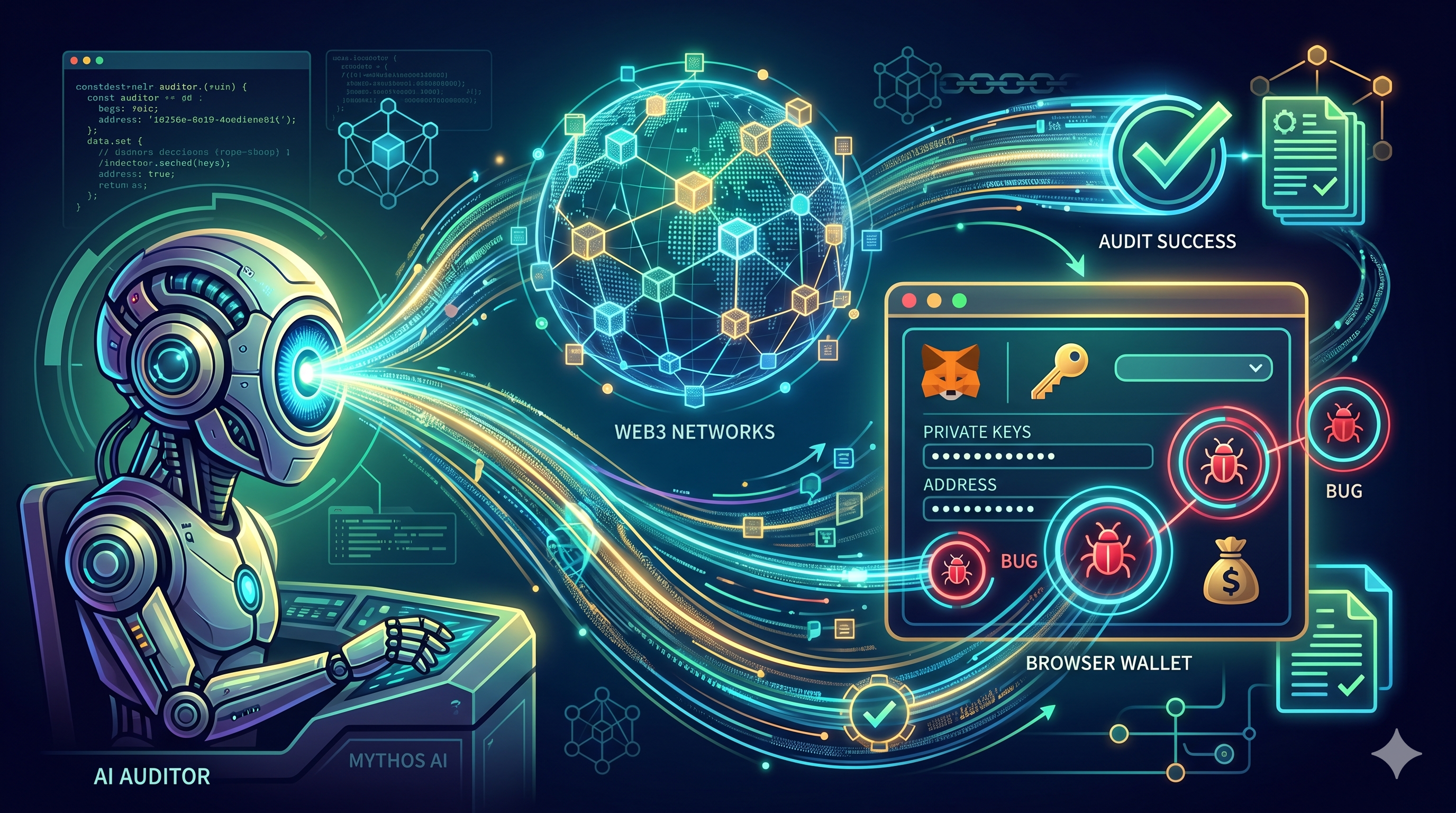
The central query of this article is both timely and technically intricate: can AI-powered bug-finding tools like Mythos effectively audit not only smart contracts but also the full gamut of Web3 and browser-based crypto wallets—including MetaMask extensions, integrated wallet SDKs, and the dependent JavaScript supply chain? The answer is complex yet vital for anyone who has engaged with a decentralized application (dApp) using a crypto wallet.
Key Takeaways
-
$600M+ has already been lost to crypto hacks in 2026, with AI-driven attacks—including deepfakes, autonomous exploit agents, and supply chain breaches—identified as major risks by CertiK.
-
Anthropic’s Claude Mythos is an AI model that claims to uncover vulnerabilities in major operating systems and is now being deployed defensively, marking a significant step forward in AI-based security auditing.
-
Mythril (the open-source symbolic execution engine) employs concolic analysis, taint analysis, and SMT solving to detect EVM bytecode weaknesses—its framework can be adapted to audit wallet-integrated smart contracts in addition to standalone DeFi protocols.
-
Browser-based crypto wallets like MetaMask are exposed to different threats than smart contracts: JavaScript supply chain attacks, harmful extension updates, XSS risks in NFT metadata, and encryption flaws necessitate AI tools tailored for browser-layer scrutiny.
-
Trust Wallet’s $7M breach in December 2025—initiated by a malicious Chrome extension update that bypassed Google’s validation—illustrates the types of vulnerabilities that existing AI contract auditors fail to cover, although forthcoming tools are being developed to address these gaps.
-
The MythX shutdown on March 31, 2026 revealed a gap in the CI/CD security pipeline, prompting a market response with multi-engine, AI-enhanced alternatives emerging rapidly.
The State of Crypto Wallet Security in 2026—A Crisis at the Browser Layer
To grasp the urgency for AI auditing tools for Web3 wallets, it’s essential to examine where attacks are predominantly occurring in 2026.
While current discussions around crypto security tend to focus on smart contract vulnerabilities—covering reentrancy issues, oracle manipulation, and logical inconsistencies draining billions from DeFi protocols—the data from 2025 and early 2026 reveals an alarming trend: the browser layer is where individual user funds are most at risk.
Despite MetaMask’s long-standing security record—with over 100 million users—it has reported rising user-level threats, as evident from a 207% increase in signature phishing attacks in January 2026, resulting in losses of $6.27 million across 4,700 wallets. Attackers are taking advantage of Ethereum’s EIP-7702 feature to deploy malicious delegation scripts, with over 80% of delegations linked to a singular malicious script crafted to drain wallets with compromised keys. Furthermore, the issue of JavaScript supply chain attacks—where harmful NPM packages sneakily alter crypto addresses—has gained alarming traction, with payloads downloaded over a billion times, according to Ledger’s CTO.
This complex and volatile security landscape underscores the essential need for AI-driven bug-finding tools to step up.
What Is Mythril (and Mythos) — and How Do These AI Security Tools Actually Work?
To assess whether AI audit tools can suitably protect Web3 wallets, we must first delineate their technical capabilities and limitations.
Mythril is an open-source security analysis tool for EVM bytecode, crafted by ConsenSys Diligence. Its primary methodology is concolic analysis (a blend of “concrete” and “symbolic” execution), augmented by SMT solving and taint analysis. Essentially, Mythril simulates contract execution across various branches, aiming to identify “dangerous” states by testing diverse parameter combinations, and flags vulnerabilities such as integer underflows, wrongful Ether withdrawals, and unprotected selfdestruct operations. This tool was fundamental to the MythX security suite, which has now ceased operations, accelerated further by the market’s movement toward AI-augmented alternatives.
In comparison, Anthropic’s Claude Mythos represents a different breed of tool. Per CertiK’s Natalie Newson, Mythos is portrayed as an AI model “capable of uncovering vulnerabilities in major operating systems,” now being cautiously deployed defensively among selected tech firms. Unlike Mythril’s deterministic symbolic execution, Mythos exemplifies a new class of large language model-enhanced security tools that comprehend code intent, identify business logic violations, and spot patterns correlated with actual exploit cases from its database—capabilities unattainable by traditional rule-based tools.
This distinction is crucial for wallet security. Mythril and similar symbolic execution tools excel in identifying precise and codifiable vulnerability categories within EVM bytecode: transactional reentrancy errors that allow external contracts to re-enter functions before a balance is updated, integer overflows disrupting accounting logic, and unprotected functions open to any external caller. These deterministic bugs are characterized by well-defined signatures that symbolic execution tools can reliably detect.
On the other hand, Mythos and its large language model counterparts excel in comprehending the semantic intent behind the code. They can recognize patterns resembling known attack scenarios without necessarily adhering to a rigid rule. They assess various layers within a system—from smart contract logic to frontend JavaScript, and wallet integration APIs—to uncover risk factors emerging from these interactions, rather than from isolated components. An AI model capturing that a wallet’s transaction-signing flow could be compromised by a malicious dApp frontend, even when both the contract and wallet extension function correctly, is accomplishing something fundamentally distinct from Mythril’s bytecode scrutiny.
Together, these methodologies—deterministic symbolic execution and AI-driven semantic analysis—form the backbone of the next-generation crypto security framework.
Can These Tools Actually Audit MetaMask and Browser-Based Web3 Wallets?
Here, the technical reality becomes nuanced. The straightforward answer is: partially, but with significant limitations that the industry is striving to tackle.
What AI audit tools can currently achieve for wallet security:
Browser-based wallet extensions like MetaMask fundamentally operate as JavaScript applications. Their attack surface, explored by security firm Zealynx, encompasses several layers: extension manifest permissions, content security policy configurations; communication channels via chrome.runtime.sendMessage that may be exploited if improperly secured; XSS vulnerabilities in NFT metadata rendering and dApp integrations; encryption of key storage in chrome.storage.local (utilizing PBKDF2 and scrypt); and IDOR vulnerabilities permitting unauthorized transaction signing. Each layer invites scrutiny.
AI-powered static analysis tools are capable of scouring the JavaScript and TypeScript source code of browser extensions to detect multiple classes of vulnerabilities. Exposed API keys, mnemonics, and secrets in source code, configuration files, and testing accounts—the type of vulnerabilities behind the Trust Wallet breach—can be effectively identified by AI-powered static analysis (SAST) tools embedded within CI/CD pipelines. Tools like ContractScan, utilizing five security engines in tandem (Slither, Mythril, Semgrep, Aderyn, and AI), and platforms such as Octane Security—which employed its AI tool to uncover a critical flaw in Ethereum’s Nethermind client potentially impacting 40% of all validators—illustrate that AI-native security tools are already identifying genuine vulnerabilities at the infrastructure level.
The vital lesson learned from the Octane Nethermind case is substantial: Octane’s AI discovered a bug that could have permitted an attacker to disrupt validators by submitting a malformed transaction, leading to missed slots for all Nethermind-based block proposers. This prompted the Ethereum Foundation to grant them a $50,000 bug bounty. Importantly, this was not merely a contract-level bug; it was an issue within the client infrastructure, showcasing that AI security tools are already functioning beyond the bytecode layer.
What these tools cannot yet accomplish reliably:
The Trust Wallet breach did not originate from a traditional code vulnerability but from compromised API credentials allowing a malicious actor to introduce a corrupted extension update through legitimate channels. No static analysis tool, however sophisticated, can detect credential compromises by scanning the source code alone since the malicious code is integrated post-development. Similarly, the JavaScript supply chain attacks currently affecting the Web3 ecosystem, involving malicious NPM packages that swap crypto addresses require not only code scanning but behavioral analysis and dependency oversight.
Vulnerabilities in business logic, particularly in wallet-dApp interactions, whereby a wallet’s frontend can be manipulated to display one transaction while signing another (as seen in the Bybit “Safe wallet interface manipulation” attack vector), necessitate an understanding of the entire flow between a dApp’s frontend, the wallet’s signing interface, and the smart contract being executed. This is where AI semantic analysis tools like Mythos have the most potential, although they are currently still in the early stages of development. Preliminary results indicate that large language models trained on comprehensive exploit databases can reveal risks at the interaction layer, but the tools needed for implementing this analysis within a continuous CI/CD pipeline for browser extensions are still evolving.
The New AI Security Stack for Web3—Multi-Engine Defense in Depth
The closure of MythX on March 31, 2026 underscored a lesson already recognized by the security community: a single-vendor, single-engine security model represents a single point of failure. ContractScan’s evaluation post-MythX articulated this clearly: “Relying on a sole security tool, governed by a single company’s API, leaves you exposed.”
The emerging security architecture is a multi-engine, AI-enhanced defense model composed of five distinct layers, each addressing a specific segment of the Web3 wallet attack surface.
Layer 1: The Code X-Ray (Static Analysis)
Tools: Slither, Aderyn, Semgrep This functions as a grammar checker for code. It examines the “framework” of your smart contract to identify clear typos, logic errors, or missing security locks.
Layer 2: The Security Brain (AI Semantic Analysis)
Tools: Claude Mythos, Specialized LLMs If Layer 1 acts as a grammar checker, this serves as a master editor. Leveraging AI trained on nearly 700 real-world DeFi hacks, it interprets the intent of your code, asking: “Does this contract’s behavior resemble the Drift exploit from last month?”
Layer 3: The Stress Test (Behavioral Fuzzing)
Tools: Diligence Fuzzing This employs the “infinite monkeys” method. It bombards your contract with millions of random and odd inputs to evaluate its resilience under stress. For wallets, it monitors the background “signals” to ensure no data is leaking.
Layer 4: The Border Patrol (Supply Chain Defense)
Focus: NPM Packages & Dependencies Most breaches occur not in your code but within the components you import. In 2026, AI agents will scrutinize each update to your software’s foundations to ensure no malicious “backdoors” were secretly introduced during a standard update.
Layer 5: The Night Watchman (Post-Deployment Monitoring)
Focus: Real-time Behavior & Governance Security does not cease upon deployment. This layer remains vigilant, continuously observing the contract’s performance. It tracks the holders of critical keys and alerts the team if admin permissions appear to be gearing up for a potential hostile takeover.
Stay Ahead of the Security Curve—The Market Opportunity for AI Auditing
In light of the ongoing security turmoil in 2026, an essential question for any crypto investor is: who stands to benefit financially when AI-driven security becomes as indispensable to Web3 as auditing itself?
The answer links directly to several compelling token categories present in the market today. The AI security movement within crypto necessitates three foundational infrastructure layers: AI compute resources that power LLM-based analytical tools (such as DePIN GPU networks like Render, Aethir, and Akash); AI intelligence protocols that orchestrate decentralized models and compute marketplaces (including Bittensor’s TAO, Fetch.ai’s FET, and the Virtuals Protocol); and blockchain infrastructure designed to accommodate the increased load from the continuous security analysis and real-time transaction monitoring conducted by thousands of AI agents.
In just the first four months of 2026, the crypto sector has lost over $600 million. This burgeoning market for security tools—covering AI auditing tools, bug bounty initiatives, on-chain insurance protocols, and real-time monitoring systems—addresses a demand signal that is set to escalate further as AI-enabled attacks outpace manual defense capabilities.
While the security crisis of 2026 is adverse for the broader crypto industry, it serves as a clear call for investors capable of discerning which tools and infrastructure protocols are in development to address it.
What Web3 Developers and Wallet Users Must Do Right Now
The rapid pace of AI-driven attacks in 2026 is outstripping the uptake of AI-powered defenses. Both wallet developers and individual users urgently need actionable responses rather than mere awareness.
🛠 For Developers: The “Triple-Lock” System
If you are developing a wallet or a dApp, relying on a single audit is insufficient. An automated security pipeline that operates continuously is essential.
1. The Automated Filter (CI/CD)
Visualize this as a security gate at your factory. Each time you make a code change, three actions need to occur:
-
The Robot Scan: Implement tools like Slither and Mythril to capture basic coding errors.
-
The AI Brain: Use ContractScan to evaluate whether your code logic bears any resemblance to identified scams or hacks from the past.
-
The Ingredient Check: Before incorporating any external code (NPM packages), run an AI scanner to ensure it hasn’t been compromised.
2. The “Wallet-Specific” Shield (Zealynx Framework)
Constructing browser extensions is akin to building a house with numerous openings. Therefore, you should:
-
Lock the Windows: Examine your browser permissions to ensure NFT metadata cannot inject malicious scripts (XSS).
-
Hide the Keys: Use AI to scan your source code for embedded secrets—passwords or keys inadvertently left in the code that hackers could quickly find.
🦊 For Individual Users: The “Digital Hygiene” Checklist
Individual users are increasingly targeted by signature phishing attacks (up over 200% this year). Here’s how to protect yourself:
1. See the Future (Transaction Simulation)
Never sign a transaction without scrutiny. * Use tools that provide a “preview” of what will transpire before you confirm. If the simulation forecasts, “You lose 50 ETH,” while attempting to mint a free NFT, stop.
2. Read the Fine Print (Human-Readable Signing)
-
If your wallet displays a series of random numbers and letters (Hex data), refrain from signing.
-
Demand wallets that convert that jargon into clear language: “You are granting Site X permission to spend 100 USDC.”
3. Clean Your House (Revoke.cash)
-
Every time you interact with a dApp, you’ve likely granted it a “key” to your tokens.
-
Regularly visit Revoke.cash to retrieve those keys from apps you are no longer utilizing.
4. Use the “Vault and Wallet” Strategy
-
The Wallet: Keep a small amount of “spending money” in your browser extension for daily dApp interaction.
-
The Vault: Store your life savings in a separate, “cold” hardware wallet that never interacts with a dApp.
The forthcoming generation of AI-enabled wallet security—tools capable of analyzing dApp code in real-time prior to connection, signaling suspicious transaction structures before you authorize, and monitoring your approval history for unusual delegation patterns—is on the horizon. The rollout of Anthropic’s Mythos to selected tech firms marks a promising step in this direction. The integration of AI semantic analysis into wallet guard mechanisms like MetaMask’s Wallet Guard is a logical evolution that the industry is already pursuing.
The notion of a one-time audit is definitively a relic of the past. Continuous AI-fueled security monitoring is now the standard—which is why the tools, teams, and tokens facilitating this change are crucial components of the 2026 crypto security narrative.
Conclusion
The intersection of AI-driven attacks and AI-infused defenses has established 2026 as a pivotal year in Web3 security history. On one side lie agentic AI tools rapidly scouring contracts, generating deepfakes to evade KYC, and contaminating JavaScript supply chains. On the other, Claude Mythos identifies operating system vulnerabilities, Octane Security’s AI uncovers critical issues that could jeopardize over 40% of Ethereum validators, and ContractScan constructs the post-MythX multi-engine security framework the market urgently requires.
Can AI-enhanced bug-finding tools like Mythos conduct audits on Web3 and browser-based crypto wallets? The response in 2026 is a qualified yes, with capabilities expanding rapidly month by month. Symbolic execution tools such as Mythril effectively cover the EVM bytecode layer, while AI semantic analysis tools like Mythos are broadening their scope to detect vulnerabilities at the operating-system level and cross-layer risks. The browser extension attack surface—where Trust Wallet suffered a $7 million loss due to a harmful update, and where MetaMask’s users encounter constant phishing threats—necessitates a comprehensive suite of AI-augmented defenses that surpass the capabilities of any single tool.
The $600 million already lost in 2026 does not reflect a failure of the blockchain; rather, it reveals a inadequacy within the security infrastructure that surrounds it. Addressing that security shortfall is paramount within the Web3 ecosystem currently—and efficiently deploying AI in a defensive capacity stands as a potent means of tackling this challenge.
FAQs
What is Claude Mythos and how does it differ from Mythril?
Claude Mythos is Anthropic’s AI security model reported by CertiK in April 2026 to be capable of discovering vulnerabilities in major operating systems as it is rolled out defensively to select tech firms. Unlike Mythril’s deterministic symbolic execution, Mythos utilizes large language model reasoning to comprehend code intent, identify business logic flaws, and correlate patterns with actual exploit databases—capabilities that rule-based tools cannot replicate. It stands as a next-generation tool for AI security analysis, transcending basic bytecode scanning.
Can AI audit tools protect MetaMask and browser wallet extensions?
Partially. AI-assisted static analysis tools can identify exposed API keys, hardcoded secrets, XSS vulnerabilities in NFT metadata, and insecure permission settings in browser extension code. However, supply chain assaults—where malicious code is injected through compromised CI/CD credentials or tainted NPM packages—demand credential management and dependency oversight that code scanners alone cannot provide. The next wave of AI wallet security tools is being built to fill these voids.
Why did MythX cease operations, and what has taken its place?
MythX, the commercial smart contract security service that combined Mythril’s symbolic execution with proprietary analysis frameworks, was shut down on March 31, 2026. Its closure emphasized the vulnerabilities inherent in a single-vendor security model. Emerging alternatives include ContractScan (which runs five parallel engines alongside AI), Octane Security (an AI-native firm that uncovered the Nethermind Ethereum client bug), ChainGPT’s Smart Contract Auditor, and Diligence Fuzzing (the next iteration of MythX’s Harvey fuzzing component). The market is converging around multi-engine, AI-enhanced security pipelines.
What are the foremost crypto security threats for wallet users in 2026?
CertiK identifies four key threats: AI-enhanced phishing and deepfake social engineering (with phishing losses climbing by over 200% year-over-year), supply chain assaults on wallet browser extensions (notably Trust Wallet’s $7M loss due to a harmful Chrome extension update in December 2025), vulnerabilities across cross-chain infrastructure (Kelp DAO’s loss of $293M due to a LayerZero failure in early 2026), and signature-based attacks draining wallets (exploiting EIP-7702 delegation mechanics). As of late April 2026, over $600 million has been lost to crypto hacks.
How can I safeguard my MetaMask or Web3 wallet from AI-driven attacks in 2026?
Utilize transaction simulators that display what a transaction intends to execute before you authorize it. Enable human-readable transaction signing when possible. Regularly revoke unused token permissions via Revoke.cash. Maintain separate wallets tailored to distinct risk profiles—utilizing a dedicated “burner” wallet for new dApp engagements while securing a separate wallet for long-term assets paired with a hardware wallet. Never store significant balances solely in browser extension wallets. Monitor MetaMask’s monthly security reports for emerging threat insights.
What crypto tokens stand to gain from the growth of AI-enhanced blockchain security?
The AI security revolution within crypto drives demand for AI computing infrastructure (DePIN tokens such as RENDER, AKT, ATH), AI intelligence protocols (TAO, FET), and platforms for on-chain insurance and monitoring. High-performance blockchains that support AI security agents for on-chain settlements will also benefit from increased activity. These token categories are accessible on exchanges such as KuCoin, which offers deep liquidity in AI, DePIN, and infrastructure token segments.
Disclaimer: This article serves informational purposes only and does not constitute financial or investment advice. Cryptocurrency investments come with substantial risks. Always conduct your own thorough research prior to making investment decisions.