In recent years, the integration of artificial intelligence (AI) into workflow orchestration tools has experienced significant growth. Currently, 36% of organizations consider AI-assisted workflow creation a fundamental feature in orchestration and automation platforms.
AI orchestration tools play two essential roles:
- Streamlining operational workflows:
- Managing the logic layer: LLM orchestration and agent orchestration tools facilitate comprehensive reasoning and coordination among AI agents.
Let’s delve into key tools in this domain and examine how they incorporate AI capabilities:
|
Tool |
Category |
Agentic AI |
GenAI |
Execution Model |
|---|---|---|---|---|
|
Planning: Multi-step goal decomposition |
Copilot: RangerAI assistant |
SaaS-native orchestration with an embedded AI layer |
||
|
Planning: Event-driven workflow triggering |
Copilot: Robi AI conversational interface |
Hybrid hub (central controller + agents) |
||
|
Planning: Constraint-based scheduling |
Copilot: Low-code workflow assistant |
Hybrid orchestration with job library abstraction |
||
|
Planning: SLA-aware workflow planning |
Copilot: Jett AI advisor |
Cross-platform orchestration (mainframe to cloud) |
||
|
Planning: AI-driven workflow and agent design |
Copilot: UnO AI Pilot |
Cloud-native SaaS orchestration |
||
|
Planning: Rule and ML-based task routing |
Copilot: Limited |
RPA with a cognitive automation layer |
||
|
Planning: Event-driven and conditional workflows |
Copilot: Natural language flow builder |
Cloud-native and desktop RPA hybrid |
||
|
Planning: Script-defined logic (Python-based) |
Copilot: LLM-assisted scripting |
Code-first automation (Python agents) |
||
|
Planning: Process mining-driven workflow discovery |
Copilot: Autopilot assistant |
UI-driven enterprise RPA platform |
||
|
Planning: Connector-based pipeline configuration |
Copilot: Limited |
API-based data ingestion pipelines |
These tools are organized alphabetically, with sponsors highlighted at the top.
AI for Operational Workflow Orchestration
Enterprise Workload Automation
Workload automation tools, also known as service orchestration and automation platforms (SOAPs), can seamlessly integrate and orchestrate functions across enterprise IT environments.
Stonebranch (Universal Automation Center)
Stonebranch offers a centralized hub for automation, managing workloads across on-premises, cloud, containerized, and hybrid settings. Its key AI use cases are:
- Robi AI (Intelligent Orchestration): A controlled GenAI framework that provides:
- Conversational interface: Enables natural-language troubleshooting and automated root cause analysis.
- Governed GenAI tasks: Integrates LLM steps directly into workflows for cognitive tasks like log summarization and ticket classification, using strict output schemas.
- Agentic interoperability (MCP): Leverages the Model Context Protocol to connect external AI agents (e.g., ChatGPT, Claude, or custom agents), facilitating seamless task triggering within the UAC environment.
- Agent-based execution model: Utilizes Universal Agents for executing scripts, commands, and file transfers across distributed systems, ensuring secure and controlled automation execution.
- Data pipeline and MFT integration: Offers managed file transfer capabilities and data pipeline orchestration, streamlining automated data movement and transformation workflows.
Discover more about Stonebranch and its alternatives.
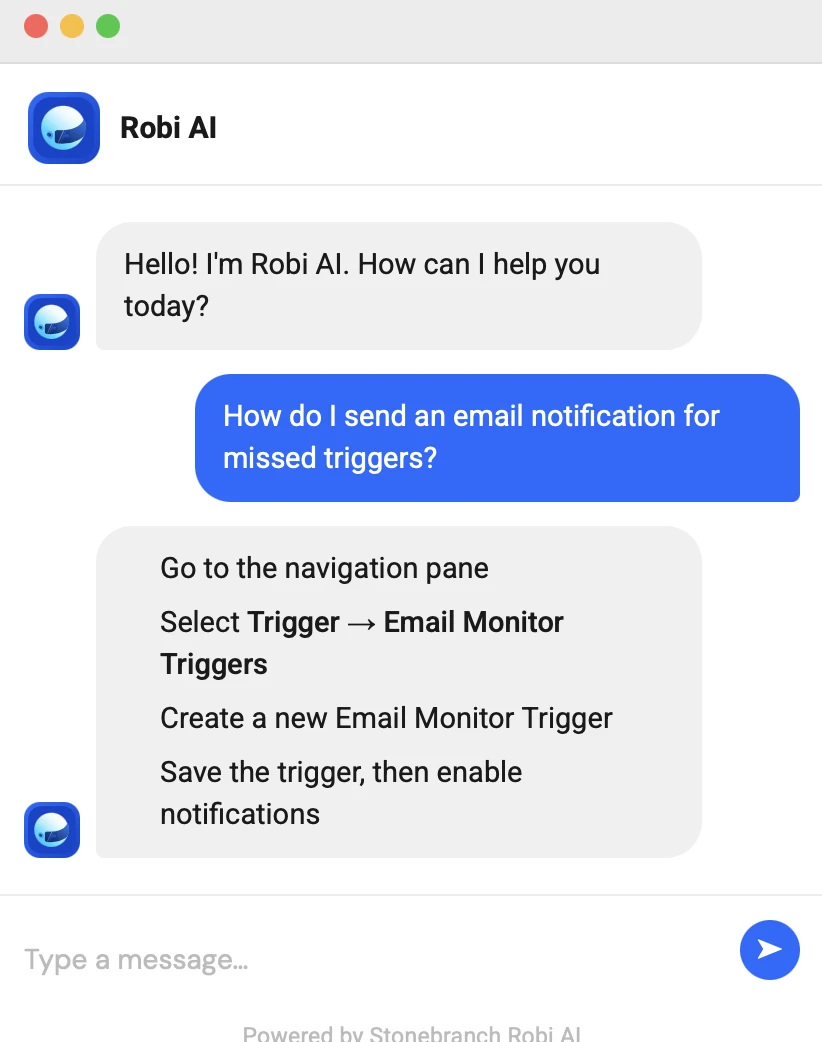
Figure 1: Stonebranch Robi AI
RunMyJobs by Redwood
RunMyJobs is a SaaS tool that integrates with SAP, Oracle, and hybrid environments to manage dependencies, balance workloads, and coordinate cross-system job execution. Its AI capabilities include:
- RangerAI agentic layer: Embeds an agentic AI layer throughout the lifecycle, featuring:
- A support assistant and automation Co-pilot for instant troubleshooting, natural-language script generation, and technical configuration guidance (e.g., K8s/OpenVMS).
- Multi-agent orchestration to assign high-level goals (such as “Prepare financial month-end”) by planning and delegating tasks.
- Autonomous self-healing which analyzes error logs to interpret failures and execute comprehensive remediation plans without human intervention.
- Metadata-driven automation: Applies a metadata-based architecture that adjusts workflows according to system states, dependencies, and context, enabling adaptive orchestration over static scheduling.
- MFT-integrated orchestration (via JSCAPE): Incorporates managed file transfer with event-driven triggers (e.g., file arrivals) to autonomously control workflows without needing external MFT tools.
Learn more about RunMyJobs features, advantages, and disadvantages.
ActiveBatch
ActiveBatch is a workload automation tool designed to scale cloud and virtual resources. It boasts a Super REST API adapter that auto-discovers API requirements to link ActiveBatch to virtually any SaaS or cloud service (like ServiceNow or Snowflake) without the need for custom code. The AI capabilities of ActiveBatch include:
- Heuristic queue allocation (HQA): Analyzes historical data to forecast optimal resource allocation, distributing job loads effectively among execution agents and minimizing slack time.
- Low-code automation design: Features a visual workflow builder with a Jobs Library for drag-and-drop automation logic, enabling users to create complex workflows with minimal scripting.
- Event and constraint-based scheduling: Utilizes constraint-based scheduling to guarantee that jobs run when specific environmental conditions (such as disk space or database availability) are met, reducing failure risks.
Explore more about ActiveBatch capabilities and use cases.
BMC Control-M
BMC Control-M’s notable AI use cases encompass:
- Jett (GenAI advisor): A conversational assistant that provides contextual guidance for workflow troubleshooting and produces automated operational insights for performance optimization.
- AI workflow creator: An intent-driven tool that leverages natural language to rapidly compile complete workflow structures, suggesting job types and dependencies to expedite delivery.
- Orchestration of AI agents: Control-M can integrate with frameworks such as CrewAI and LangGraph to govern AI agents and AI-powered tasks as production-ready assets.
- Agentic governance and compliance: Incorporates granular access controls for AI features and maintains comprehensive audit trails for all actions triggered by AI agents to ensure secure execution.
HCL Universal Orchestrator
HCL UnO (previously Workload Automation) is a cloud-native SaaS solution that offers adaptive workflow execution through context-aware triggers and AI-driven decision-making. Its primary AI use cases include:
- UnO AI pilot: A generative front-end transforming plain language prompts into technical workflow templates, minimizing the need for manual scripting and complex configurations.
- Agentic AI builder: A low-code environment to create autonomous agents that utilize GenAI and logic to perceive system context and make real-time decisions across distributed applications.
- Autonomous decision-making: UnO empowers agents to manage exceptions, optimize quote-to-cash processes, or handle financial close tasks through intelligent decision-making.
Intelligent RPA
RPA tools leverage computer vision and machine learning to automate tasks on legacy interfaces and web applications lacking API access.
AutomationEdge
AutomationEdge is an automation platform embedded with AI for front-end execution of workflows.
- Self-healing bot operations: If a bot fails, an LLM evaluates the error and re-routes the path to complete the task.
- Cognitive decision-making: Employs machine learning models to determine next steps in structured tasks based on incoming data patterns.
- Smart document processing: Integrates built-in OCR and ML to extract structured data from unstructured documents for automated workflow triggers.
MS Power Automate
Microsoft Power Automate is a low-code platform equipped with a Copilot interface and other agentic features.
- Copilot for Power Automate: Enables users to construct, describe, and refine complex workflows using natural language, handling AI Codegen to write expressions and scripting logic without requiring technical expertise.
- Agentic self-healing flows: Instead of failing due to UI changes, the AI component re-evaluates the path, utilizing computer vision and LLM reasoning to identify shifts and automatically correct flow execution in real-time.
- AI desktop agents: Progressing beyond simple “bots,” these agents can manage unstructured tasks, such as interpreting a disorganized email.
Robocorp (Semafor)
Robocorp is a Python-native automation platform featuring an agent-based execution model that integrates machine learning libraries directly into workflows.
- Agentic browser control: Optimized for web agents operating within dynamic, JavaScript-heavy environments for data extraction or task execution.
- Cloud-native scaling: Facilitates orchestration for parallel execution of multiple agents without per-bot licensing constraints.
UiPath
UiPath operates as an enterprise automation platform that supports multi-agent coordination, contextual reasoning, and adaptive task execution across front-end interfaces, featuring:
- Autopilot: An agentic layer capable of planning, decision-making, and tool utilization. For instance, it can assess a messy invoice, strategize data entry steps, and act by interacting with a legacy ERP.
- Agentic orchestration: One agent might identify a supply chain delay, another calculates re-routing, while a third updates the inventory—all overseen by a human-in-the-loop approach.
- Clipboard AI: Utilizes LLMs to extract context from one screen (like an unorganized email) and logically transfer it to another (for instance, an SAP field) without predetermined rules.
Data Orchestration
Data orchestration tools manage data movement and transformation through AI, enhancing quality control, schema detection, and pipeline generation.
Airbyte
Airbyte utilizes AI to detect and adapt to modifications in source data structures, thereby preventing pipeline failures during updates. Its application of AI encompasses:
- AI connector generation: Uses LLMs to create custom data connectors by analyzing API documentation for specific sources.
- Vector database destinations: Offers specialized destinations (e.g., Pinecone, Weaviate) to support RAG-based AI application pipelines.
Dagster
Dagster coordinates AI pipelines by leveraging GenAI. For example, it can monitor data asset states by checking numerous table transformations and analyzing the business implications of data flow. Other significant AI applications for workflow orchestration include:
- ML integration: Manages the lifecycle of an AI model by triggering “retraining” agents whenever performance declines.
- Data quality guardrails: Implements automated checks that pause pipelines if AI detects anomalies in data schemas or distributions.
dbt Cloud
dbt Cloud can integrate with MCP-based agent frameworks to coordinate both external and internal AI agents. Specific dbt agents include:
- Developer agent: Validates SQL generation against the dbt Fusion engine and verifies dependencies before execution.
- Analyst agent: Deploys the Semantic Layer to accurately respond to natural language inquiries using appropriate SQL, ensuring business definitions for metrics like Revenue or Churn are applied.
- Observability agent: autonomously monitors pipelines, identifies root causes of failures, and recommends (or enforces) fixes.
Prefect
Prefect showcases a GenAI interface called Prefect Control, allowing engineers to inquire about the status of the entire orchestration layer. For instance, when a user asks, “What caused the 3 AM delay?”, the AI synthesizes logs and lineage to provide an informative response. Additional AI features of the tool include:
- Autonomous error handling: Evaluates specific exceptions. If it’s a transient API error, it reroutes the task; if it’s a schema drift, it suspends the flow and alerts the user with a GenAI-suggested code fix.
- Task-level hybrid orchestration: Permits “Agentic Nodes” within a pipeline, allowing a workflow to pause at a designated step for an LLM agent to verify data quality before advancing to the data warehouse.
AI for Agent Orchestration
LLM Orchestration
LLM orchestration frameworks act as the “reasoning engine” within automation, coordinating multi-agent collaboration, sustaining memory, and enabling autonomous decision-making.
According to our agentic orchestration benchmark, performance is evaluated by balancing token efficiency (cost) against latency (speed):
- CrewAI: Rated less favorable for the tested travel planning task, utilizing over 6,500 tokens with a latency of 75 seconds.
- LangGraph: Achieved the best combination of latency and token usage, maintaining approximately 1,000 output tokens with a latency of about 25 seconds for end-to-end tasks.
- Microsoft AutoGen: Occupies a middle ground with moderate efficiency, using around 4,200 tokens with a latency of 40 seconds.
CrewAI
- Fault-tolerant reasoning: CrewAI utilizes multiple decision events post-tool failures, ensuring result completeness, albeit at the expense of higher latency.
- Role-based autonomous delegation: Automatically assigns sub-tasks to specialized agents (e.g., Researcher, Manager) based on well-defined personas.
- Hierarchical task management: Facilitates sophisticated organizational structures wherein agents report to lead agents, mimicking corporate workflows.
LangGraph (by LangChain)
- Stateful cyclic orchestration: Unlike traditional linear chains, it allows agents to loop, backtrack, and iterate on tasks, crucial for autonomous error correction.
- Fine-grained control flow: Employs a graph-based architecture for predefined execution dependencies, thus mitigating redundant LLM calls and token waste.
- Multi-agent persistence: Retains long-term checkpoints of agent states, enabling human intervention without losing task progression.
Microsoft AutoGen
- Conversational multi-agent logic: Tailored for dynamic, non-linear reasoning in which specialized agents communicate to debug and resolve open-ended issues.
- Autonomous code execution: Capable of agents writing, testing, and running their own code securely for resolving data-heavy tasks.
- Scalable context handling: Able to synthesize outputs from various specialized agents (e.g., flight, weather, and activity agents) into a cohesive plan.
What is AI for Workflow Orchestration?
AI workflow orchestration marks a pivotal shift from conventional, rule-based automation toward dynamic, intelligent coordination. AI-driven systems can:
- Link disparate data sources, APIs, and services into a unified, cohesive layer that learns from feedback.
- Modify execution paths based on evolving conditions.
- Understand inputs that traditional systems are incapable of processing.
While the demand for smarter automation is high, the transition to enterprise-wide AI orchestration often encounters substantial challenges.
Disclaimers
We acknowledge that our list and categorization of tools present challenges due to several factors:
- Categorization overlap: Many platforms possess hybrid capabilities that span multiple functional categories.
- Variable AI implementation: The depth and application of AI features differ significantly across the tools mentioned.
- Universal integration: Our analysis assumes standard interoperability, as nearly all enterprise tools offer native integrations with major third-party ecosystems.
- Agentic AI maturity: The term “AI Agent” is often used loosely in industry literature, and features attributed to agentic or autonomous capabilities may not be fully matured or production-ready.
Further Reading
For additional insights, consider exploring:
Industry Analyst

Hazal Şimşek
Industry Analyst
Hazal is an industry analyst at AIMultiple, specializing in process mining and IT automation.