As our world becomes increasingly digital, the way we learn about food and nutrition is evolving. Gone are the days when knowledge was primarily confined to lecture halls and health facilities. Today, information about nutrition is available at our fingertips through our phones. With just a scroll, a swipe, or a quick video clip, our attitudes and choices regarding food can be influenced. While access to nutritional information is easier than ever, this convenience does not always ensure that the content is credible.
As nutrition and dietetics professionals, it is crucial for us to take a moment to reflect on the authenticity of the information people are engaging with. Recently, I supervised an undergraduate research project that investigated this very concern. The findings are significant and relevant not only for those in academia but for anyone seeking to make informed choices regarding their diet and health.
In Ghana, just like in many parts of the globe, social media has emerged as a primary source of health and nutrition information, particularly among young adults. Unfortunately, much of this information is often unverified, oversimplified, or completely misleading. This reliance on potentially unreliable data is particularly alarming, as individuals readily act upon it.
What We Did
Alongside my student Gerald, we sought to answer an essential question: how reliable is the nutrition information that university students are exposed to on social media? To investigate this, we conducted a cross-sectional online survey targeting 200 undergraduate students at the University of Ghana. Participants were asked to share a nutrition message they had encountered, disclose its source, and indicate whether they had acted or intended to act on it. A pivotal aspect of our study was how we evaluated the quality of this information.
The Tool We Used
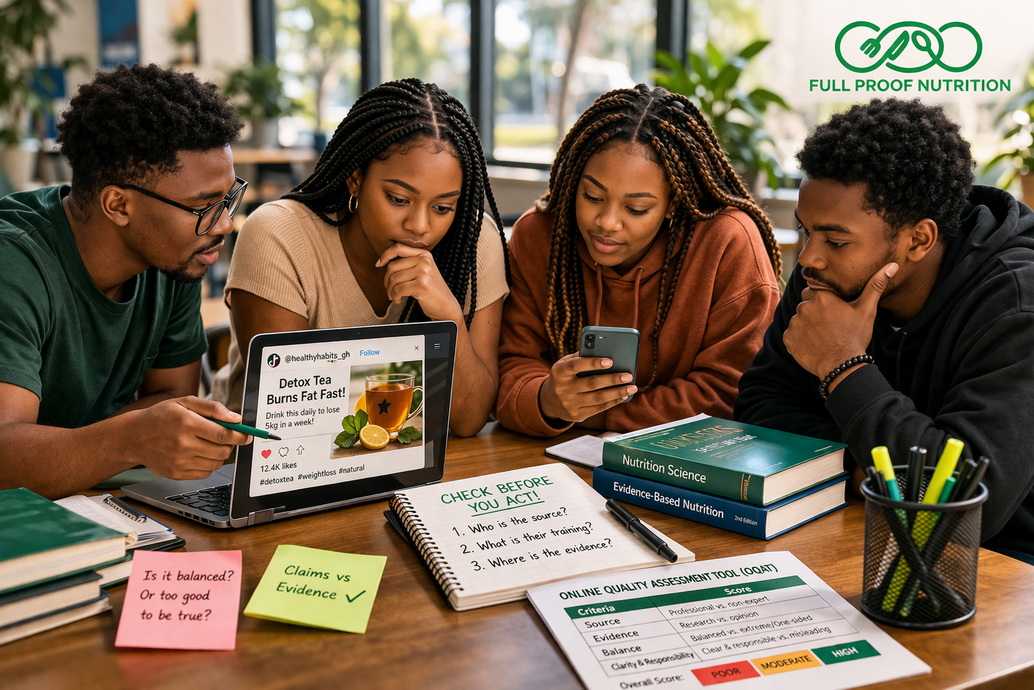
To assess the nutritional messages, we employed the Online Quality Assessment Tool (OQAT), developed and validated by Ellis et al. This tool is particularly valuable as one of the main challenges concerning misinformation is people’s inability to critically evaluate the information they consume. OQAT prompts users to consider several key questions:
- Who is the source? Is the information provided by a qualified professional or just an anonymous individual online?
- Is there evidence? Are the claims supported by research, or are they based solely on opinions and personal anecdotes?
- Is it balanced? Does it provide a fair perspective, or is it based on extreme, one-sided statements like “completely avoid this” or “this cures every disease”?
- Is it clear and responsible? Or does it contain misleading, exaggerated, or fear-inducing content?
Each message was then assessed and categorized as poor, moderate, or high quality. The utility of this tool lies not only in its research application but also in fostering critical thinking skills, which are essential for the public when engaging with online nutrition information.
What We Found
While some findings were unsurprising, they still warrant thoughtful consideration:
- Social media is a significant source of nutrition information: Nearly half of the students (49%) reported receiving nutrition-related messages online, with TikTok being the predominant platform (35%). This underscores the popularity of short, fast-paced, and engaging content that often lacks filtering.
- Students are acting on this information: Alarmingly, 57% of students indicated that they had acted on or planned to act on the information they received, revealing the active role social media nutrition information plays in shaping their food choices and health behaviors.
- A considerable amount of online nutrition information is of low quality: According to the OQAT assessment, 37% of messages were rated as poor quality, while only 31% were classified as high quality. This indicates that much of what students encounter—and potentially act upon—is unreliable.
- Personal relevance drives action more than information quality: Notably, factors such as age and gender did not significantly impact whether students acted on the information. However, a correlation was found with Body Mass Index (BMI), suggesting that individuals may be more inclined to respond to messages linked to personal health concerns, especially weight, thereby increasing their susceptibility to misinformation.
What This Means
The results of this study highlight a broader change in how nutrition knowledge is acquired among youth in Ghana, and possibly older demographics as well. Information is increasingly shifting from trained professionals to influencers, peers, and algorithm-driven platforms, often lacking in quality control. Over time, persistent exposure to misinformation begins to shape choices related to diet, body image, health approaches, and ultimately, disease risk. This issue cannot be ignored.
So, What Do We Need to Do?
First, educators, public health institutions, and media platforms must lead efforts to help individuals critically assess the information they see, hear, and read. Not everything that appears credible is supported by solid evidence. Simple checks regarding the source, qualifications, and supporting evidence should be consistently promoted.
Second, nutrition and dietetic professionals, along with health practitioners, need to be more visible and proactive in public spaces, particularly on social media. In the absence of credible voices, misinformation proliferates.
Third, those of us producing and sharing evidence-based nutrition information—academics, clinicians, and health communicators—should prioritize clarity and accessibility. Misinformation often spreads because it is simplified and visually appealing; we must strive to provide clarity without sacrificing accuracy.
Finally, policy makers, educators, and public health programs must recognize digital nutrition literacy as essential. This skill should be integrated into curricula and community education, as evaluating online information has become a fundamental life skill, akin to reading and comprehending food labels.
In closing, I would like to acknowledge my student, Gerald Quartey, for his thoughtful contributions and dedication to this project. Research requires patience, curiosity, and discipline, qualities he exemplified commendably. I look forward to seeing the manuscript draft for publication!
Written by Dr. Laurene Boateng (PhD, RD)
Dr. Laurene Boateng is a Registered Dietitian and Senior Lecturer in the Department of Dietetics, University of Ghana. She founded and serves as the editor-in-chief of Full Proof Nutrition, a consultancy dedicated to delivering reliable, evidence-based, and practical healthy eating advice. Visit the website www.fullproofnutrition.com for more. Join our WhatsApp channel for educational content by clicking here, or reach us at fullproofnutrition@gmail.com. My book on healthy eating is available now on Selar (Buy HEALTHY EATING MADE SIMPLE by Laurene Boateng on Selar) and Amazon (https://amzn.eu/d/6i9OeVb).
References
Ellis, C. H., Moore, J. B., Ho, P., & Evans, C. E. (2023). Development and validation of a quality assessment tool to assess online nutrition information. Digital Health, 9, 20552076231187249.
Quartey, G.N.K. (2025). Assessing the quality of nutrition and health information disseminated via social media among University of Ghana undergraduate students. Undergraduate dissertation, University of Ghana.
DISCLAIMER: The Views, Comments, Opinions, Contributions and Statements made by Readers and Contributors on this platform do not necessarily represent the views or policy of Multimedia Group Limited.