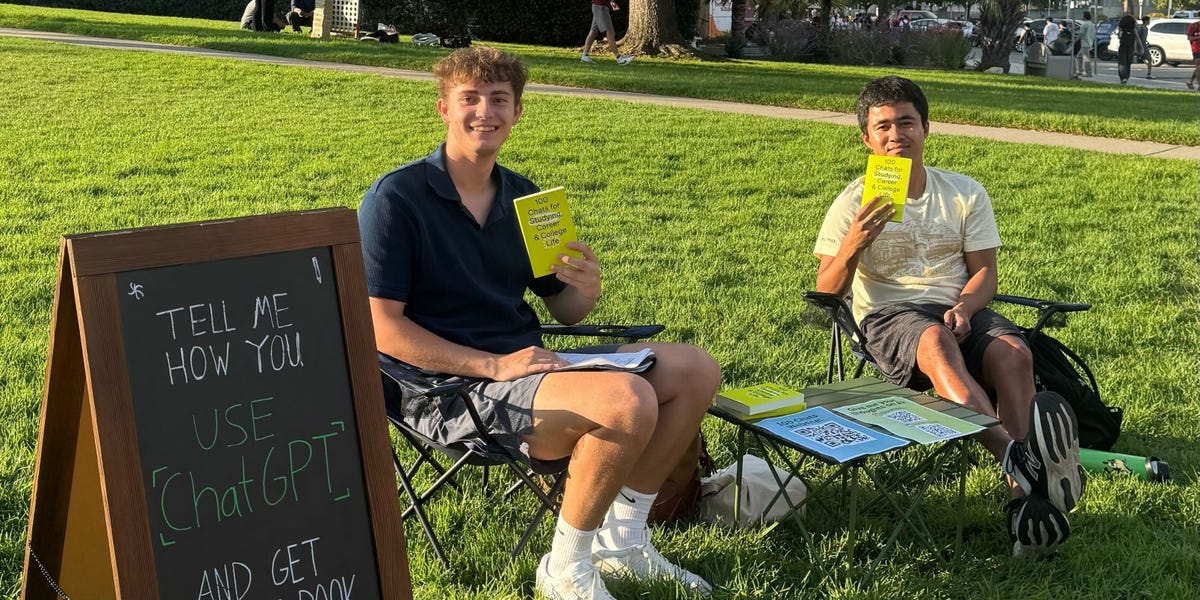
In an unexpected turn of events, Parker Jones, a software engineering student at Cal Poly, finds himself at odds with his professors. Rather than merely absorbing lessons, he is pushing back against the traditional academic framework.
After conducting interviews with over 50 peers regarding their use of AI tools like ChatGPT, Jones concluded that students are evolving faster than the faculty intended to guide them.
This observation starkly contrasts with the predominant narrative perpetuated by academic institutions and, in many cases, the professors themselves.
While the media often fixates on issues like cheating, Jones discovered that the majority of students utilize AI in more practical and mundane ways. For instance, they treat it as a “24/7 office hours” assistant, asking questions for clarification, organizing assignments, and enhancing their thought processes. This usage is less about shortcuts and more about sustaining their learning momentum, a point he elaborates on in a recent post on OpenAI’s ChatGPT for Education blog.
Despite the normalization of these practices, many professors remain hesitant, reticent, or express outright skepticism, notes Jones, who previously participated in OpenAI’s student lab program designed to help undergraduates explore their engagement with ChatGPT.
“The most common reaction is avoidance,” he shared in a recent interview.
When AI does come up in discussions, it is often viewed through a negative lens. This disconnect creates a peculiar scenario wherein students rely on tools they feel compelled to keep secret, he explained.
Jones believes that institutional inertia poses a greater challenge than AI misuse. He anticipated that computer science educators would champion the cause but instead found many waiting for more clear directives or additional research before incorporating AI into their curriculums.
“There’s an inclination in academic circles to delay and perfect things, which is often well intentioned,” he explained. “However, this tendency risks missing critical opportunities.”
Cal Poly Responds
In response, Cal Poly spokesperson Matt Lazier highlighted that the university offers a concentration in AI and machine learning as part of its computer science and software engineering curriculum, bolstered by initiatives from the Noyce School of Applied Computing.
Upcoming projects include an Nvidia-powered Advanced AI Factory, along with a new bachelor’s program in data science launching in Fall 2027. Events like PolyPrompt also emphasize practical AI learning experiences.
According to Lazier, AI is also being integrated across various disciplines, co-curricular programs, and other initiatives, giving students a comprehensive and hands-on understanding of AI technologies, ethical considerations, and real-world applications.
The California State University system, which encompasses Cal Poly, has also initiated an AI strategy that includes educational versions of ChatGPT, grants for faculty, training opportunities, and partnerships with industry.
Student Concerns About AI
Jones’s concerns were echoed in a recent conversation with Kiran Maya Sheikh, who graduated from UC Irvine with a degree in computer science in June 2025. She expressed that while she learned various programming languages and software development skills, AI tools did not feature in her studies.
Other recent graduates have also shared their unique challenges in navigating the technology job market, including how AI is reshaping workplaces.
“Graduating just before the AI boom made me feel somewhat underprepared,” Sheikh stated.
With limited formal curricular support, many students have taken it upon themselves to learn and share knowledge about new AI tools, Jones remarked. He recounted how he introduced AI coding tools like OpenAI’s Codex to his classmates during a senior project, significantly enhancing their outputs.
This grassroots approach is emerging across campuses, primarily occurring without formal guidance, he added.
Jones is not advocating for the abandonment of foundational principles or an uncritical embrace of AI. Many students he spoke with are wary of becoming overly reliant on these technologies. However, he believes it’s essential for universities to acknowledge the reality that students are already actively engaging with and experimenting with these tools.
His straightforward message to educators is to catch up or at least engage in the conversation. At present, students are navigating one of the most significant technological transformations in education largely without institutional support.
For more insights, sign up for BI’s Tech Memo newsletter here. For inquiries, reach out via email at abarr@businessinsider.com.