
This month commemorates the 250th anniversary of Adam Smith‘s seminal work, The Wealth of Nations. Published in a 950-page print edition by Liberty Fund, this text is filled with enlightening insights that have significantly shaped economic thought. Despite its imperfections, The Wealth of Nations is rightfully celebrated as a groundbreaking contribution to our understanding of economics and society.
As a trade economist, my attention is particularly drawn to Book IV, Of Systems of Political Œconomy, where Smith adeptly critiques mercantilism and protectionist policies. At the conclusion of Book IV, he asserts:
“All systems either of preference or of restraint, therefore, being thus completely taken away, the obvious and simple system of natural liberty establishes itself of its own accord. Every man, as long as he does not violate the laws of justice, is left perfectly free to pursue his own interest his own way, and to bring both his industry and capital into competition with those of any other man, or order of man. The sovereign is completely discharged from a duty…of superintending the industry of private people, and of directing it towards the employments most suitable to the interest of the society” (pg 687).
Smith was a strong advocate for free trade, opposing tariffs aimed at disrupting the natural flow of commerce. While he acknowledged that revenue tariffs were somewhat less objectionable, he provided room for exceptions. These exceptions are discussed in pages 463–471 of his work, and you can find more on this topic in my piece, “Would Adam Smith Have Supported the Jones Act?,” as well as in Don Boudreaux’s book, Globalization. He suggests that temporary tariffs may be justifiable in cases where retaliation could lead to the removal of another country’s high trade barriers:
“There may be good policy in retaliations of this kind, when there is a probability that they will procure the repeal of the high duties or prohibitions complained of. The recovery of a great foreign market will generally more than compensate the transitory inconveniency of paying dearer during a short time for some sorts of goods” (pg 468).
However, if there is little chance for such repeal, Smith argues that maintaining a tariff-free system is preferred (ibid). Engaging in negotiations is often problematic, as they tend to be influenced by the unpredictable nature of political interests. Smith aptly illustrates this by calling out “that insidious and crafty animal, vulgarly called a statesman or politician, whose councils are directed by the momentary fluctuations of affairs” (ibid). Factors such as global dynamics and individual motivations can heavily impact tariff negotiations.
The argument Smith presents is known as the “Crowbar Theory” or “Aggressive Unilateralism.” Under specific circumstances, this theory posits that if Country A is large enough, it can impose tariffs on Country B, which would improve A’s trade terms with B. Conversely, since B’s terms with A are reciprocal, A’s gain may lead to B’s loss. B, to avoid becoming worse off, would then be motivated to negotiate. However, most trade economists consider this theory impractical because political self-interest often overshadows economic principles, leading to miscalibrated tariffs and retaliatory actions. It is generally advisable to keep tariffs low and address issues directly, rather than relying on disruptive tariffs.
Historically, the efficacy of aggressive unilateralism has been inconsistent. While it has occasionally succeeded in opening markets, more often it has led to trade wars or even military conflicts. Smith references the France-Dutch conflict of the 1670s as a cautionary tale of aggressive unilateralism failing. A more recent example is the Franco-Italian Tariff War from 1887 to 1898, which resulted from Italy’s unsuccessful attempt to use tariffs to pressure France into market concessions, ending in economic turmoil for Italy.
In contrast, Franklin Delano Roosevelt managed to successfully employ aggressive unilateralism to defuse the tensions from the Smoot-Hawley Tariffs. The measures taken in the late 1930s catalyzed a revival of free trade and laid the groundwork for numerous free trade agreements in the latter half of the 20th century.
Why did Roosevelt succeed where others stumbled? The key lies in the institutional framework guiding the negotiations. I propose in an upcoming working paper that the effectiveness of aggressive unilateralism is contingent on the institutions governing these discussions. How do these institutions channel the skills of those “insidious and crafty” politicians to ensure adherence to liberal economic principles rather than yielding to temporary political pressures?
To illustrate this concept, consider the game theory perspective of trade negotiations, which can be modeled as a prisoner’s dilemma. In this scenario, two negotiators face a choice: to cooperate (lower tariffs) or defect (raise tariffs). The simplified visual representation below depicts this situation:
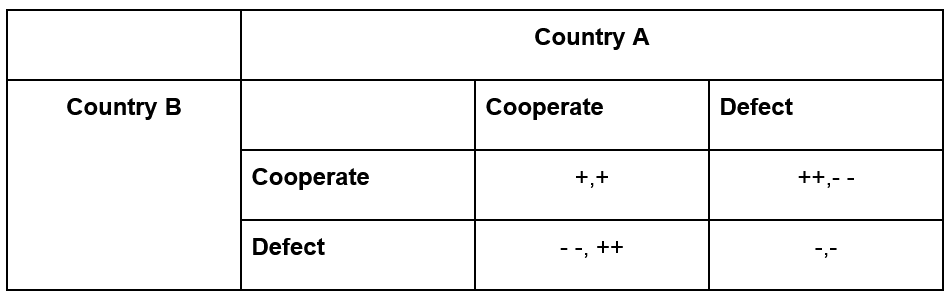
If both countries choose to cooperate, the result is mutually beneficial (+,+) through lower tariffs. Conversely, if Country A defects while Country B cooperates, A gains substantially (++) while B suffers (–), and the reverse occurs if B defects. In the event that both countries choose to defect, a trade war ensues, resulting in a negative outcome for both parties.
According to the theory of the prisoner’s dilemma, self-interested individuals will always opt to defect, resulting in a stable but sub-optimal situation for both parties involved.
Proponents of aggressive unilateralism leverage the prisoner’s dilemma framework to advocate for tariffs, arguing that cooperation should yield the best outcome. They suggest that negotiations can facilitate cooperation, possibly through binding agreements.
However, this argument falters under the practical application of aggressive unilateralism. The first move to defect means Country A has already signaled its unwillingness to cooperate. Country B is then faced with a tough choice: rely on A’s goodwill to cooperate or defect preemptively. If B doubts A’s commitment, retaliation seems the most logical choice, leading to an inevitable trade war.
Yet, if B receives a credible commitment to de-escalate from A, the scenario shifts, motivating both parties to cooperate. Such a credible commitment arises from the institutional context in which A operates.
In 1933, representatives from 66 nations convened in London to discuss mitigating the trade war. Their efforts yielded no agreements. However, by 1934, FDR was rapidly forging 19 trade deals. What changed within that year? The institutional environment guiding FDR’s actions.
In 1934, Congress enacted the Reciprocal Trade Agreements Act (RTAA). Prior to this, tariffs were managed solely as tax policy driven by Congress, making them susceptible to political pressures. Tariffs as tools for market access were treated as treaties requiring a two-thirds Senate approval, which complicated negotiations and often led to failure. The RTAA shifted the authority to the President, allowing for executive agreements that required only a simple majority in Congress, significantly streamlining the process and diminishing the influence of special interests. This new framework fostered a credible commitment to de-escalation.
Smith’s concerns about free trade were well-founded, as political self-interest often complicates trade negotiations. However, as illustrated by the 1934 institutional changes, the right framework can significantly alter those dynamics.
Further Reading:
- Clashing Over Commerce by Douglas Irwin
- “Trade Wars: A Comparative Study of Angle-Hanse, Franco-Italian, and Hawley-Smoot Conflicts” by John Conybeare. World Politics, 38(1) 1985, pp147–172.
- “The Institutional Roots of American Trade Policy: Politics, Coalitions, and International Trade” by Michael A. Bailey, Judith Goldstein, and Barry R. Weingast. World Politics, 49(3) 1997, pp. 309–338.
