Before the rise of generative AI, writing assistants were already gaining traction as popular tools for reviewing human-created content and suggesting meaningful improvements in grammar and style. With the emergence of generative AI, these writing assistants have evolved, now boasting advanced features designed to enhance and optimize the writing process.
One particularly transformative feature is voice mimicry. This function analyzes extensive text samples to generate new content that mirrors the vocabulary, syntax, style, and rhythm of the texts from which it learned.
While this capability offers undeniable advantages, it raises critical questions: Is such precise imitation ethical, and does it yield long-term benefits?
Why Voice Mimicry Matters in AI Writing Assistants
Long before the introduction of ChatGPT in late 2022, innovations were already in the pipeline aimed at mimicking human vocal patterns for virtual assistants (Scientific American). In the landscape of written communication, voice mimicry is emerging as a key feature that distinguishes AI writing tools. This allows software to replicate the tone, style, or writing voice that often represents a company’s brand identity or a unique author style.
This is crucial because writing encapsulates more than just factual accuracy; it embodies identity.
On a larger scale, businesses depend on consistent messaging to establish trust with their audiences and convert leads into customers. On an individual level, writers strive for authenticity rather than generic expressions to better connect with their audience and cultivate their personal brands. While AI writing assistants have made significant strides in improving grammar, clarity, and efficiency, a lack of tonal alignment risks generating content that feels impersonal or formulaic.
Voice mimicry effectively bridges this gap, enabling teams to scale content production while preserving their distinct personality and allowing individuals to maintain authenticity, even through automated methods. Its significance cannot be overstated; as highlighted by Education Week, mimicry presents both opportunities and challenges in writing contexts (Education Week). Fortunately, G2 Data offers valuable insights into this topic.
What Does G2 Data Reveal About Voice Mimicry in AI Writing Assistants?
According to review data from G2, features for voice mimicry are present in various AI writing assistants, albeit at different maturity levels. Despite the absence of standardization, of the 5,000 unique buyer reviews for these products, around 10% referenced voice mimicry features, with a majority offering positive feedback—7% of all reviews praised this capability. While this percentage might seem small, it is significant given the novelty and variability of the feature across platforms.
This suggests that users are not only recognizing voice mimicry but actively seeking it out, investing in it, and sharing their positive experiences with others.
At the forefront of this innovation, tools like Jasper analyze and replicate individual writing styles. G2 reviewers have noted that “Jasper can mimic my voice once I write,” emphasizing its personalized capabilities. However, many tools tend to prioritize brand voice instead of individual nuances. For instance, Grammarly is frequently commended for helping teams “ensure consistency… with built-in style guides and tone settings,” facilitating brand adherence and reworking content authored by various team members.
Other writing assistants, such as Junia AI and GravityWrite, boast similar voice mimicry features, including functions for “brand voice” or “tone adaptation.” Due to their underlying programming, these tools often rely on predefined rules, templates, or guidelines rather than learning from real-world writing samples. Consequently, they produce content poised to meet predetermined standards and align with established brand messaging. This feature becomes particularly essential for brands requiring pre-approved communications across different channels.
What Buyers Appreciate About Voice Mimicry
The primary reason buyers value voice mimicry is its ability to ensure messaging consistency. This foundational aspect enhances the additional advantages associated with this feature.
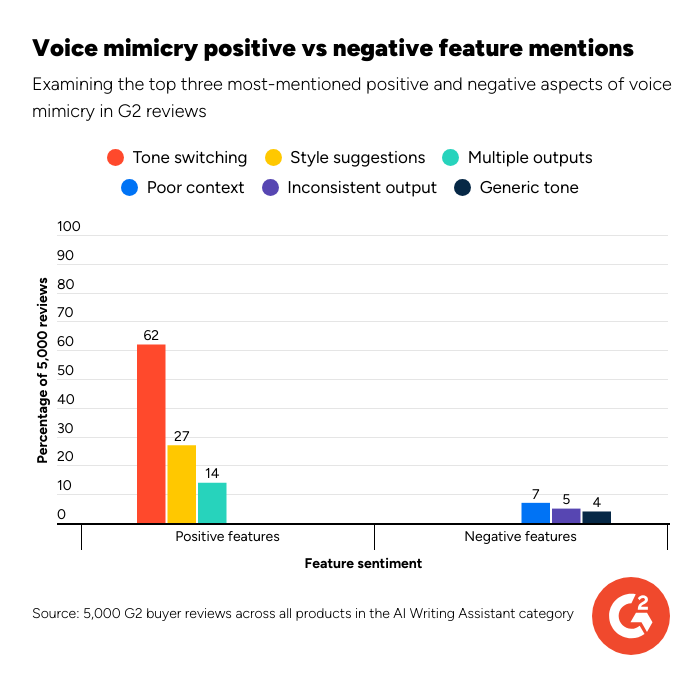
Data from the analyzed reviews indicates that 62% of positive mentions of voice mimicry highlight tone control, which plays a crucial role in messaging consistency and scalable personalization. This means a single communication can resonate differently with various audiences, each receiving a version of the message tailored to their needs. The AI writing assistant is designed to convey the same concept while adjusting its tone accordingly for each specific group.
Challenges Buyers Encounter
The first notable criticism, present in 7% of negative reviews mentioning voice mimicry, conveys that despite technological advancements, outputs sometimes lack contextual relevance and fail to accurately adopt a mimicked tone for the user’s or brand’s voice. Additionally, 5% of these negative reviews cite inconsistency in output quality, while 4% complain that the AI-generated content can come across as generic or robotic.
A significant barrier to widespread adoption of AI writing assistants with voice mimicry capabilities is the setup and training process involved. Users often need to provide writing samples to train the AI models, with better results typically requiring a larger volume of samples. Even if the AI doesn’t learn directly from the provided materials and instead follows predetermined guidelines, ensuring accurate adoption of brand messaging will necessitate ongoing review, adjustments, and training to ensure long-term effectiveness—particularly when specialized industry terms, humor, and intricate brand identities are involved.
In addition to these technical concerns, ethical dilemmas related to “authenticity” surface in discussions regarding brand personas. The debates surrounding AI-generated voices reflect growing public apprehension about consent and ownership of an individual’s established writing style.
Implications for AI Writing Assistant Buyers
With this information in mind, prospective buyers should consider several factors when evaluating the utility of AI writing assistants featuring voice mimicry capabilities.
- Voice mimicry technology is still evolving. Buyers should approach this feature with a mindset geared toward experimentation, weighing the two primary methods of integration: training with materials or adhering to pre-defined programming.
- Define specific objectives. For basic content generation, tone controls may suffice. If maintaining brand consistency across teams is the objective, prioritize tools equipped with style guides and brand voice features. Conversely, if producing personalized, human-like output is the priority, seek platforms capable of learning and adapting from writing samples over time.
- AI writing assistants serve as collaborative tools, not replacements for human creativity. Although these tools offer tremendous capabilities, they require proper training, refinement, and oversight. Given the importance of writer or brand voice for effective public relations and audience engagement, these tasks should be handled by individuals who can be accountable for the content produced.
The potential is evident: as voice modeling technology progresses, AI writing assistants will be increasingly adept at producing content that sounds authentically human, often indistinguishable from the original voices and brands they emulate.
For further insights into AI writing assistants and to compare highly-rated products in the marketplace, visit the G2 Grid® for AI Writing Assistants and discover what users have to say.