Submitted by Hamilton Heights School Corporation
In a remarkable display of collaboration, Hamilton Heights administrators, educators, and legal partners joined forces to help high school student Alexander Weiland secure a provisional U.S. patent on March 6 for an innovative engineering tool he created as part of a classroom assignment.
This patent filing is a significant achievement for Weiland, who developed his project in the engineering class led by teacher Dave Post. The students were tasked with identifying a real-world issue, designing and testing a solution, refining their ideas through development iterations, and building a viable business case around their projects.
Weiland chose to explore a concept he had contemplated long before the assignment began. With encouragement from his teacher, he was able to channel that passion into his classroom work.
The outcome was an impressive demonstration of initiative, technical expertise, and determination. Weiland wrote extensive code, built comprehensive part-file libraries, and conducted thorough research to bring his idea to fruition. His final creation, the TraceAI Reverse Engineering Analysis Tool, utilizes artificial intelligence to significantly lower the time and cost involved in reverse-engineering printed circuit boards (PCBs).
- The Problem: Reverse-engineering a PCB typically demands 20 to 40 hours of manual tracing by engineers, making the process slow, costly, and reliant on specialized tools.
- The Solution: TraceAI enables users to upload a photo of any PCB, generating a schematic, component list, and netlist in mere minutes. No specialized hardware is needed, making the tool accessible and efficient for reproducing PCBs.
“My provisional patent is for an AI system that can reverse-engineer PCBs from images,” explained Alexander Weiland regarding his innovative tool. “Users simply take a picture of a circuit board, and the software automatically identifies the components, traces all connections, and produces a comprehensive schematic. The main innovations involve a pipeline that integrates multiple AI models for enhanced accuracy and an engine that recreates the circuit logic from the image alone.”
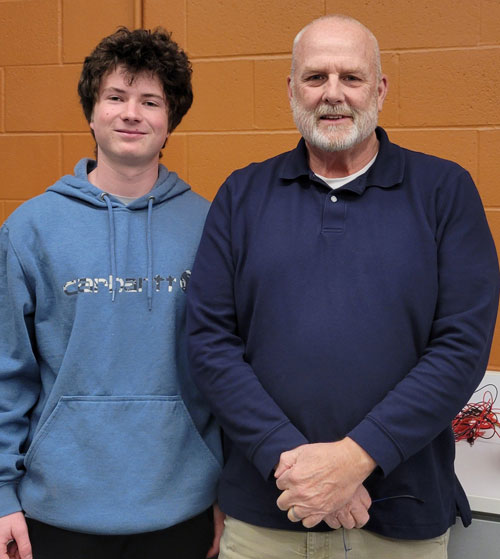
HHHS junior Alexander Weiland and engineering teacher Dave Post share a moment of pride as Alexander’s TraceAI project – developed in Post’s class – earns a provisional U.S. patent and advances to the STARTedUP Region 2 Finals at Purdue University. (Photo provided by Hamilton Heights School Corporation)
Weiland’s TraceAI project has progressed to the Region 2 Finals of the STARTedUP statewide entrepreneurship competition, scheduled at Purdue University on April 16.
The swift transition from concept to provisional patent was achieved through rapid collaboration. Legal counsel was first contacted on February 24, and within just two weeks, all necessary obstacles were overcome to enable Weiland to file the patent.
Looking to the future, Weiland expressed, “I want to transform my patent and idea into a technology startup. My aim is to create an integrated tool that can aid hobbyists, engineers, and businesses when they lack documentation, want to understand a product, or analyze a competitor’s offering. Currently, I’m focused on developing the AI training pipeline and gathering feedback from engineers. I plan to continue refining my idea and hope to launch a usable product within the next year or two.”
Reflecting on the learning journey that led to this achievement, he shared, “I have always been curious if I could bring this idea to life, so seeing it come together has been incredibly rewarding. I thrive on tackling challenging projects, especially during school time. My engineering teacher provided valuable feedback, and I completed much of the coding outside of class, which allowed me greater freedom to experiment.”
For Weiland, the most important lesson learned was that perfection is not a prerequisite for taking the first step.
“The patent process prompted me to consider what differentiates my idea, and this exploration actually helped to refine the concept,” he noted. “Creating something tangible from an idea is an enriching experience, and I would encourage anyone to try it.”
“I want to express my gratitude to patent attorneys Todd Coffeen and Joel Tragesser for their expertise,” he continued. “I also appreciate the support from my engineering teacher, David Post, and the Hamilton Heights Administration for facilitating my patent journey.”
Hamilton Heights celebrates Weiland’s remarkable achievement and expresses gratitude to the administrators, educators, and legal allies who made this milestone possible. This success highlights the power of student-centered learning and the incredible potential that unfolds when passion aligns with opportunity.