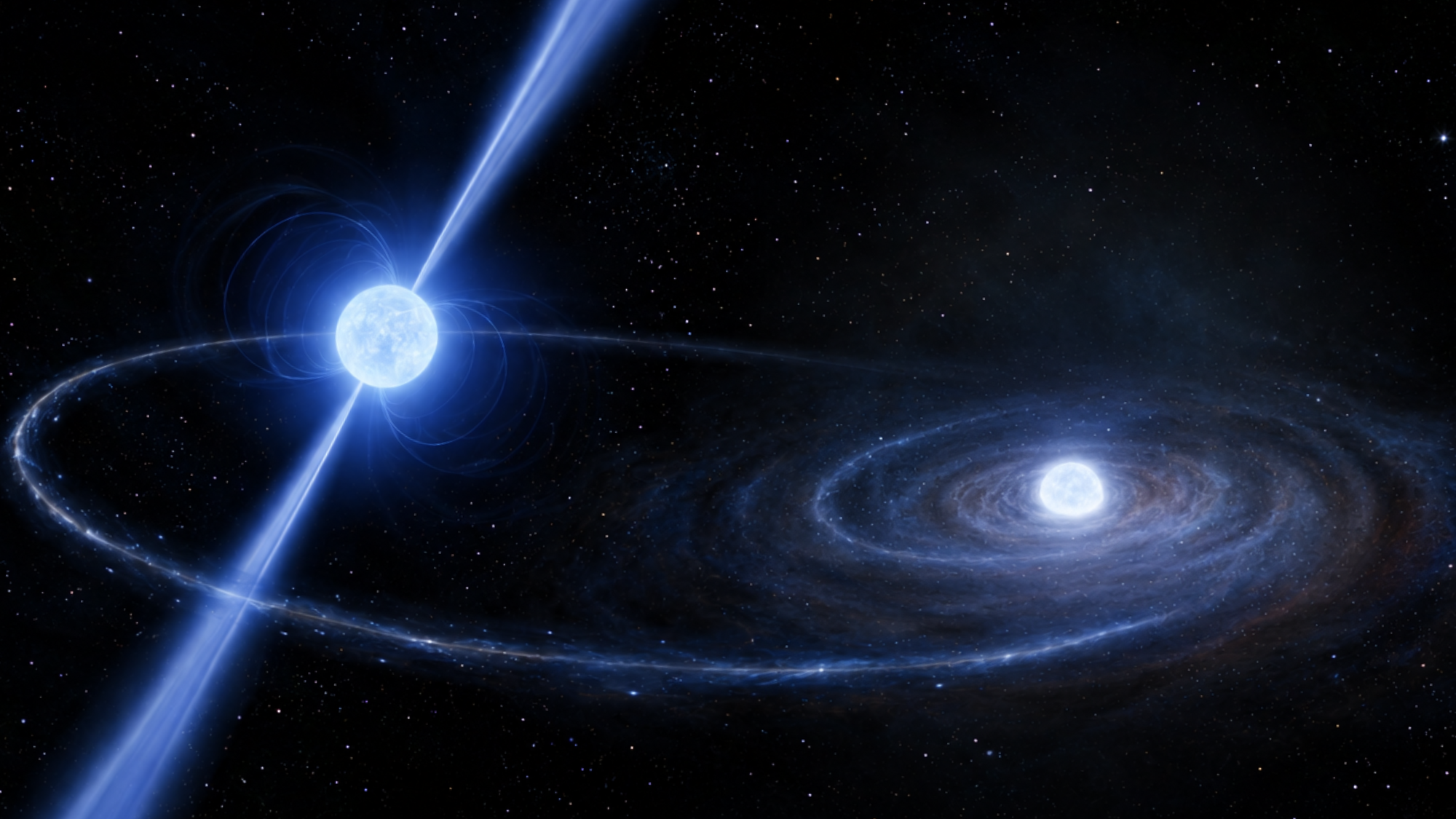
Astronomers have observed a rare evolutionary stage of a white dwarf, a remnant of a star like the sun, in a binary system known as NGC 362D. This system features a millisecond pulsar, a neutron star that emits intense beams of radiation as it spins rapidly. Discovered using the MeerKAT radio telescope in South Africa and assisted by archival data from the Hubble Space Telescope, this particular white dwarf is noted as the youngest ever observed in conjunction with a millisecond pulsar.
Notably, the white dwarf emits less ultraviolet radiation than expected, likely due to an envelope of ejected material that is blocking some of the light. This discovery highlights the system’s potential for studying stellar evolution, particularly what occurs following the transfer of stellar material from one star to another.
The millisecond pulsar was formed when a massive star exploded as a supernova, leaving behind a neutron star with extreme density. As it gathers material from its companion star, which eventually becomes a white dwarf, it can spin incredibly fast, a phenomenon referred to as “pulsar recycling.”
The findings from NGC 362D could provide insights into similar systems and their evolutionary stages, enhancing our understanding of stellar evolution and the nature of pulsars, which are valuable for testing theories like general relativity. The results have been published in the journal Astronomy & Astrophysics Letters.


