Introduction: The United States has been actively shaping its foreign policy in Latin America, particularly concerning nations like Venezuela and Argentina. Through a strategy of incentives and penalties, the U.S. aims to exert its influence and draw clear lines among regional governments. This article explores how these dynamics play out in practice and what they imply for the geopolitical landscape.
During a press conference following a meeting with Zelensky, a reporter inquired about Trump’s approach toward Venezuela, noting that Maduro had “offered everything.” Trump’s response was revealing: “Yes, he has offered everything, and you know why? Because he doesn’t want to mess with the United States.”
In contrast, the U.S. has committed $20 billion in credit to Argentina’s Milei and is considering an additional $20 billion. Moreover, the U.S. is actively purchasing Argentine bonds. It seems implausible that Argentina could stabilize with this aid or ever repay the funds, and it would be naive to assume Bessent and his team think otherwise. So, what explains this generosity?
The straightforward explanation is that the U.S. aims to establish a precedent with Argentina and Venezuela for the rest of Latin America. It appears that a reward-and-retribution approach is guiding the U.S. strategy in the region, as part of its effort to reclaim its “sphere of influence.” This strategy seems to be driven by Secretary of State Marco Rubio and Chief of Staff Stephen Miller, who are behind it.
According to The Wall Street Journal, the push against Maduro is central to a “Venn diagram of interest” among Trump’s top advisors. Meanwhile, Scott Bessent is leading Argentina’s bailout effort. Paul Krugman contends that this is to assist his wealthy friends; while this may hold some truth, a broader regional policy is also in play.
James Bosworth, whose insights are often valuable, though sometimes excessively Western-focused, created a satirical map illustrating a crucial reality: the Trump administration is compelling every government in the region to take a definitive stance.
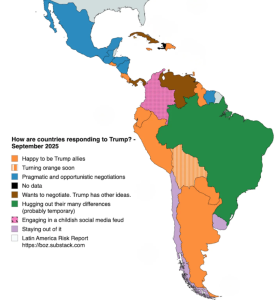
You are either with us, or you are against us. More accurately, you either align with U.S. interests, or the U.S. will impose its will upon you. A distinct pattern becomes evident as we examine the region. Since Trump’s administration began, Latin American politics—and sometimes its politicians—are transforming.
Mexico has been negotiating with Trump, particularly by limiting immigration and intensifying its anti-drug trafficking efforts. Additionally, Mexico has raised tariffs on Chinese imports, a significant concern for the U.S. Sheinbaum has been cautious not to provoke Trump and insists on working cooperatively with his administration. Thus, when Trump declared cartels to be terrorist organizations, I suggested it likely wasn’t aimed at Mexico.
Most of Central America generally aligns with U.S. objectives, except for Nicaragua, where Trump has largely ignored developments but threatens new tariffs due to “human rights abuses.” El Salvador and Panama deserve special mention as Bukele is a Trump favorite, gaining preferential treatment by aligning with his needs. Conversely, Panama was coerced into expelling China from its Canal ports under the threat of invasion and providing preferential access to U.S. military vessels.
The Caribbean is currently under strong U.S. military oversight, with illegal attacks against boats suspected of transporting drugs—allegations frequently lacking evidence. Notably, about 10% of drug trafficking occurs through the Caribbean, while 80% transpires in the Pacific. If Trump genuinely aimed to combat this issue, he must be looking in the wrong waters. However, the intention seems more focused on projecting “strength” and pressuring Venezuela and Colombia.
Beyond Venezuela and Colombia, Marco Rubio has ensured the U.S. maintains leverage against Cuba, designating it as a state sponsor of terrorism, imposing additional sanctions, and hindering assistance from other nations like Russia and China. The electricity shortages affecting the Cuban populace could be viewed as a consequence of this pressure. Additionally, the U.S. has been involved in Haiti, collaborating closely with the Dominican Republic’s president.
Noboa, who became Ecuador’s president in February, has already proposed a referendum to amend the constitution, permitting foreign military bases—namely, U.S. bases—in Ecuador. His election coincided with a severe security crisis that has plagued the country over the last seven years. Once viewed as one of Latin America’s most peaceful nations, Ecuador has experienced a swift descent into violence, prompting the rise of a Bukele-style administration.
Peru has recently replaced its widely unpopular president and is experiencing major protests. Last year, Peru inaugurated a deep-water port as part of the Chinese Belt and Road Initiative, developed by the Chinese state-owned company Cosco—this has not been well received by the U.S. Early next year, Peru will hold elections, and it is likely to elect a candidate who pledges to tackle violence akin to the approaches of Noboa and Bukele.
Chile is set to have elections in November 2025, likely resulting in a right-leaning president who would shift away from the current left-oriented leadership of Gabriel Boric. Bolivia has just elected its new president, Rodrigo Paz, who has pledged “capitalism for all” and aims to restore relations with the U.S. while supporting Venezuela’s regime-change leader, Corina Machado.
This rapid survey suggests that Latin America is moving away from the “Pink Tide” that characterized the region at the end of the last century, in favor of an “Orange (Trump) Tide.” This transition might not be purely coincidental, especially when considered alongside the rise of a more authoritarian governance style in the U.S., a notable decline in hegemony, and the revival of the concept of spheres of influence. This observation is particularly relevant given the CIA’s historical—and ongoing—activities in the continent.
Three nations most resistant to U.S. interference are Brazil, Colombia, and Venezuela. Brazil has been at odds with the U.S. since at least August 2024, when a Brazilian judge restricted X due to Musk’s noncompliance with the country’s disinformation regulations. The allegations claim X reinstated accounts linked to the purported coup attempt involving former president Jair Bolsonaro.
After Trump’s re-election, he expressed outrage over Brazil’s legal proceedings against Bolsonaro, attempting to pressure Lula through tariffs to secure Bolsonaro’s release. Lula remained firm, upholding the judiciary’s decisions, which has escalated existing tensions. Although they seemingly reconciled at the UNGA, this may reflect Lula’s effort to mimic Sheinbaum’s strategy rather than an authentic rapprochement. Furthermore, Trump is displeased that Brazil is a founding member of BRICS and that Lula advocates for de-dollarization. More critically, Brazil is strengthening its ties with China.
In parallel to Brazil, Trump has criticized Colombia’s legal actions against former president Alvaro Uribe, associated with bribery and witness tampering allegations. The High Court overturned the ruling, which Rubio publicly applauded. Uribe served as president for eight years, coinciding with the implementation of U.S. Plan Colombia.
Since 2000, Colombia has been the largest recipient of U.S. aid and its closest ally in the region. However, the election of Gustavo Petro—the first leftist president arising from a former guerrilla group—has disrupted this relationship. Petro has been vocal in criticizing U.S. policies in the region, particularly those aimed at combating drug trafficking, which he claims have resulted in over a million deaths. His approach advocates for economic alternatives to impoverished communities, contrasting sharply with the U.S. model. He has also bolstered cooperation with China, positioning Colombia within the Belt and Road Initiative.
Petro has not hesitated to critique the U.S. military presence in the Caribbean, condemning attacks on boats as illegal and labeling extrajudicial killings as crimes against humanity. He has explicitly stated that the U.S. seeks regime change in Venezuela, motivated by a desire for its natural resources. This stance has prompted Trump to launch threats, reduce aid funding, set forth sanction threats, and accuse Petro of drug production. If we regard Venezuela as a case study, these actions may signal a prelude to authorizing CIA intervention.
Venezuela stands as the U.S.’s primary adversary in the region, a status largely determined by U.S. decision-making. Despite being willing to trade oil with the U.S.—as indicated by Chevron’s licenses, even amid severe sanctions—Venezuela’s vast resources remain inaccessible to the U.S., both directly and through U.S. corporations. This situation is a consequence of Chávez’s Bolivarian Revolution, which nationalized natural resources and instituted a socialist democracy.
These two aspects—a political system and an economic model that challenge U.S. dominance—are intolerable to America. In doing so, Chávez and Maduro established strong alliances with China, Russia, and Iran. Hence, the U.S. seeks to set a precedent with Venezuela as an example for the rest of Latin America, reinforcing its claim to a sphere of influence.
In stark contrast to Venezuela’s situation is Argentina, where Milei has endeavored to remake the country’s socioeconomic model into a neoliberal framework and to consistently support U.S. positions on foreign policy issues, including the conflict in Gaza. Milei has lauded Trump’s efforts to reform the international economy, portraying Israel as “the bastion of the West,” and has committed to unequivocal support for the nation. It is worth noting that Colombia, Brazil, and Venezuela have been among the most vocal critics of Israel’s actions in Gaza.
Scott Bessent has emphasized that Argentina serves as a “systemic ally” to the U.S., justifying its financial support. Yet, it’s challenging to determine the practical implications of this relationship. Argentina’s agricultural sector competes with U.S. exports, particularly in soybeans and beef, leading to complaints from American farmers regarding the bailout. With limited resources beyond lithium and some silver, Argentina doesn’t hold significant sway as a trading partner.
However, this may precisely explain the situation. The Trump administration appears to apply its own distinctive approach to reward-and-retribution. For Argentina, it’s a reward; for those who do not offer considerable trade or resources but adhere to U.S. interests, whether practical or ideological, support will follow. In contrast, for Venezuela, it involves retribution. Any country willing to challenge U.S. supremacy in favor of its national interests—regardless of its resource wealth—will be met with hostility. This fundamental notion seems to encapsulate U.S. policy in Latin America.
Conclusion: The U.S. continues to navigate the complex political terrain of Latin America through a blend of incentivization and punitive measures. As countries like Argentina align closely with U.S. interests, while others like Venezuela resist, the future of U.S.-Latin American relations will likely remain contentious. Understanding these shifting dynamics is crucial for anticipating how they will evolve in the coming years.