This article provides an overview of the recent developments in the Iran conflict, as well as the broader geopolitical implications surrounding the Middle East. With current events being influenced significantly by both regional and global dynamics, there is much to discuss despite recent low levels of military activity.
Today’s update on the Iran war is relatively brief due to a quiet period preceding the Israeli elections and the upcoming U.S. midterms. Meanwhile, media coverage is focusing on various global events—the aftermath of Lula’s victory in Brazil, protests across Europe, and the Anthropic IPO—largely neglecting the ongoing Israel-Saudi Arabia tensions and the severe escalation of ethnic cleansing in the West Bank, notably in Hebron.
Before delving into the grim realities of the West Bank, we must consider a significant potential shift in Middle Eastern politics: key U.S.-aligned states may be contemplating a regional security alliance with Iran. From the start of the Iran war, it has been suggested that a potential resolution could involve Gulf States distancing themselves from U.S. influence and establishing a more conciliatory relationship with Iran. This concept seems to be gaining traction, particularly with Saudi Arabia recognizing the limitations of U.S. support for its petrostates.
The proclivity for these monarchies to remain dependent on the U.S., however, persists. The value of the UAE dirham and the Saudi riyal continues to be pegged to the U.S. dollar. Observing how difficult it has been for European nations to disengage from U.S. military and economic ties helps illustrate the challenges faced by these vulnerable Middle Eastern countries. Consequently, while the initial discussions between Mecca Alliance members and Tehran show promise, they may not progress significantly unless the U.S. uses these talks as a pretext for its own withdrawal from the region. This scenario becomes plausible when considering Robert Barnes’ insights into potential outcomes of the upcoming U.S. election.
As for other Mecca Alliance members like Pakistan and Turkey, Trita Parsi recently shared on a Mario Nawfal discussion that Iran is skeptical of Pakistan’s role as a mediator, perceiving Islamabad as a mouthpiece for U.S. interests. Turkey, under Erdogan, embodies a history of duplicity, as highlighted by violations of agreements with Russia regarding Azov fighters returning to Ukraine.
Despite this, Israel retains agency and will likely persist in its cycle of violence and self-destruction until its resources are depleted. We can set aside the pre-election speculation for now, as the results will be available shortly, allowing us to assess the next steps. For those closely following these developments, Al Jazeera has dedicated its live feed to the Israeli elections.
Turning our attention to the West Bank, a recent UN panel has accused Israel of committing crimes against humanity, including extermination and torture, within the occupied territories, while continuing to perpetrate “genocide in Gaza,” even amid a ceasefire facilitated by the U.S.
A United Nations commission of inquiry has accused Israel of committing crimes against humanity in the occupied West Bank, including extermination, torture and rape, while also continuing “to commit genocide in Gaza” despite a ceasefire brokered by the United States.
The report, published on Monday by the UN Independent International Commission of Inquiry on the Occupied Palestinian Territory, examined killings and physical and mental harm inflicted by state actors from October 7, 2023, through September of this year.
It’s important to note that this UN report does not capture the surge of violence in the West Bank prior to the elections, which many perceive as an effort to bolster Netanyahu’s political credentials. The justification was the recent deaths of two IDF soldiers in the West Bank; for further details, refer to the Associated Press article from October 24 on an imminent IDF attack.
Returning to the Al Jazeera report:
The commission found that the situation in the West Bank, which Israel has occupied since 1967, had “deteriorated gravely” since the Hamas-led attacks on southern Israel on October 7, 2023.
It said Israeli military operations, reinforced by sustained violence by settlers, amounted to a “widespread and systematic attack” on civilians, and that Israeli authorities “intended to collectively punish” residents of the occupied West Bank for the Hamas-led attack on Israel.
“The Israeli authorities and forces have committed the crimes against humanity of extermination, torture, rape and other forms of sexual violence in the West Bank, as well as persecution based on intersecting discriminatory grounds, with nationality, race and ethnicity at its core,” the report said.
In a notable development, Iranian official Ali Bagheri Kani suggested that the recent quadrilateral meeting in Tehran is likely not a one-off event. According to Bagheri:
– There was no discussion about expanding the format to include additional countries; the focus remained on continuing consultations among Iran, Saudi Arabia, Pakistan, and Turkey.
– The participants discussed the timing and location of future meetings, although no final decisions were reached. Mohsen Rezaei reportedly tasked Bagheri with overseeing preparations for upcoming consultations.
– This indicates that the quadrilateral format may evolve into a more regular diplomatic channel rather than merely a temporary initiative to address the Iran-U.S. crisis.
Concerning the assault on Hebron:
🇮🇱🇵🇸 Disturbing scenes depicting what can only be described as COLLECTIVE PUNISHMENT in the West Bank!
Two IDF soldiers were shot dead in Hebron on Friday, prompting the Israeli government to respond by demolishing entire neighborhoods.
Peace remains elusive as long as such injustices prevail!
Source: BBC, Reuters / Writer: Mhedi
— Mario Nawfal (@MarioNawfal) October 26, 2026
This is not Gaza. This is Hebron today.
The Israeli occupation has begun to dismantle Palestine’s economic capital, a region that contributes to 75% of the country’s production in various industries.
Ethnic cleansing is being inflicted upon the Palestinian population throughout the land.
— Ahmed Nashwan (@ahmed_nashwan1) October 24, 2026
Everyone I’ve spoken with recently has conveyed a similar message:
Armed resistance in the West Bank has nearly ceased.
The recent orders by the Israeli government to implement mass collective punishment in Hebron signal a dangerous intent.
The goal appears to be to create an environment devoid of Palestinian presence—a central aspect of the Israeli agenda.
— Zachary Foster (@_ZachFoster) October 26, 2026
Foreign media continue to face predictable harassment. The implication is that there seems to be something they wish to conceal:
This moment shows Channel 4 News Foreign Affairs Correspondent Secunder Kermani confronted by a group of Israeli settlers in the Occupied West Bank.
The settlers have besieged a Palestinian home while Israeli soldiers observe without intervening.
Violent attacks by Israeli settlers against Palestinians have risen sharply in the past two years, coinciding with increased approvals for new settlements by the Israeli government.
— Channel 4 News (@Channel4News) October 26, 2026
New restrictions have been imposed:
Palestinian children in Jenin now must crawl under military gates to reach their school.
Such limitations have disrupted education for 24,500 Palestinian students in the West Bank this year.
— Al Jazeera English (@AJEnglish) October 27, 2026
Now, focusing on outreach to Iran through the Mecca Alliance, I advise caution regarding over-optimism. If these discussions proceed, it could allow Trump to portray progress where there is none, potentially soothing anxious markets and allowing him to claim credit for any perceived advancements. Such halting negotiations may provide Trump with an excuse to refrain from his previously pledged aggressive actions. Consider this scenario akin to Penelope weaving a shroud during the day only to unravel it by night in order to ward off unwanted suitors, or Scheherazade captivating a king night after night to postpone her execution.
Although the independent commentary sphere has shown enthusiasm about the discussions in Tehran, PressTV did not showcase it as the primary story on their landing page:
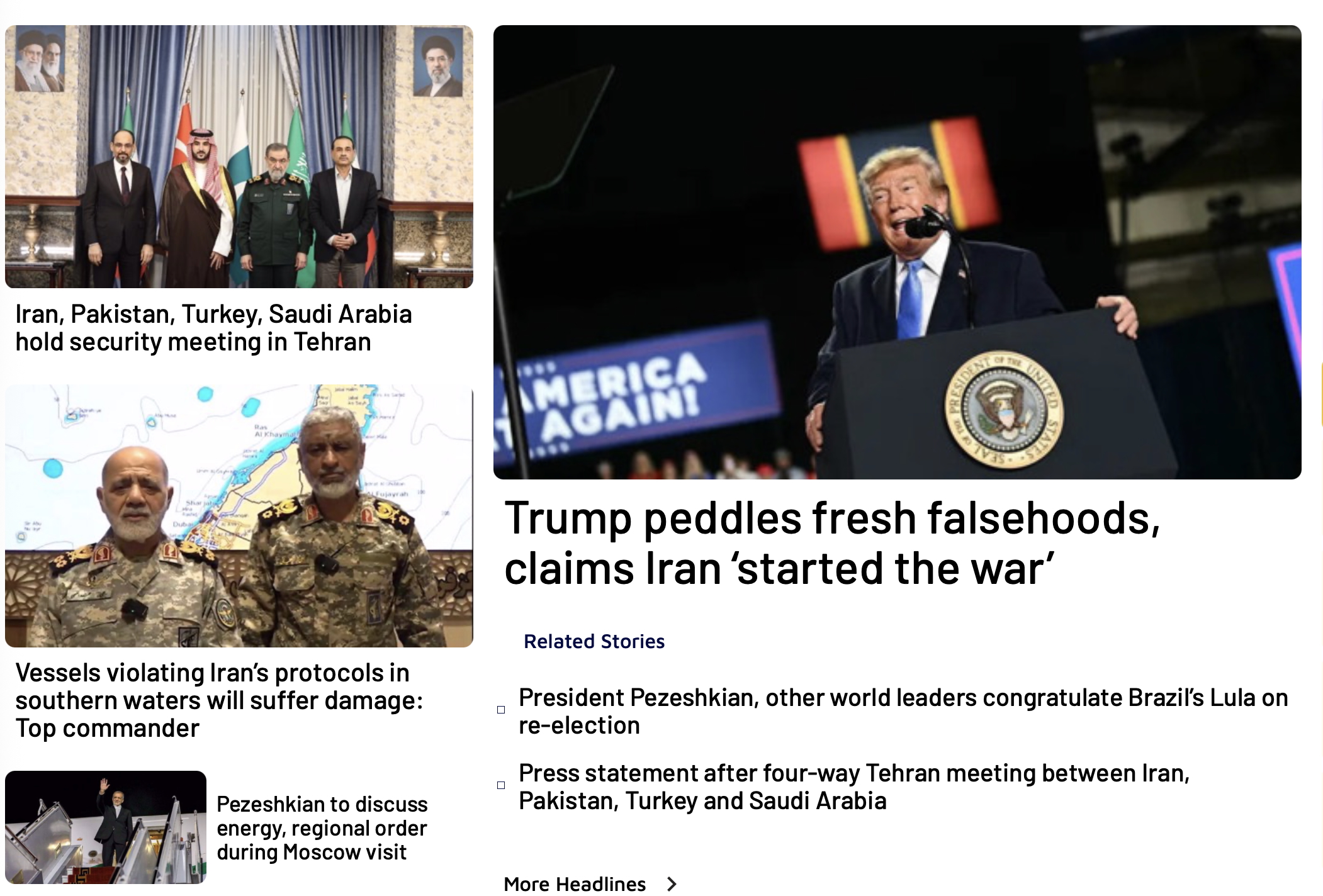
In contrast, there was no coverage of these talks on the front pages of the BBC, Financial Times, Wall Street Journal, or The Guardian. The Washington Post did briefly mention the talks, but it was relegated to the bottom of the lengthy landing page, effectively minimizing its impact:
With fear rising across the Middle East that the U.S. and Israel will restart military strikes on Iran, diplomats from Saudi Arabia, Pakistan and Turkey met with Iranian leaders in Tehran in a new push to negotiate an end to the war. https://t.co/0aEnNkkZfk
— The Washington Post (@washingtonpost) October 26, 2026
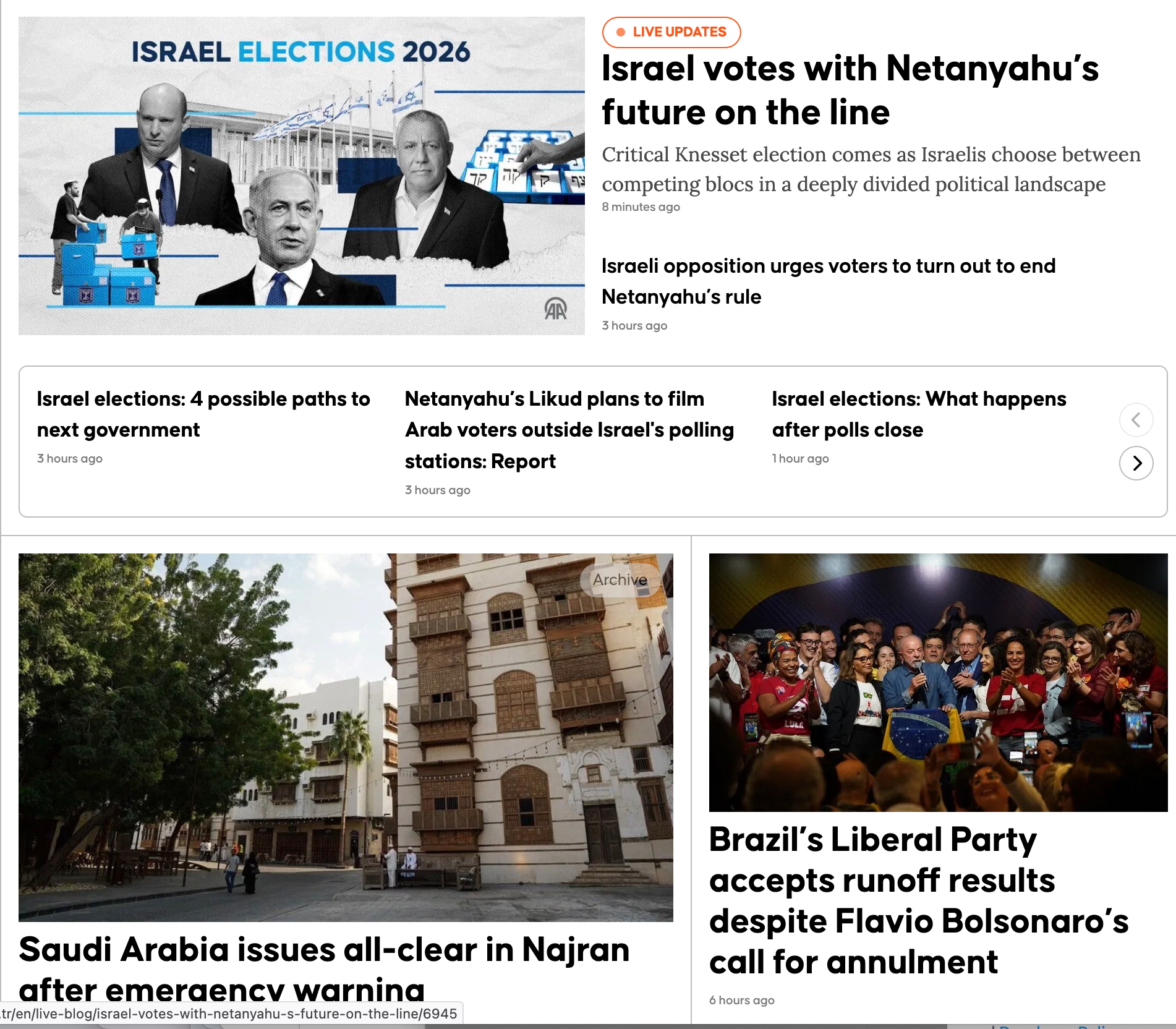
Further, Anadolu Agency also did not prioritize the meetings on its landing page:
According to PressTV, delegations from Iran, Pakistan, Turkey, and Saudi Arabia convened in Tehran to discuss regional security, the consequences of U.S.-Israeli military actions, and the support needed for Palestinians and Lebanese. The meeting was initiated by Pakistan and took place with Iran’s cooperation.
Delegations from Iran, Pakistan, Turkey and Saudi Arabia have begun a meeting in Tehran, with regional security, the consequences of US-Israeli military aggression and support for the Palestinians and Lebanese among the main topics of discussion.
The meeting, which kicked off on Monday, was proposed by Pakistan and held with Iran’s support and cooperation.
Secretary of Iran’s Supreme National Security Council (SNSC) Major General Mohsen Rezaei is hosting the gathering.
Pakistan’s Army Chief Field Marshal Asim Munir, Saudi Defense Minister Prince Khalid bin Salman, and Turkish National Intelligence Organization Director Ibrahim Kalin are representing their respective countries.
Iranian Foreign Minister Abbas Araghchi also participated in this quadrilateral meeting. Prior to the gathering, the representatives had discussions with Iranian President Masoud Pezeshkian. Rezaei noted post-meeting that regional cooperation is overdue, and these visits demonstrate that U.S. threats carry little weight in the global context.
The secretary of Iran’s Supreme National Security Council emphasized that regional countries should have begun collaboration long ago. He pointed out that the presence of senior officials from Turkey, Pakistan, and Saudi Arabia underscores that U.S. threats have minimal impact on international relations.
This summit leaves many wondering if the motivation behind these talks is to pressure Iran to persuade Ansar Allah to temper its attacks. This claim seems plausible but remains questionable; Ansar Allah, despite receiving financial backing from Iran, has significant indigenous military capabilities and its position is firm. Historically, Iran has nudged Ansar Allah toward military engagements affecting Red Sea shipping routes but has also refrained from overtly interfering in their decision-making.
Once again, shifting focus to media coverage, in the case of Anadolu Agency, readers had to scroll significantly down the page to locate information regarding the Iran-backed regional security talks. The headline notably omits mentioning all participants, especially Turkey, reinforcing an impression of underwhelming results:
Talks with senior officials from Türkiye, Saudi Arabia, and Pakistan created a new, positive atmosphere, says secretary of Iran’s Supreme National Security Council.
The coverage suggests that the secretary of Iran’s Supreme National Security Council believes regional security must be grounded in the states of the region and devoid of external interference. This sentiment emerged following discussions about regional security, Israeli actions, and the situations in Palestine and Lebanon.
The secretary of Iran’s Supreme National Security Council stated that security in West Asia should be handled by the countries of the region, free from external intervention.
Insights from Twitter echo similar observations, underscoring skepticism regarding the potential for the Tehran meeting to influence the war’s trajectory:
The Tehran meeting is HIGHLY UNLIKELY to alter the war’s course because the true decision-makers—Washington and Jerusalem—were not present.
While there is hope among observers that Saudi Arabia might adopt a more conciliatory stance, concerns remain about the motivations behind the meetings in establishing peaceful relations with Iran.
Despite some cautious optimism, particularly regarding Saudi Arabia’s outreach to Iran, it is crucial to maintain a critical perspective. Genuine progression necessitates sustained public pressure to ensure that the status quo does not re-establish itself in a manner similar to historical instances of foundering political changes. The complexities and challenges inherent within the larger geopolitical landscape must not be overlooked.