A defense expert quoted by the NYT remarked that he could not recall a deployment to the region “that ever came close to 600, except for contingencies like invasions or natural disasters.”
In light of ongoing conflicts in Ukraine and West Asia—primarily instigated by the US, with Israel’s involvement in the latter—it is easy to overlook that the US is igniting various new issues within its own “backyard.” Last week, the Trump administration revealed plans to deploy hundreds of Army soldiers to train local forces in the region, framed as part of the Pentagon’s campaign against drug trafficking.
This effort is described as “ostensible,” as highlighted in our September 26, 2023, post, “Back to Business As Usual: The US Is Once Again Vigorously Stirring the Pot in Its Own ‘Backyard’”. The US’s renewed war against Latin America’s drug cartels—initially ramped up under the Biden administration but significantly escalated with “Trump 2.0”—has little intention of curbing the influx of drugs or addressing the escalating violence in drug trafficking across Latin America:
If Washington were genuinely concerned about these issues, it could simply enact laws to limit the influx of American-made firearms and other weaponry. However, such actions would negatively impact the profits of arms manufacturers. Furthermore, had it truly aimed to combat drug addiction, it would not have allowed pharmaceutical companies to instigate an opioid crisis in the first place, and subsequently, it wouldn’t have let these offenders evade serious consequences.
Ultimately, this campaign reflects the age-old focus of the US war on drugs: asserting geopolitical and geostrategic dominance in critical regions while penalizing and controlling the domestic population for substantial financial gain. Jorge Retana Yarto, a former director at Mexico’s Centre for National Intelligence, articulates this notion profoundly in an article:
The US “war” on drugs and organized crime is essentially a grand narrative constructed for geopolitical and geostrategic ends, despite the very real issues surrounding drug trafficking and associated criminal organizations. This narrative has served to facilitate punitive and reactive public policies that have devastated social, political, cultural, and economic structures across Latin America. By adopting a military approach, it laid the groundwork for armed intervention in the region, transforming both territorial integrity and national sovereignty into arenas of strategic influence.
The insights of Mexican journalist Oswaldo Zavala, summarized in a three-minute video by Calla Walsh of Vocal Politics, further illuminate the current landscape of the escalating US-led war on drugs in Latin America:
Trump’s labelling of drug cartels as “narco-terrorist organizations” set the precedent for the January 3 invasion of Venezuela and the subsequent abduction of Nicolás Maduro over drug trafficking allegations, which were quickly downplayed after his capture, alongside other developments.
Recently, the US announced mobilizing a 600-soldier battalion from the 10th Mountain Division based at Fort Drum, N.Y., to a new jungle training facility in Panama, as noted by the NYT reports. This number surpasses the peak troop presence recorded in Colombia during the height of Plan Colombia, as highlighted by El Tiempo.
According to the NYT article:
The troops will eventually engage in training exercises with local military units in Colombia and Honduras, and may also support U.S. Special Operations forces in advising operations against alleged drug traffickers, say officials.
In addition to the tasks in Central and South America, other officials indicated multiple soldiers from the 10th Mountain Division would help establish a new command for Western Hemisphere operations located in Miami.
Recently, Defense Secretary Pete Hegseth initiated a Pentagon office aimed at overseeing military counter-cartel activities.
The influx of troops and the establishment of the new command, which have not been previously reported, coupled with the Pentagon’s redirection of several MQ-9 Reaper drones from Africa to Colombia and Ecuador, signify an expansion of the Defense Department’s engagement against drug traffickers in the region.
Adam Isacson, Defense Oversight Director at the Washington Office on Latin America, noted that he had not seen such a deployment of US troops in the region “that ever came close to 600, except for contingencies like invasions or natural disasters.”
These developments coincide with increasing US pressure on leaders across the region to enhance their military offensives against drug trafficking networks and allow for joint operations with the United States. General Francis L. Donovan, the top US military commander for much of Latin America, indicated an intention to broaden operations to include land strikes alongside sea targets.
The sequence of deploying troops to Panama is unsettling, particularly given the country’s historical association with the US military’s infamous School of the Americas. The SOA Watch provides a brief overview of the school’s legacy, both in Panama and throughout the region:
The School of the Americas, established by the US Army in 1946 in Panama, aimed to educate Latin American soldiers in warfare and counterinsurgency tactics. Over 83,000 students have attended, many of whom became notable human rights violators in their countries, as evidenced in places like Chile, Guatemala, Argentina, Peru, and others.
–
In 1984, following Panamanian President Jorge Illueca’s request, the school moved to Georgia, USA, with Illueca referring to it as “the largest base for destabilization in Latin America.” By that time, a prominent Panamanian newspaper had dubbed it “The School of Assassins.” Historical evidence supports such claims.
–
Numerous Latin Americans have suffered torture, murder, and abduction at the hands of graduates from this academy, who have also persecuted activists, union leaders, and those advocating for their rights.
–
In 1996, US media revealed the existence of training manuals used at the academy, which taught techniques of “torture, extortion, and incentivizing the killing of enemies.”
So, why is the US deploying an unprecedented number of soldiers to Latin America at this moment?
The answer lies in the need to enforce the Trump Corollary to the Monroe Doctrine, which asserts direct political, economic, and military control over the Western Hemisphere. Achieving this requires a significant military presence across the region, focusing on South and Central America.
In recent years, several US and Israel-aligned governments have risen to power in the region, supported by Israeli tech firms and US giants like Meta and Google. Endorsements from Trump—either explicit or implicit—along with threats of severe repercussions against those who vote for opposing candidates, have played a role.
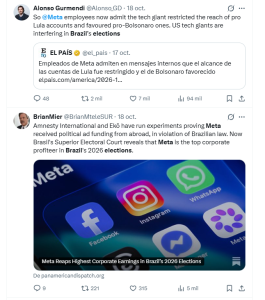
The emergence of these same subservient governments seeking IMF and World Bank funding—historically seen as antagonistic in the region for pushing austerity—is notable, as remarked by Bloomberg in the following tweet:
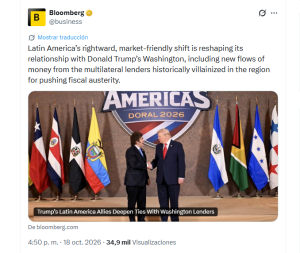
These policies garner little support, particularly from low and middle-income households suffering the consequences of economic hardships. Consequently, approval ratings for newly installed populist right-wing governments in Latin America typically plummet within months—an outcome visible with Chile’s President José Antonio Kast, son of a Nazi, and Kiki Fujimori, daughter of former dictator Alberto Fujimori.
To maintain power over the medium to long term, these puppet governments resort to significant political and social repression. This trend is increasingly evident in Ecuador, which is ahead of many other countries in this regard, showcasing the potential trajectory for the region under the Monroe Doctrine.
As one of the first countries to request an IMF bailout in 2019—allegedly part of an arrangement with Washington to extradite Julian Assange—Ecuador was also the initial nation in the region to sign a comprehensive security pact similar to Plan Colombia in 2023, welcoming US troops and law enforcement agencies as of 2026.
This involvement has led to a surge in violence, exceeding even the chaos seen in Colombian and Mexican drug-trafficking territories. The Center for Economic Policy Research (CEPR) states that “Ecuador has become a crucial testing ground for the Trump administration’s attempts to expand its so-called war on narco-terrorism beyond the illegal strikes in the Caribbean and eastern Pacific, which have already led to at least 239 deaths.”:
Recent months have witnessed an unparalleled level of security collaboration between Quito and Washington, featuring direct US involvement in land and maritime operations, troop deployments at an Ecuadorian air base, elevated diplomatic interactions, and sanctions against Ecuadorian entities.
Together, these actions underscore the strategy laid out by SOUTHCOM Commander Francis Donovan in a September 29 interview with the Wall Street Journal, in which he stated that the US seeks “all options on the table” in engagements with regional partners, including “strikes and arrests.”
With strong US backing, Ecuador’s President Daniel Noboa is intensifying authoritarian measures. His administration has already forbidden the main opposition party, Rafael Correa’s Citizens’ Movement, from participating in upcoming local elections. Just yesterday (October 21), Ecuadorian authorities detained the party’s former presidential candidate, Luisa González, along with other senior members, on alleged corruption charges.
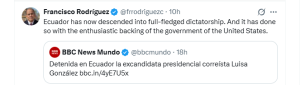
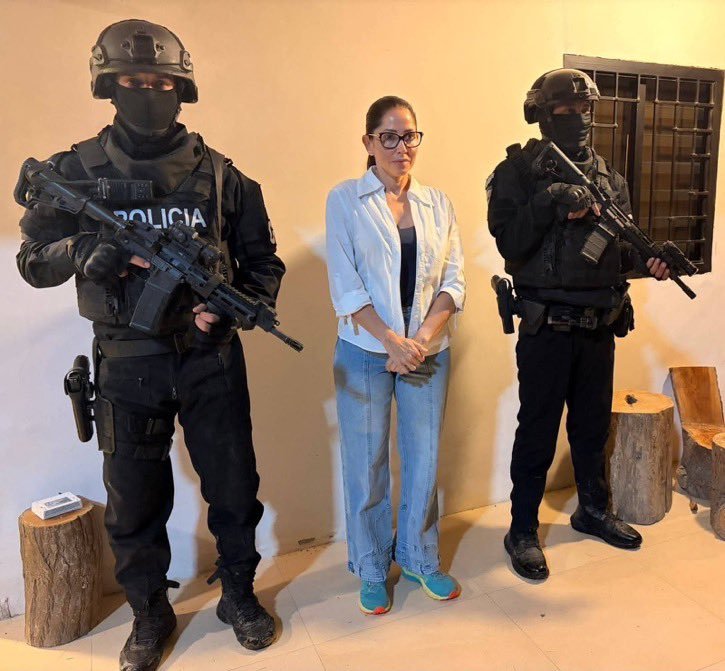
During the 2024 election debates, González challenged Noboa to undergo a drug test, which he declined, while also revealing the president’s and his family’s banana business’s involvement in making Ecuador a narco-state. González noted that European authorities have repeatedly intercepted tons of cocaine hidden in Bonita Banana containers shipped from Ecuador.
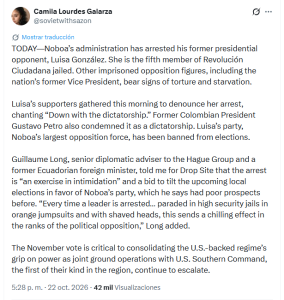
CEPR also offers a useful summary of recent developments in Noboa’s Ecuador:
- The Inter-American Commission on Human Rights has called on Ecuador to “ensure pluralistic political participation,” while NYU’s Rule of Law Lab released a report detailing threats to judicial independence posed by President Noboa.
- Critics accuse Noboa of manipulating government spending to sway voters.
- Despite past abuses, Noboa has declared a new state of emergency and instituted curfews across several provinces.
- Human rights advocates have raised alarms over the military’s hesitance to cooperate with investigations of forced disappearances and allegations of sexual abuse in women’s prisons.
- The National Assembly adopted new legislation permitting military support for police without needing a state of emergency declaration.
- Press freedoms are under threat, exemplified by a major outlet ceasing publication in the wake of intense government scrutiny.
- US troops have collaborated with Ecuadorian police in unprecedented raids and have strengthened their presence at an Ecuadorian air base.
- US forces have interdict fishing vessels multiple times, reportedly detaining and mistreating crew members while destroying the boats.
- A UN expert expressed concern over alleged violations of international law related to US-Ecuador joint operations.
- The US Departments of State and Treasury have imposed sanctions and visa restrictions on Ecuadorian targets while Secretary of State Marco Rubio promises millions in new US commitments to Ecuador.
Lastly, let’s highlight significant events from the broader region, illustrating a similar trend.
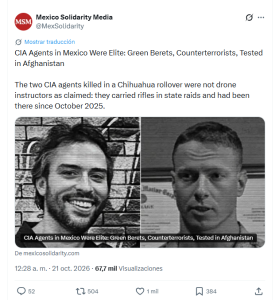
This incident underscores both the penchant of the CIA to engage in deceitful actions, as alluded to by former director Mike Pompeo, and the potential dangers faced by US military personnel and intelligence agents while expanding their presence in Latin America.
In an unusual firm response to the scandal, Mexican authorities have accused César Jáuregui, the former prosecutor of Chihuahua, of treason due to alleged irregularities during the operation in April involving CIA agents.
The federal government has also enacted constitutional reforms that prevent dual nationals from fulfilling senior executive roles in both state and federal administrations, including the presidency—an approach worth considering for governments worldwide, particularly in the US.
Meanwhile, in Bolivia, politician and businessman Samuel Doria Medina distanced himself from the US-aligned government of Rodrigo Paz, revealing allegations that government officials were charging fees for allowing the passage of small planes carrying cocaine. These statements lend credence to accusations from activist Nadia Beller that Paz’s administration is colluding with drug traffickers.
This pattern is increasingly evident, with governments closely allied to the US and Israel in Ecuador, Argentina, and now Bolivia appearing to maintain connections with drug traffickers while touting their efforts to suppress cartel activities. In Ecuador, it seems that the president’s family business itself is a significant player in the drug trade.
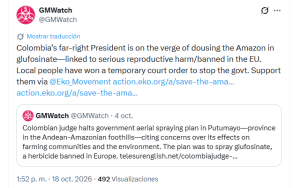
While this dynamic is not new, it has become far more brazen under “Trump 2.0.” In Colombia, the more egregious aspects of Plan Colombia are resurfacing under President Abelardo de la Espriella…
In Guatemala, jurist Juan Francisco Solórzano Foppa was assassinated on October 18 after challenging the “Pact of the Corrupt”—an informal alliance of politicians, business leaders, judicial officials, military figures, and organized crime that has captured the justice system. Three days before his assassination, Foppa publicly denounced a military operation in the town of Huité, Zacapa, where eight peasants were killed, describing it as a “failed operation by CIA mercenaries” supported by military helicopters from Honduras and personnel from the Guatemalan army.
Finally, in Brazil, which represents 50% of South America’s economic activity and is home to significant reserves of rare earth minerals, the outcome of upcoming elections will strongly influence the trajectory of South America, either reinforcing the US-Israeli agenda for territorial domination or hindering it.
In a recent documentary, General Carlos Alberto dos Santos Cruz, a former ally of Bolsonaro, warned that if Flávio Bolsonaro wins, it will pave the way for Donald Trump to establish a government in Brazil that aligns closely with US interests.