While there may not be any disheartening news today, the links below offer plenty of engaging reading material for your leisurely weekend coffee breaks. Dive in and enjoy!
Part One: Political Hope Amid Despair Independent media has become crucial for making sense of our world, a truth well-known in this community. One intriguing source is Salvation South. Its founder, Chuck Reece, played a pivotal role in creating The Bitter Southerner, which previously sparked our conversation about lunchroom ladies in February. Recently, Salvation South delves into Southern politics through an article by Doug Cumming, a retired journalist and professor, titled No Choice in God’s Country.
The absence of choice has been a long-standing issue in certain regions of Georgia. Rural North Georgia has been predominantly Republican for quite some time, a trend mirrored in South Georgia, with exceptions found in specific rural counties in the Black Belt. Urban areas such as Atlanta, Macon, Augusta, Athens, and Savannah typically vote Democratic but are encircled by a strikingly red gerrymandered backdrop. More broadly in the South:
In Rockbridge County, Virginia—one of America’s most picturesque locales—there used to be two political parties and competing candidates for the General Assembly in Richmond. However, in many parts of the Deep South today, counties are so solidly red or blue that numerous local candidates for state legislatures find themselves unopposed on Election Day. Uncontested state legislative races are becoming increasingly common throughout the South. An analysis by Salvation South using data from Ballotpedia revealed that seven states, from South Carolina to Louisiana and Arkansas (including Kentucky but excluding Tennessee and Florida), had only one major party appearing on more than half the ballots during the latest state legislative elections. Most of those candidates were Republicans.
The 2023 extremes were in Louisiana, where 82.6% of the seats were uncontested (69% of those candidates being Republican), and in Mississippi, where 86% went uncontested, with 67% being Republican.
To me, this appears not just undemocratic but also immoral.
Having spent much of the past year in rural North Georgia, I’ve stepped away from my more liberal retirement in Decatur. On some Sundays, I sought various religious experiences, engaging with different mid-sized churches. I was not searching for the roots of Christian Nationalism or the MAGA ideology. Yet, I was surprised by the complete absence of political dialogue in these congregations.
These were vibrant communities where the Democratic Party seemed to have vanished, along with some of their electoral influence. I saw no campaign bumper stickers in the church parking lots. While attendance was robust and sermons were heartfelt, conversations during coffee hours carefully avoided the prickly subject of politics. The attendees preferred to maintain that ten-foot distance from such inconvenient topics.
Immoral? When I cast my first vote in Georgia during the mid-term elections of 1974, the balance was quite different. Though I share Mr. Cumming’s sense of participation back then and now, the article doesn’t quite address the nature of our current Uniparty situation—an issue that extends nationally. Local and state politics, however, might signal the beginning of much-needed change. I don’t think Mr. Cumming should be surprised to find that discussions of politics often do not emerge from the pulpit or pews in the churches he visited; generally, it’s a line that remains uncrossed, except in certain mega-churches of dubious theological grounding.
Trump campaign signs seem to be sparse now. Will general dissatisfaction with the current administration catalyze change? Observing from a state that lacks even a trace of the once-prevalent Atlanta Constitution, which used to deliver news to every one of Georgia’s 159 counties, this remains a complex question. Yet, candidates like Mishael White represent a refreshing perspective:
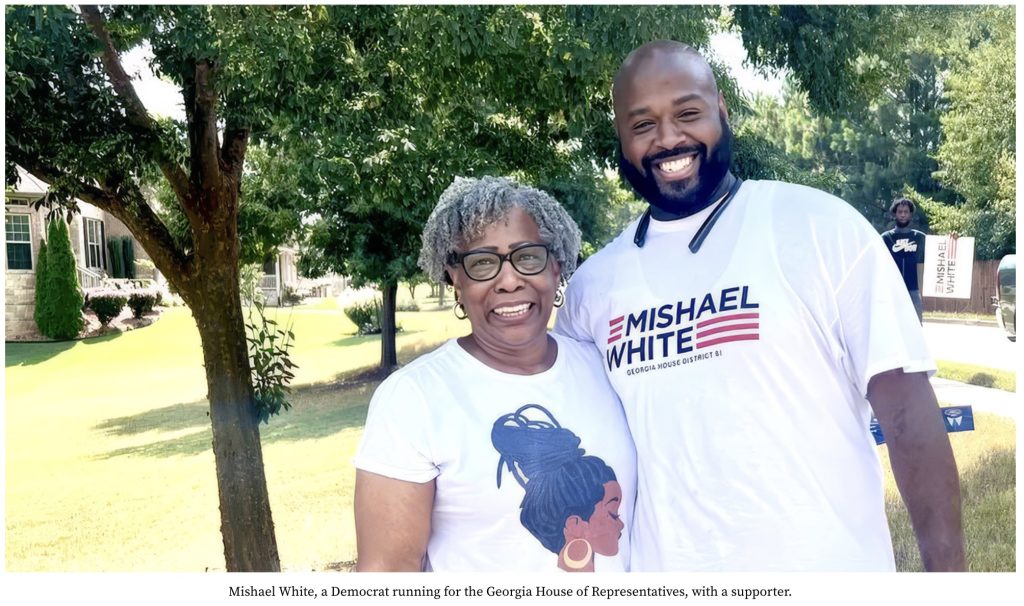
Mishael White is a Black truck driver for Domino’s Pizza, running for a state House seat in Henry County—a key area between Atlanta and middle Georgia. With encouragement from the Fighting Fifty organization, he aims for the 2024 elections after losing by 14 percentage points to Noelle Kahaian in 2024. Kahaian, a Bible college graduate and paralegal, previously defeated a conservative incumbent in the Republican primary, campaigning against “Critical Race Theory” in public schools. Within the legislature, she co-sponsored a stalled bill meant to lessen the authority of health boards regarding vaccine mandates.
After relocating his family from New Orleans to Georgia post-Hurricane Katrina in 2005, Mishael White is focused on supporting trade schools (having received his welding training at Avondale Shipyard in New Orleans), tackling the state’s high maternal mortality rate, and backing small businesses (he co-owns a restaurant in Stockbridge called Sheauxtime Kitchen & Lounge).
Over the years, he’s gained valuable insights driving an 18-wheeler. He understands the need for unity among fellow drivers, especially in team driving scenarios. The predominantly white, MAGA culture fades away on the road. In regard to Georgia Governor Brian Kemp’s claims of funding for highway expansions, White insists that while the number of lanes increases, the traffic worsens. He argues the real issue lies in the sheer number of big trucks and proposes additional parking areas to help drivers navigate when fewer personal vehicles are on the road.
In the 2024 elections, White lost to Kahaian by 14 percentage points—a margin of 4,717 votes. Interestingly, Kamala Harris received approximately 43.3% in the same district, reflecting a similar voter sentiment as White.
This time around, he is running under more favorable conditions with a growing voter base in Henry County. According to the U.S. Census Bureau, the population in that area increased by about 4,400 in 2024, amounting to an annual growth rate of 1.7%. While he refrains from discussing politics during Sunday services at Victory Tabernacle Church International, he’s engaging in interviews and town hall meetings that are shared online. He and his family are knocking on thousands of doors and connecting with voters in McDonough’s popular Main Street Market every Saturday, one of his three days off.
With less than two weeks remaining until the elections, the outcome remains to be seen. The prospect of a true representative from the working class in the Georgia House of Representatives would be remarkable! My grandmother, who served as a poll worker in Telfair County during the 1930s when voting was bizarrely constrained, might have exclaimed, “Imagine that!”
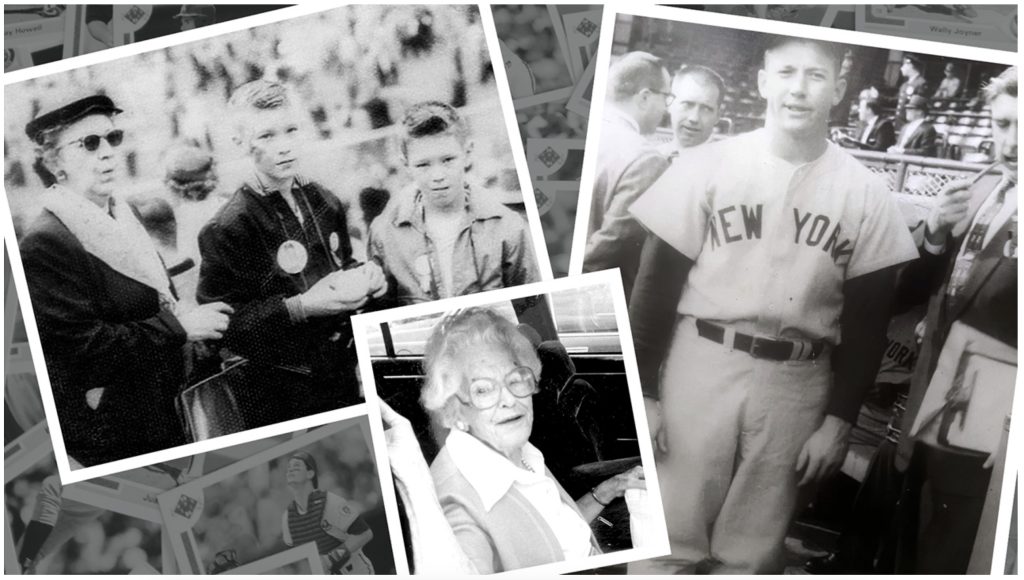
Part Two: A Legendary World Series Encounter While I typically do not experience envy, the story of Mickey Mantle and Don Larsen elicits such feelings in this Little Leaguer who emerged a decade after their memorable matchup. Mantle remained a fixture in the sport, and I even wore #7 on my high school baseball jersey, but it lacked the same magic. Here’s a snapshot of A Picture Perfect World Series, which recalls the moment seventy years ago when Don Larsen pitched a perfect game while Mickey Mantle clinched the Triple Crown:
Seventy years ago this month, a spirited, middle-aged aunt drove two Little Leaguers from Greenville, North Carolina, to New York City for the very first time. They departed with a photograph of Mickey Mantle and memories worthy of the baseball history books.
Enjoy this brief yet compelling read during your coffee break!
Part Three: The Return of Thomas Frank I have read each of Thomas Frank’s books starting with One Market Under God. Frank faced considerable backlash from mainstream media for his intelligence. I’ve eagerly anticipated his latest release, The Creativity Con: How Innovation Became America’s Biggest Racket. An excerpt in the recent issue of Jacobin titled The Creativity Con Ate the Middle Class suggests there’s much to ponder on this topic:
The hopes and beliefs of postwar middle-class society have largely faded. The faith in consensus and the goodness of American civilization has been relegated to nostalgia. Yet, one idea from that era endures and flourishes—our infatuation with creativity, that human force believed to make life worthwhile and propel civilization forward.
Every year, a plethora of bright literature on this well-worn topic emerges. Self-help books aim to enhance our creative skills; Substack writers dive into mental performance; gatherings like South by Southwest (SXSW) celebrate diverse artistry; governmental policies devote space for innovation; foundations offer lavish prizes for exceptional creativity; and industries from advertising to defense tout their commitment to fostering human imagination. Even Silicon Valley sold artificial intelligence as a creativity booster—until apprehensions about AI as a potential creativity killer began to surface.
The allure of creativity for middle-class Americans is easy to see: it offers a narrative of progress that positions them as the heroes in history’s tale. This narrative reassures them that the nation’s success stems from the day-to-day innovation of countless ordinary, ingenious individuals. However, the real-world consequences of creativity have not been kind to middle-class society. Throughout the trajectory into our current disheartening state of inequality, creativity has been invoked as a justification for various policies. Tax cuts in the 1970s and ’80s were framed as a way to revive our creativity. Our leaders deregulated banks, favored tech and pharmaceutical industries, encouraged deindustrialization, and generally transitioned us into a “postindustrial” age where working-class individuals lost their grip on middle-class comfort—all in the name of enhancing creativity and innovation.
Yes. A comparison between The Creativity Con and We Have Never Been Woke: The Cultural Contradictions of a New Elite by Musa al-Gharbi could spark further discussion in the future.
Part Four: David W. Orr—A Beacon of Sanity in Today’s Madness I have delved into at least six of David W. Orr’s nine books, and I even received a response from him to an email long ago. His students at Oberlin and Arizona State are fortunate to learn from him, but his wisdom extends to all of us. We return to the Front Porch Republic for a profound discussion between Professor Orr and Teddy Macker: The Great Work: An Interview with David W. Orr (approximately 9,800 words and absolutely worth your time). Here’s a glimpse:
With eloquence befitting a preacher’s son, a wealth of knowledge, and an intelligence keenly aware of connections, along with an undeniable sense of humor, few have alerted us to our nation’s challenges as compellingly as David W. Orr.
We are straying dangerously from what reality mandates for a healthy and enduring existence on Earth. Our alignment with Creation is perilously skewed. It’s imperative to reimagine and reconstruct the human presence on Earth in sustainable ways. True healing necessitates stretching our empathy toward other species and future generations.
Orr’s many sobering publications, which do not gloss over dire issues for the sake of credibility, strangely inspire hope. In a time when our nation seems dominated by negativity, he calls us to embody care, compassion, and wisdom; to embrace thriftiness, neighborliness, and bravery. He urges a patriotic loyalty that shifts focus from “I,” “me,” and “mine” to “we,” “ours,” and “us.” Instead of being mere spectators scrolling on our phones, we must actively engage. As Orr states, “Let’s just buckle down, do what we can, with what’s before us. Everybody has something to contribute to this process.”
He also encourages us to rise above what could be termed “whole-blindness.” We must evolve as “systems citizens” with a broader understanding of our obligations. Each thread we pull affects the wider fabric of existence. Orr’s nine works, which I recommend heartily, invite us to rediscover our agency, nobility, and interconnectedness with each other, all life, and future generations.
Other notable authors include Garrett Hardin, Thomas Berry, Bill McKibben, Wendell Berry, Robert Louis Stevenson, Aldo Leopold, Georgescu-Roegen, Herman Daly, Kate Raworth, Wes Jackson, Jane Austen, Ian McGilchrist, Mary Shelley, Pope Leo XIV, Joseph Wizenbaum, George Orwell… and in the midst of it all:
Even though much of the science may be beyond our grasp, our hope continues to lean towards better gadgets rather than improved system designs or behavioral changes. Despite the historical catastrophes of the Titanic, Fukushima, and future crises lurking, this optimism conceals a far bleaker reality. Today, skepticism toward technological fundamentalism casts one as a heretic—not burned at the stake, but ignored as out of touch. We are capable of doing better.
To start, we need to establish a common understanding of our devices and their intricate systems. Here’s a rather uninspired list of considerations, adapted from thinkers such as Mary Shelley, Herman Melville, Lewis Mumford, David Ehrenfeld, Neil Postman, David Noble, and Kirkpatrick Sale, among others:
- Using tools to solve problems is not exclusively human; some animals exhibit similar behavior. For example, birds construct nests using their beaks and claws without opposable thumbs or engineering degrees. Even bumblebees demonstrate inferential reasoning.
- Every human-made tool or technological device exists within a system of political economy, ecology, culture, and morality.
- Technological benefits are often realized before costs, leading to a pattern similar to addiction. We can do better.
- The impact of any device, anticipated or otherwise, resonates throughout a larger system, leading to unpredictable consequences.
- Sometimes these effects can be counter-intuitive, manifesting in ways contrary to our expectations—which can lead to backlash.
- Technology amplifies the intricacies and paradoxes of human existence. Who would have guessed!
- The invention process during the 19th century transformed technological innovation into a positive feedback loop, accelerating the pace of change.
- Technological advancements frequently counteract smarter system designs that are typically cheaper, faster, and less destructive.
- The development of technology without thorough public evaluation is fundamentally anti-democratic.
- Ultimately, is technology a blessing or a curse? In 1972, when asked about the French Revolution, Chinese Premier Zhou Enlai replied, “It’s too early to say.” The same applies to all our devices and the systems they shape and inhabit.
Such knowledge, whether one agrees with it or not, is increasingly rare in our times—and may not last long. But unless we let go of certain long-held beliefs, our time may face an inevitable end.
Part Five: The Peace of Wild Things
When despair for the world grows in me
and I wake in the night at the slightest sound
in fear for what my life and my children’s lives may hold,
I go and lie down where the wood drake
rests in his beauty on the water, and the great heron feeds.
I enter into the peace of wild things
who do not burden their lives with forethought
of grief. I find solace in the presence of still waters.
Above me, I sense the day-blind stars
waiting with their light. For a moment
I rest in the grace of the world, and I am free.
– Wendell Berry, 1934-2026
Thank you for engaging with this reading. See you next week. Stay safe in the meantime!