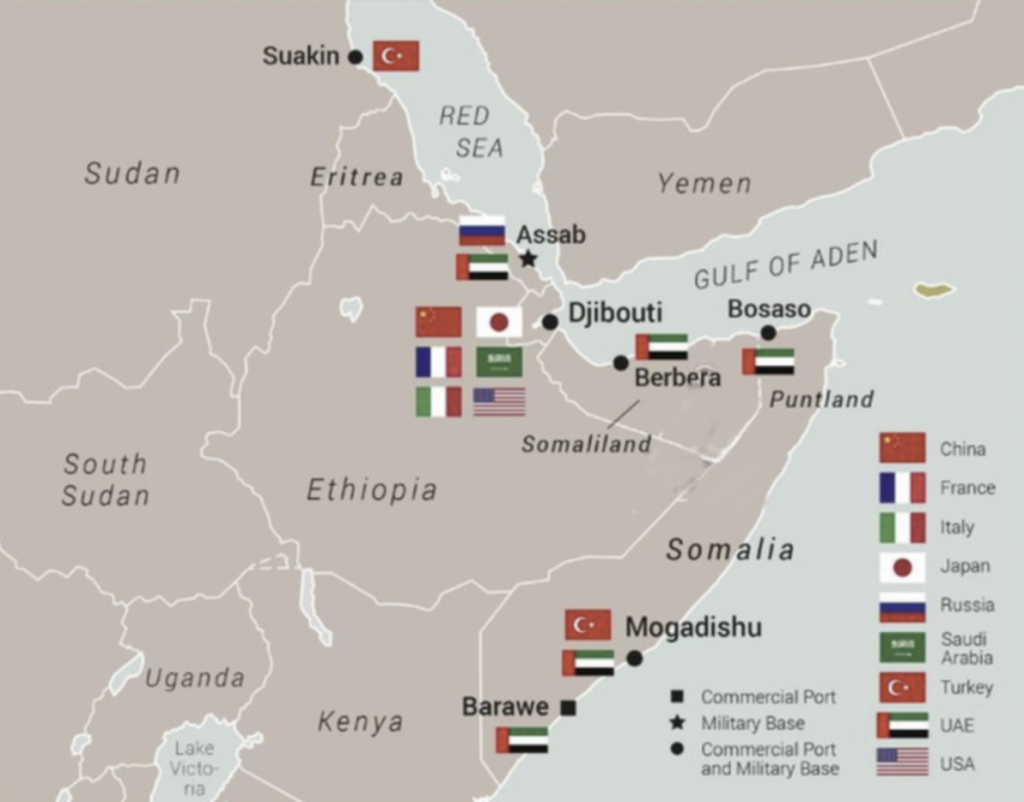
Conor here: While Korybko presents the argument that Israel’s actions are primarily influenced by Turkey’s presence in Somalia, it’s crucial to also recognize the other international players involved in the region.
The United States maintains a presence of several hundred troops in Somalia, primarily affiliated with the Danab (“Lightning”) Brigade, an elite U.S.-sponsored Special Operations Force formed in 2014.
In the past year, the U.S. has signed an agreement with the Somali government to construct up to five military bases aimed at enhancing the capabilities of the Somali National Army in the ongoing battle against militant groups. Most of these bases will serve the Danab Brigade, which received initial funding from the State Department through a contract with the private security firm Bancroft Global. Recently, financial support has shifted to the Pentagon’s 127e program, a proxy war fund that allows U.S. special operations forces to utilize foreign military units for counterterrorism operations, circumventing congressional oversight.
Is the Trump administration likely to follow Israel in recognizing Somaliland? Given Trump’s previous remarks about his administration being influenced by prominent Zionist oligarchs, such a move wouldn’t be surprising. However, Trump currently asserts that the subject requires “more study.” He is surely examining historical documents and scholarly articles, so his stance could shift unexpectedly.
While Somalia receives U.S. aid to cover government salaries, it launched an extensive lobbying initiative following Trump’s election victory, employing high-profile firms like BGR. As reported by Africa Report, the Somali president is also courting Elon Musk by issuing him a Starlink license for operations within the country. Additionally, Somaliland is positioning itself as a modern Panama, aiming to attract U.S. interests in controlling vital shipping routes.
In July, Somaliland extended an offer to the U.S. for access to a strategic military base near the Red Sea, alongside deals concerning critical minerals in exchange for formal recognition. However, Washington has yet to act on this proposal, likely due to the complexities it would introduce to the existing U.S. operations in Somalia.
Despite the collaboration between the U.S. and Israel in the region, the UAE has established a significant presence in Somaliland, operating a port and military airstrip in Berbera, while still maintaining bases in Somalia.

Project 2025 advises recognizing Somaliland’s statehood as a strategy to counterbalance the diminishing U.S. foothold in Djibouti. According to Semafor, members of the Trump administration have expressed a willingness to acknowledge Somaliland, potentially enabling U.S. intelligence to establish long-term operations that monitor weapon movements in a volatile area while countering Chinese influence. Furthermore, an influential subcommittee in the U.S. House of Representatives recently urged the State Department to open a representative office in Somaliland.
The U.S. has ramped up airstrikes in Somalia, with reports indicating up to 119 strikes within the first year of Trump’s second term—more than double the previous record—which has further intensified calls for Somaliland’s recognition. The Trump administration appears to be building on existing policies while bringing a new perspective. Although the Biden administration reiterated the importance of Somalia’s territorial integrity, there have been signs indicating a Pentagon interest in establishing a presence in Berbera, driven by several visits from AFRICOM officials.
At present, there has been swift condemnation of Israel’s recognition of Somaliland from various nations across Africa and the Middle East (and China). The question remains: do these nations genuinely mean their statements, and are they prepared to take action?
By Andrew Korybko, a Moscow-based American political analyst specializing in the global transition to multipolarity amid the New Cold War. He holds a PhD from MGIMO, an institution under the Russian Foreign Ministry. Originally published at his website.
Israel’s recognition of Somaliland introduces strategic considerations relating to Turkey’s operations in Somalia. Israel may seek to monitor and potentially neutralize any elements that could be repurposed for nuclear applications, amid suspicions surrounding Turkey’s ambitions in the region.
Recently, Israel became the first member state of the UN to formally acknowledge Somaliland. Some analysts theorize that this decision is partly motivated by a desire to counter Iranian influence in the region, particularly in light of Somaliland’s reported acceptance of a large number of Gazans. However, Israel’s ability to act against Houthi forces in North Yemen without needing a base near Somaliland complicates this narrative.
This analysis suggests that the principal reason behind Israel’s unexpected acknowledgment of Somaliland stems from strategic concerns regarding Turkey. Turkey has gained significant influence across various critical sectors in Somalia, prompting Israel to view this as a potential national security threat. Before delving further into Turkey’s role, it is vital to scrutinize its specific influences in Somalia.
The Turkish Cooperation and Coordination Agency (TIKA) has implemented over 500 projects in Somalia since opening its operations in 2011. Additionally, Turkey has been training Somali forces since launching its largest overseas base, TURKSOM, in 2017. The relationship between the two nations was solidified through a related pact in early 2024, which aims to modernize the Somali Navy in exchange for Somalia ceding a substantial portion of its offshore energy revenue to Turkey.
By the end of this year, Somalia confirmed that Turkey is developing a spaceport on its territory. Reports suggest this facility could also serve a dual purpose as a site for missile testing, as Turkey faces challenges conducting such tests from its own territory due to congestion over the Eastern Mediterranean. Moreover, earlier this summer, Pakistan, Turkey’s perceived junior partner, signed a military training agreement with Somalia, indicating a convergence of military interests in the region.
These developments culminated in a recent Israel Hayom article emphasizing that “Turkey’s quiet power play in the Red Sea is transforming Somalia into a proxy.” The piece illuminated the potential security threats posed by Turkey’s actions, suggesting that it is shaping a “second strategic geography” for the potential testing of nuclear weapons and delivery systems, capitalizing on resources from Niger and missile technology from Pakistan.
While some might dismiss these assertions, Netanyahu’s gratitude expressed to the Mossad chief after Israel’s recognition of Somaliland indicates the gravity of the national security considerations at stake. By acknowledging Somaliland, Israel could enhance its capability to monitor Turkey’s activities in the area and potentially neutralize threats should evidence surface regarding nuclear intentions.
From Somaliland, Israel could initiate political maneuvers to undermine Turkey’s significant influence over Somalia, preventing the worst-case scenarios through non-kinetic means, a goal that Somaliland may support as it ensures its own security. Ultimately, Israel’s recognition of Somaliland is more strongly tied to its rivalry with Turkey than with concerns about Iranian influence, suggesting that Turkey might soon incite issues with Somaliland to strengthen its position in the region.

