In today’s complex landscape of social movements, it’s worth examining the insights of Myles Horton, a significant figure in American education and activism. His perspectives resonate deeply in our current context, particularly during this era characterized by technological advancements and complex societal challenges.
“[Horton] wrote in the late 1980s about how this was distinct from a movement peak: “Now we’re in what I call an organizational period, which has limited objectives, doesn’t spread very rapidly, and has a lot of paid people and bureaucracy.”
Horton viewed this bureaucratic structure skeptically and was wary of calls for “unity”—two hallmarks of contemporary political dynamics. He believed that organizers could primarily prepare during these times rather than ignite new movements. The question remains: what will it take to ignite the next wave of activism and ensure it withstands oppression and surveillance?
By Mark Engler, a writer based in Philadelphia and an editorial board member at Dissent. He is the co-author, along with Paul Engler, of the book on the craft of mass mobilization, “This Is an Uprising: How Nonviolent Revolt Is Shaping the Twenty-First Century.” Cross posted from Common Dreams.
Over a career spanning more than five decades, Myles Horton emerged as one of the most significant educators and activists in America, deeply involved in pivotal social movements of the 20th century.
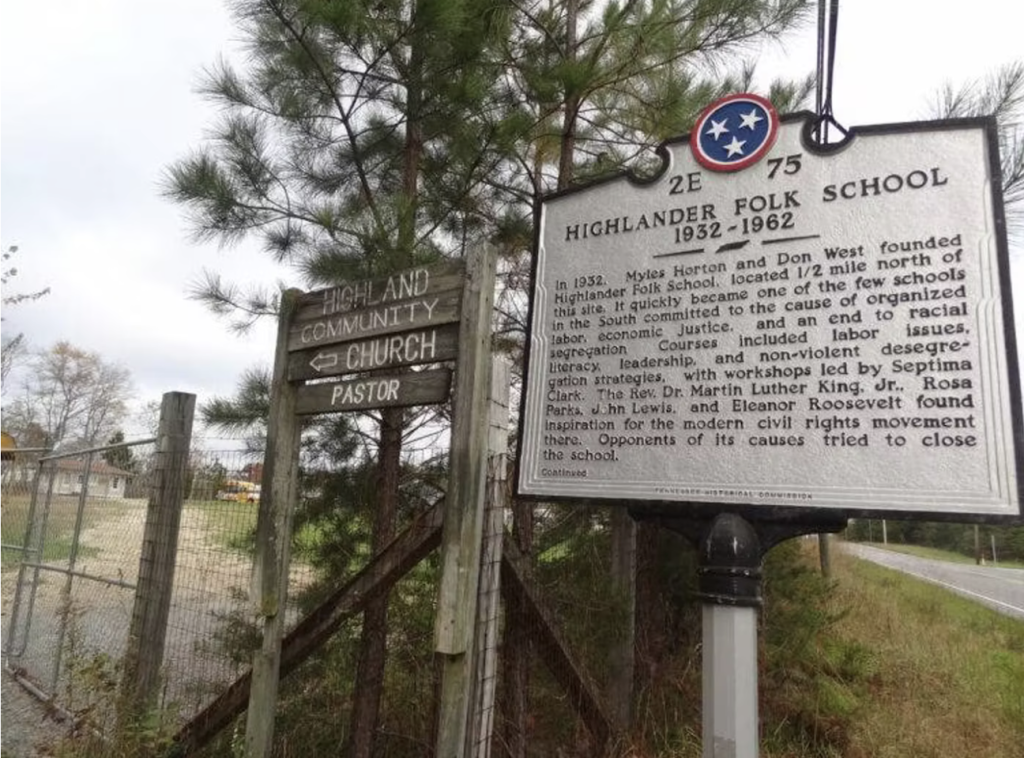
As a co-founder of the Highlander Folk School, later transformed into the Highlander Research and Education Center following its closure by Jim Crow officials in Tennessee, Horton played an essential role in adult education that connected deeply with labor movements during the New Deal era of the 1930s. By the 1940s, it had become one of the few integrated spaces in the region, where white activists and communities of color could unite in pursuit of liberation.
Rosa Parks famously attended Highlander before her pivotal act of defiance on a segregated bus, and numerous influential figures in the civil rights movement, including Martin Luther King Jr, Ella Baker, and John Lewis, engaged with its mission. However, the true measure of Highlander’s impact lies not just in its prominent attendees but in the everyday leaders and union stewards who left empowered to enact change in their communities.
A self-described “hillbilly radical” and pioneer of progressive education, Horton’s journey through the various rises and falls of social movements provided him with profound insights. He recognized both the importance of constructive organizations and the dangers of bureaucratic stagnation. Understanding how Horton navigated these complexities offers essential guidance to current advocates for social justice.
A People’s Pedagogy
Myles Horton was born in 1905 in Savannah, Tennessee. Raised by schoolteacher parents, he grew up surrounded by a strong work ethic and a sense of purpose. At 15, he became self-sufficient, working various jobs, including crate assembly in a tomato packing plant.
Throughout his involvement in Appalachian communities, education became an essential calling. In 1924, he enrolled at Cumberland University, all while teaching Presbyterian Bible classes in the Tennessee mountains during summer breaks. By 1929, Horton gained admission to the prestigious Union Theological Seminary in New York City, where he was one of the few representatives from rural Appalachia. At Union, he was influenced by notable socialist theologian Reinhold Niebuhr, prompting his engagement with the social gospel movement, advocating for action against poverty through the lens of Christian values.
While his perspective gradually shifted toward secularism, the principles of compassion remained with him. He often reflected Che Guevara’s sentiment: “The true revolutionary is guided by strong feelings of love.” For Horton, this love rooted back to his theological upbringing: “You can’t be a revolutionary, you can’t want to change society if you don’t love people; there’s no point in it.”
Horton continued his studies at the University of Chicago, where he interacted with sociologist Robert E. Park and began to formulate his vision for a new type of educational institution. A pivotal moment came during a visit to Denmark in 1931, where he learned from the folk school movement, established by philosopher N. F. S. Grundtvig. These schools championed communal, experiential learning, blending music and local knowledge. On his final night in Denmark, Horton penned, “You can go to school all your life, you’ll never figure it out because you are trying to get an answer that can only come from the people in the life situation.”
Upon returning to the Southern Highlands, Horton set out to establish a similar school, creating a list of integral lessons:
Students and teachers living together
Peer learning
Group singing
Freedom from state regulation
Nonvocational education
Freedom from examinations
Social interaction in nonformal settings
A highly motivating purpose
Clarity on objectives.
Highlander was established in 1932 with a mission focused on training “effective labor leadership and action” through education as a tool for achieving a new social order. This mission began to bear fruit shortly after, coinciding with the burgeoning Congress of Industrial Organizations (CIO) in 1935. Collaborating with these unions, Highlander became the official educational training center for the CIO across the South, preparing shop stewards and labor educators. “Within two years, Highlander became the official CIO educational training center for the entire South,” Horton stated. By 1937, he was instrumental in organizing one of the first CIO locals for textile workers that included both white and Black workers.
As labor activism slowed in the 1950s, Highlander became a vital training ground for the civil rights movement. Horton collaborated with local activists in South Carolina to create programs aimed at preparing African Americans to vote and pass literacy tests. Under the leadership of Septima Poinsette Clark and Bernice Robinson, these initiatives evolved into the Citizenship Schools that proliferated across the South, cultivating a base of dedicated volunteers for the movement’s campaigns. Highlander also played a crucial role in founding the Student Nonviolent Coordinating Committee (SNCC), hosting early meetings of leaders who organized sit-ins at segregated lunch counters. Additionally, the center’s singers helped popularize “We Shall Overcome,” which became an iconic anthem of the movement.
Although Horton officially retired in the early 1970s, he remained actively engaged with Highlander and continued to influence discussions on popular education throughout his life, until his passing in 1990.
Living Through Movement Cycles
Social movement theorists like Sidney Tarrow and Bill Moyer have explored how movements evolve through cycles of intensity. Myles Horton’s unique experience across many major movements allowed him to adapt Highlander’s role and reflect meaningfully on this progression.
“Highlander’s always been in the mountainous part of the United States,” Horton once stated, “and our history has reflected the peaks and valleys of social movements.” He used this metaphor to categorize the different phases of activism, with “movement times” indicating high levels of mobilization and “organizational periods” representing quieter, less dynamic phases. Understanding the current context enables movement participants to determine potentially effective actions.
Horton noted, “The best educational work at Highlander has always taken place during strong social movements. We’ve engaged meaningfully with the labor movement in the 1930s and 1940s and the civil rights movement in the 1950s and 1960s. During movement times, participants share common struggles and can easily exchange ideas across communities.”
However, these peaks are not permanent. After the 1968 Poor People’s Campaign, which assembled in Washington, DC, Horton observed that Highlander primarily served during valleys. He wrote in the late 1980s, distinguishing this from a movement peak: “Now we’re in what I call an organizational period, which has limited objectives, doesn’t spread very rapidly, and has a lot of paid people and bureaucracy. It’s completely different from the social movement phenomenon.”
Horton believed that sparking a new movement was challenging, yet preparation was essential. “During organizational times, we anticipate future movements. If we guess correctly, we’ll find ourselves at the core of mobilization and strategy rather than merely riding the bandwagon,” he posited. This groundwork sets the stage for future movements: “Using these quieter periods effectively strengthens our capacity for peak periods.”
The Unique Properties of Peak Mobilizations

Scholars studying movement cycles find Horton’s observations particularly enlightening. He recognized that peak mobilizations—rapid periods of mass activism—are often unpredictable and frequently underestimated. Many observers, both within and outside movements, tend to regard these episodes of collective action as spontaneous or mere coincidences, overlooking their significance.
Horton did not dismiss these peak periods. Instead, he emphasized their unique characteristics.
First, he noted that mass mobilizations encourage independent action among participants. Horton perceived these times as exceptional opportunities for rapid idea dissemination and increased engagement. “It’s in a movement that ideas are simplified and made direct enough to spread rapidly. Leadership can multiply in these moments because there is a contagious energy.”
He recounted a story of a woman in the South who, without realizing it, established her own Citizenship School to teach others to read, facilitating their political engagement. She likely gained inspiration from a conference about Citizenship Schools, demonstrating how tactical ideas can diffuse quickly through grassroots movements.
Acts of courage also tend to inspire others. Horton elaborated, “Witnessing individuals, seemingly similar to themselves, accomplishing the unexpected emboldens others to participate. Once they take the plunge, they experience a sense of belonging.”
Second, Horton observed that movements are inherently polarizing. Rather than fostering unity, they highlight pressing controversies that compel individuals to take definitive stances. “A significant social movement forces individuals to commit to a side; neutrality becomes untenable,” he noted. This polarization can yield both benefits and drawbacks: “While it may push some individuals toward violence, it can also galvanize support for a cause, prompting people to act passionately or even sacrifice for it.”
While polarization can be advantageous, managing its positive and negative aspects is essential for effective movements. Horton shared a critical insight: “You cannot make progress without pain, as opposition is inevitable when people demand change.”
Lastly, Horton identified that the momentum required for movement surges differs from the routine activities of organizations. During organizational periods, goals may be limited in scope and do not typically compel broad public participation. However, once mobilization starts, members from various organizations can tap into that energy. “During the civil rights movement, individuals from labor unions, Black churches, and pacifist movements rallied behind the call for social equality. The movement attracted countless participants seeking excitement, fulfilling guilt, and aiming for a common cause.”
A well-known notion among protest trainers is: “Alignment does not create momentum; momentum creates alignment.” Simply assembling a coalition with unified demands does not guarantee action; instead, it often results in a diluted consensus. Conversely, an active movement naturally unites diverse forces toward a shared vision, typically more ambitious than originally conceived.
The Problem of Bureaucracy
At Highlander, Horton founded a resilient organization that has persisted through generations. He named his memoir The Long Haul, illustrating the importance of sustained struggle. Despite this dedication, he scrutinized the bureaucratic tendencies that often infiltrate organizations, including progressive ones. His perspective provides a nuanced viewpoint of organizational life.
Contrasting with prominent disruptive mobilization theorists like Frances Fox Piven and Richard Cloward, who have been labeled “anti-organization,” Horton recognized the critical role organizations play in empowering individuals. Yet, he lamented how institutions can ossify and lose vitality over time.
In The Long Haul, Horton noted, “I realized actions need to occur through organizations; individuals alone are often powerless. Yet, when people unite in organizations, they can gain influence, provided they utilize their organizations instead of becoming subservient to them.” He added, “I observed that organizations develop fixed structures, often outlasting their relevance.”
Having seen labor movements transform from marginal to establishment power players by the end of the 1950s, Horton joined the New Left critique of new power brokers, asserting, “The bureaucratic system is an inevitable ailment of organizations and governments, often propagated by well-intentioned individuals who inadvertently propagate misalignment from the very people who empowered them.”
Mindful of bureaucratic pitfalls, Highlander remained an outsider. Horton believed, “Highlander’s mission is to initiate programs.” The institution aimed to intervene in social change by addressing unfulfilled needs and maintaining an experimental approach. “We avoided replicating programs already in existence; to stay true to our vision, we focused on small-scale initiatives that required minimal funding,” Horton stated.
Highlander acted as an incubator for innovative social movement ideas, allowing successful initiatives to be handed off to other organizations once they reached scalability. “We maintained our size by transferring programs that others took on willingly,” Horton elaborated, highlighting how this permitted Highlander to stay at the cutting edge of social change.
Highlander exemplified this approach in the 1940s by allowing the CIO to adopt its curriculum for training labor educators and shop stewards, subsequently passing the Citizenship School program to the SCLC during the 1960s. “Once a project becomes larger than Highlander, we recognized others could effectively manage it,” Horton noted.
“These transitions allowed Highlander to concentrate on pioneering initiatives often overlooked by other organizations,” he asserted.
“One Battle, Many Fronts”
Viewing Horton’s journey through the lens of social movement ecology reveals how he found a unique niche within the broader context of 20th-century progressive movements. This framework highlights that various organizing strategies and theories of change contribute uniquely to social movements. Different methods—mass protest, institution-building, political advocacy, and transformative education—play essential roles at various junctures in the movement cycle.
Through this perspective, it is evident that Horton primarily engaged in establishing alternative institutions and promoting education for personal growth. Though he supported a range of tactics including mass protest, he focused on educational initiatives rather than engaging in conventional political systems.
Later in life, Horton participated in enlightening dialogues with Brazilian educator Paulo Freire, known for his influential text *Pedagogy of the Oppressed*. These discussions revealed their varying positions within the movement ecosystem.
Freire navigated dozens of significant educational roles within the Brazilian government and endorsed strategies from both the inside and outside. Horton, on the other hand, favored an outsider approach, expressing skepticism about unions or nonprofits that became overly institutionalized. This inclination kept him distanced from standard political engagements, reinforcing his allegiance to alternative practices.
Another distinction was Horton’s understanding of the difference between education and organizing. He viewed education as a means to cultivate independent thinkers capable of analyzing societal complexities and determining their own transformative actions. In contrast, organizing brings individuals together to pursue specific objectives. Horton succinctly articulated, “[E]ducation facilitates organization, but the emphasis differs.” Freire, however, depicted education as an ongoing process intertwined with organizing, suggesting continuation even after achieving initial goals.
Horton’s perspective not only complemented structure-based organizing but set it apart in important ways.
In his significant 1984 study, *The Origins of the Civil Rights Movement*, sociologist Aldon Morris described Highlander as a “movement halfway house”—an organization with limited integration into mainstream society that actively engages in social change. This “relative isolation” from the larger social context limits direct intervention but permits the development of invaluable movement resources, including skilled activists and specialized knowledge.
As a halfway house, Highlander avoided direct political campaigning and instead modeled alternative societal frameworks while enhancing the capacity of others in the movement ecosystem. Horton articulated, “Highlander’s goal is not to organize or train organizers, but to foster education for action and develop social leadership.”
A slogan he embraced from the folk singer “Utah” Phillips encapsulates his movement ecology perspective: “One Battle, Many Fronts.” Horton wrote, “The singular battle is to rebuild our country, yet many fronts exist for pursuing revolutionary change.”
Ultimately, while Highlander thrived during Horton’s lifetime and continues to provide valuable training today, it has not proliferated to the extent he envisioned, as he and co-founder Don West desired Highlanders across every state. “A dozen attempts to establish similar centers have occurred, but none have succeeded.”
Despite these limitations, Horton’s enduring legacy offers a powerful framework for understanding how popular education can facilitate progressive change, nurturing critical thought during quieter phases and accelerating the spread of radical ideas during peak mobilizations. “The essence of my vision is to continuously exceed my expectations,” he reflected in his autobiography. “Struggle is perpetual…there must always be growth, for stagnation leads to decline.”


