
Maine Experts Review New Federal Dietary Guidelines

Recently, the food pyramid has made a comeback — but in an unexpected way. The new dietary guidelines introduced by the Trump administration have stirred discussion among nutrition experts in Maine, with opinions divided about their implications.
This month, the administration revived the “food pyramid” graphic, which had previously been replaced by the MyPlate model in 2011. In this new iteration, the pyramid is flipped upside down: it places animal proteins, fats, full-fat dairy, and fruits and vegetables at the top, signifying that most calories should come from these sources, while whole grains have been relegated to the bottom.
This shift in dietary priorities has raised concerns among Maine’s dieticians and nutrition specialists, who worry it could pose health risks and set the public up for failure.
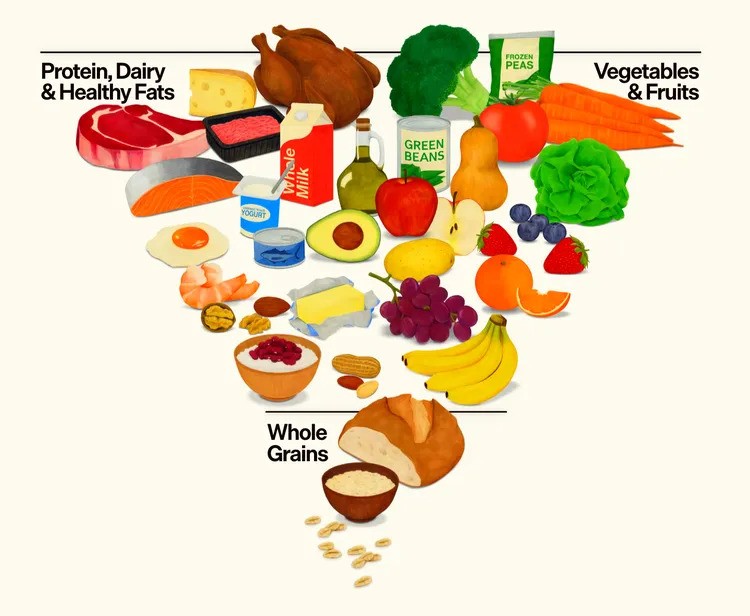
Many experts appreciated the guidelines’ focus on whole foods, urging the consumption of fruits and vegetables while cautioning against ultra-processed items. However, they expressed concern that the increased emphasis on protein doesn’t align with most people’s eating habits.
The revised guidelines suggest individuals should consume 1.2 to 1.6 grams of protein per kilogram of body weight, a significant increase from previous recommendations. For instance, a person weighing 180 pounds would need about 98 to 131 grams of protein daily, equivalent to several servings of meat or seafood.
“Americans typically aren’t deficient in protein,” remarked Leslie Ouellette-Todd, a dietitian and owner of Nourished Lifestyles in Scarborough. She questioned the evidence supporting the increased protein intake. “Excess protein that’s not utilized for muscle growth can be converted to fat,” she noted.
Mixed Reactions
The updated guidelines emphasize the inclusion of animal protein and full-fat dairy, contradicting previous health advice. While the cap on saturated fat remains at 10% of total daily calories, there’s a tension between these fat sources and the stipulated limits.
Given that saturated fats are linked to elevated cholesterol levels, Michele Polacsek, a public health professor at the University of New England, expressed concern over the lack of clarity in the guidelines. “The mixed messages can be confusing for the public,” Polacsek stated.
Moreover, Ouellette-Todd noted that public figures like HHS Secretary Robert F. Kennedy Jr. have made conflicting statements about saturated fats that might erode trust in dietary professionals. “People may be inclined to follow influencers over registered dietitians,” she noted.
Polacsek found the push for increased consumption of red meat and full-fat dairy troubling, as it conflicts with decades of scientific research advocating for plant-based protein sources.

Kim McDevitt, the lead dietitian at Longevity Maine, criticized the placement of a raw ribeye steak prominently in the new food pyramid, saying that it may not be the best message. She suggests a balanced approach that includes various protein options, advocating seafood, legumes, poultry, and eggs, while limiting red meat to no more than once weekly. McDevitt maintains that higher protein intake is beneficial for preserving muscle as people age.
Fiber and Gut Health
While some experts praised the new 10-page guidelines for being more concise than the previous 164-page version, they also highlighted certain shortcomings. They appreciated the call to limit added sugars, refined carbohydrates, and highly processed foods, as well as the recommendation to keep sodium intake under 2,300 milligrams daily.
Joan Lavery-McLaughlin, head of Nutrition Works in Portland, lauded the guidelines for mentioning gut microbiome health. However, she criticized the lack of emphasis on fiber, which is only mentioned twice in comparison to the 17 mentions of protein. “Fiber is critical for a healthy gut microbiome, yet it’s not adequately recognized,” she stated, noting that only 5% of men and 9% of women consume the recommended fiber intake of 25 to 30 grams daily.
The new guidelines present a looser approach to alcohol consumption, simply recommending that individuals should consume less alcohol for better health. This differs from previous versions that provided specific limits: one drink for women, two for men. Ouellette-Todd argued that this leniency could lead some to misinterpret the message, potentially resulting in excessive consumption.
Concerns in Guideline Development
Rebecca Boulos, executive director of the Maine Public Health Association, raised concerns about the development process for the new guidelines. The Trump administration dismissed the advisory committee’s draft and assembled a different committee, negating the traditional public review process that has historically accompanied guideline revisions.
“If we abandon rigorous, transparent procedures, we may end up with recommendations that don’t address the needs of the population, compromising public health,” Boulos expressed.
Support for Schools is Essential
Jeanne Reilly, director of school nutrition at Windham Raymond School District, sees the emphasis on whole foods in the new guidelines as a positive step that aligns with current school nutrition efforts. “We’re striving to improve the health of America through school meals,” she stated.

Reilly reported that 70% of the approximately 3,900 meals served daily in her district are prepared from scratch, marking a significant increase since 2012. However, she emphasized that continued success depends on adequate funding, staffing, and resources. She noted that recent cuts to federal reimbursements for purchasing local foods hinder their goals.
Despite these challenges, Reilly finds the guidelines encouraging and believes they provide beneficial direction for both students and the wider public. “If Americans focused on fresh, local, and minimally processed foods, it could vastly improve their diets,” she concluded.


