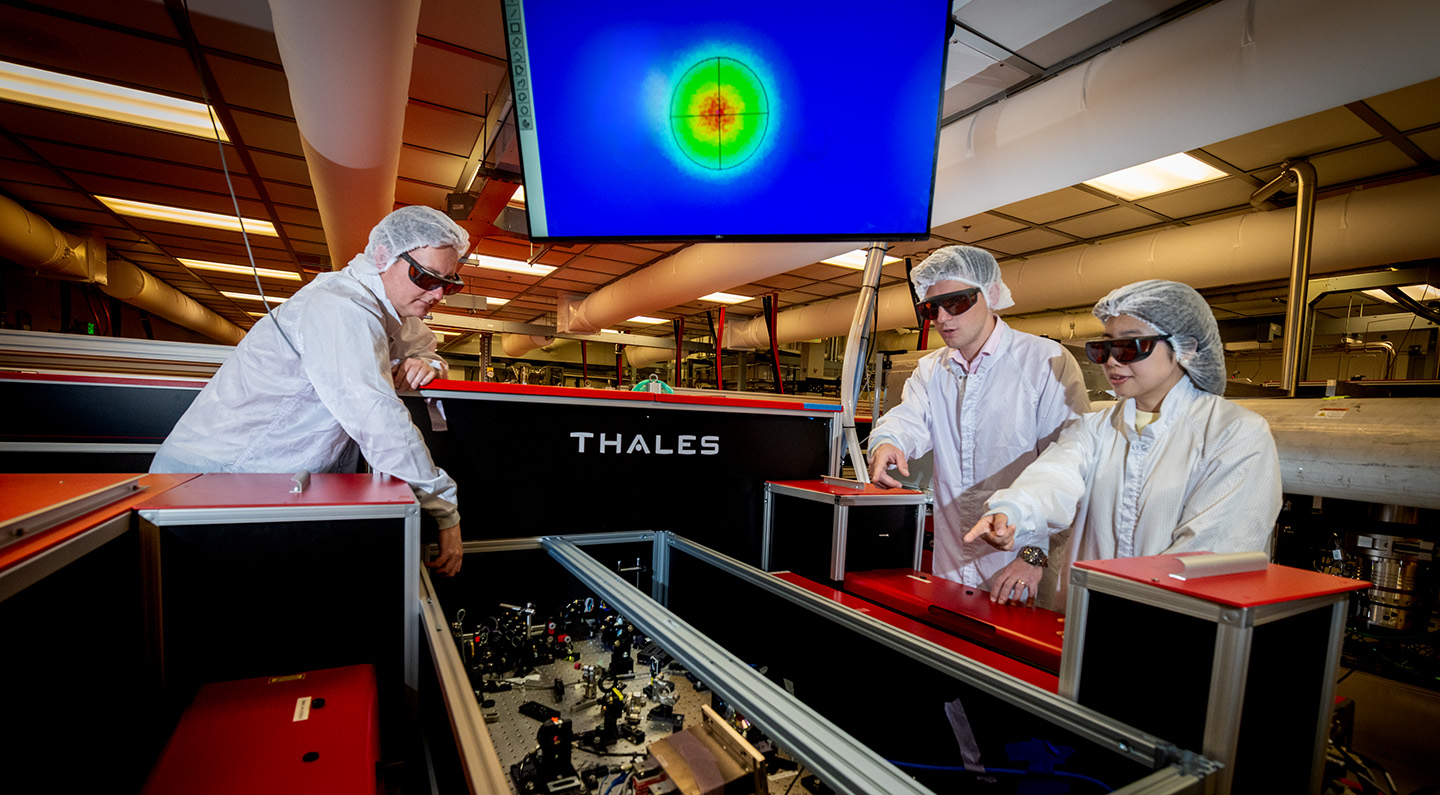
Particle accelerators are remarkable instruments that have significantly transformed various fields, including physics, chemistry, materials science, and biology. They have also been integrated into multiple sectors such as medicine, national security, and manufacturing. The Multi-Office Particle Accelerator Team (MOAT) is set to introduce artificial intelligence tools to enhance the design and operation of these accelerators, aiming for greater efficiency and effectiveness.
This initiative is part of the Genesis Mission, a national program spearheaded by the Department of Energy to promote AI in scientific discovery, tackling challenges related to science, energy, and national security. A key component of the Genesis Mission is the Transformational AI Models Consortium (ModCon), which will develop and implement self-improving AI models using the unique data, facilities, and expertise provided by the Department of Energy (DOE). MOAT is one of three AI model teams that Lawrence Berkeley National Laboratory (Berkeley Lab) either leads or significantly contributes to, building upon its AI expertise in high-performance computing, large dataset management, and pioneering AI models with industry collaboration.
This project will leverage a wealth of experimental data, simulations, and expertise available across the DOE Office of Science’s accelerators and light sources, which constitute half of the agency’s user facilities. MOAT plans to develop and enhance tools such as digital twins, intelligent assistants, and advanced AI models to simulate intricate accelerator physics and operations. Moreover, these tools will be designed to be platform-agnostic, enabling national laboratories, universities, and industrial partners to share knowledge and improvements easily.
“By creating intelligent AI tools that learn continuously and function across multiple facilities and disciplines, we are speeding up discoveries that particle accelerators can facilitate in critical areas such as fundamental physics, fission and fusion energy, advanced materials, and cutting-edge medical technologies,” stated Jean-Luc Vay, MOAT’s lead and head of the Advanced Modeling Program in the Accelerator Technology & Applied Physics (ATAP) Division at Berkeley Lab.
In its initial stage, MOAT will build upon recent accomplishments by ATAP and collaborators who implemented an AI “Accelerator Assistant” at Berkeley Lab’s Advanced Light Source (ALS). This potent particle accelerator circulates electrons in a ring, producing ultraviolet and X-ray light, which is utilized in hundreds of experiments annually to explore various scientific domains, including physics, materials science, biology, and chemistry. This intricate system has a myriad of variables.
For the first time, researchers have shown that an AI system powered by a large language model can independently prepare and execute a multi-stage physics experiment on a synchrotron light source, setting up the experiment 100 times faster than human efforts alone. Engineers provide the Accelerator Assistant with goals using natural language. The AI can then identify various parameters, generate and execute code for data analysis and visualization, and interact safely with the accelerator.
“We are observing the rise of a new layer of scientific infrastructure: AI systems capable of understanding intent, planning actions, and safely operating complex instruments,” remarked Thorsten Hellert, an ATAP staff scientist and lead author of the study detailing the recent milestone. “This strategy can expedite experiments at ALS today and lay the groundwork for interconnected, AI-enabled facilities throughout the DOE complex.”
During its first phase, MOAT plans to expand this framework and test its applicability across various accelerator facilities, demonstrating interoperability and a shared AI infrastructure.
MOAT currently collaborates with partners from Argonne, Brookhaven, Fermi, Jefferson, Oak Ridge, and SLAC national laboratories, along with industry stakeholders.
###
Lawrence Berkeley National Laboratory (Berkeley Lab) is dedicated to cutting-edge research focused on discovery science and developing solutions for reliable and abundant energy sources. The laboratory’s expertise encompasses materials, chemistry, physics, biology, earth and environmental science, mathematics, and computing. Scientists from around the globe depend on the lab’s top-tier scientific facilities for their pioneering research. Established in 1931 with the belief that complex challenges are best handled by collaborative teams, Berkeley Lab and its researchers have garnered 17 Nobel Prizes. Berkeley Lab operates as a multiprogram national laboratory managed by the University of California for the U.S. Department of Energy’s Office of Science.
The DOE’s Office of Science is the largest source of funding for basic research in the physical sciences in the United States, addressing some of the most urgent challenges of our times. For further information, please visit energy.gov/science.