Colorado Grey Wolf Activity Update
Recent Movements:
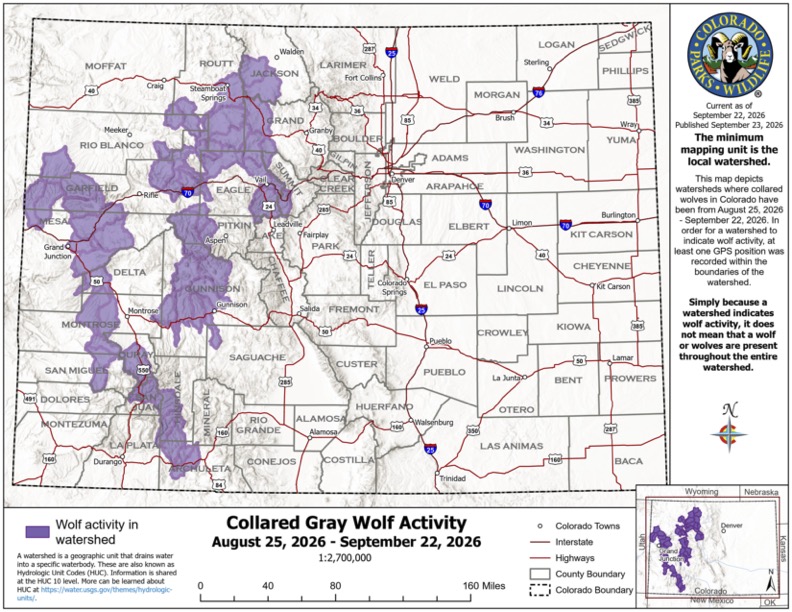
In September, collared gray wolves in Colorado have been observed exploring the Western Slope, with activities particularly noted in the San Juan Mountains. The Colorado Parks and Wildlife (CPW) documented significant pack movements through its monthly wolf activity map, which reports locations from August 25 to September 22.
Key Findings:
- Continued activity was noted across various watersheds in several counties: Jackson, Routt, Grand, Summit, Eagle, Rio Blanco, Garfield, Pitkin, Delta, and Gunnison.
- The northwest region currently supports four reproducing packs:
- Piney Ridge Pack (Eagle County) – the only new pack this year.
- One Ear Pack (Jackson County)
- Copper Creek Pack (Pitkin County)
- Three Creeks Pack (Rio Blanco County)
Pup Development:
Wolf pups have begun to leave their dens and are venturing short distances with other pack members. They typically remain near “rendezvous sites,” where adult wolves bring them food.
Geographic Expansion:
The latest map indicates that wolf activity has extended into the southern watersheds of Mesa, Montrose, San Miguel, Ouray, San Juan, Hinsdale, and Archuleta counties.
Technology and Tracking:
Collared wolves provide GPS points every four hours, giving insights into their movements. It’s important to note that highlighted areas on the map represent at least one recorded GPS point, which may not cover the entire range of their travels.
Euthanization of Problem Wolves
- As of March 31, 2023, an estimated 32 wolves were present in Colorado, half of which were collared. This count showed 18 adults and 14 yearlings born in 2025, excluding the number of pups from the reproducing packs.
- Six uncollared wolves have died since March 31, primarily due to euthanization by CPW in response to frequent livestock attacks. A regulated approach to managing predator-livestock conflicts involves removing wolves connected to confirm attacks.
Concerns and Controversies:
The increased incidence of wolf euthanization—especially recent events—has raised concerns about how this might affect the growing wolf population and questions about the effectiveness of this management strategy. In 2023 alone, CPW has euthanized wolves associated with multiple livestock attacks.
Conclusion
The situation surrounding Colorado’s gray wolves remains complex, balancing the needs of wildlife management with conservation efforts and the impact on local livestock. The ongoing monitoring and data collection from collared wolves will continue to play a crucial role in understanding and managing this developing population.