 Global trade has seen significant expansions and contractions throughout history, illustrated by enduring trade routes like the Silk Road. Established in 130 BC by the Han Dynasty of China, this route facilitated not just economic exchange but also cultural and intellectual interactions for nearly 1,600 years.
However, the Silk Road eventually met its demise. After the fall of the Byzantine Empire to the Turks in 1453 AD, the Ottoman Empire severed ties with the West, ushering in an era of geopolitical isolation.
In more recent times, global trade has predominantly been conducted through maritime shipping across the high seas. Over the last 200 years, trade cycles have expanded for such prolonged periods that many individuals know only that side of the economic trend. These long stretches lead to a common belief that the growth of global trade is a linear progression.
For many in the world, particularly in the United States, Japan, and Western Europe, it has been decades since anyone has lived through a contraction in global trade. In China, the current trade expansion initiated in the 1970s, while Eastern Europe experienced a similar resurgence starting in the early 1990s.
Yet, just because global trade has consistently grown over the past 50 years does not guarantee an uninterrupted trajectory. According to the World Trade Report 2013, “Although the long-term trend has favored expanding trade and deeper integration, unforeseen geopolitical shocks have periodically disrupted or reversed this trend, highlighting the importance of caution in projecting the economic future based on past patterns.”
Instruments of Globalization
A retrospective glance at the first half of the 20th century reveals a decline in global trade as a percentage of total economic activity, marked by a nearly 50-year period of decrease from the onset of World War I until the 1960s. Alarmingly, we may be on the cusp of another cycle of global trade contraction.
As observed by the KOF Swiss Economic Institute’s globalization index, “The 2008 financial crisis not only halted extensive economic integration but also caused a partial reversal of it.” In general, global trade has stagnated over the past decade.
Today’s debt-fueled economic growth model exacerbates issues when expansionary trends stall, leading to unsustainable debt accumulation. Recent events off the shores of Long Beach, California, illustrate this phenomenon and the potential for a reversal in global trade.
Throughout the past 50 years, notable monuments to globalization have emerged, including vast consumer outlets such as Costco and numerous Walmart locations. However, one site encapsulates the era’s complexities better than most: the massive Port of Los Angeles and Port of Long Beach complex.
Here lies a striking intersection of concrete and steel merging with the Pacific Ocean, showcasing a spectacular array of container terminals, cranes, and freight transport facilities. The essence of east meeting west resonates through the operations of China Shipping and Hanjin Shipping vessels, laden with containers of various goods.
The Hanjin Situation in San Pedro Bay
On September 1, Hanjin Shipping of South Korea, the world’s seventh-largest shipping company, sought bankruptcy protection in a Seoul court. Almost immediately, Hanjin ships were denied access to ports and terminals worldwide, including Long Beach, due to concerns over their ability to settle outstanding debts. This has generated significant upheaval throughout the global supply chain.
“The repercussions for importers and exporters are rippling throughout the global supply chain,” noted Sandy Kennedy, President of the Retail Industry Leaders Association, in a call for federal intervention. “Additionally, the inability to return empty containers is causing backups and affecting chassis availability. The uncertainty surrounding Hanjin’s future, being part of a larger shipping alliance, is further complicating cargo movement unrelated to Hanjin.”
One estimate suggests it may cost over $90 million to unload the stranded cargo ships. Rumors of a potential agreement have surfaced daily, but as of this writing, no resolution has been reached. Investing in a company that has been operating at a loss since late 2015, with projected losses of around $5 billion this year, presents a considerable risk.
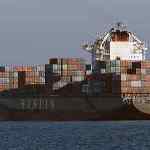
On a recent evening, during a family outing for ice cream and a stroll along Belmont Veterans Memorial Pier, we observed the tangible effects of a debt crisis. Offshore, several Hanjin vessels floated in San Pedro Bay, silhouetted against a brilliant sunset. These ships were crowded with containers, likely filled with seasonal items and novelties.
This scene could stand as a stark representation of the emerging reality of deglobalization. It is unfortunate that many of these products may never reach the shelves of your local big box store.
Sincerely,
MN Gordon
for Economic Prism
Return from Hanjin Marooning in San Pedro Bay to Economic Prism