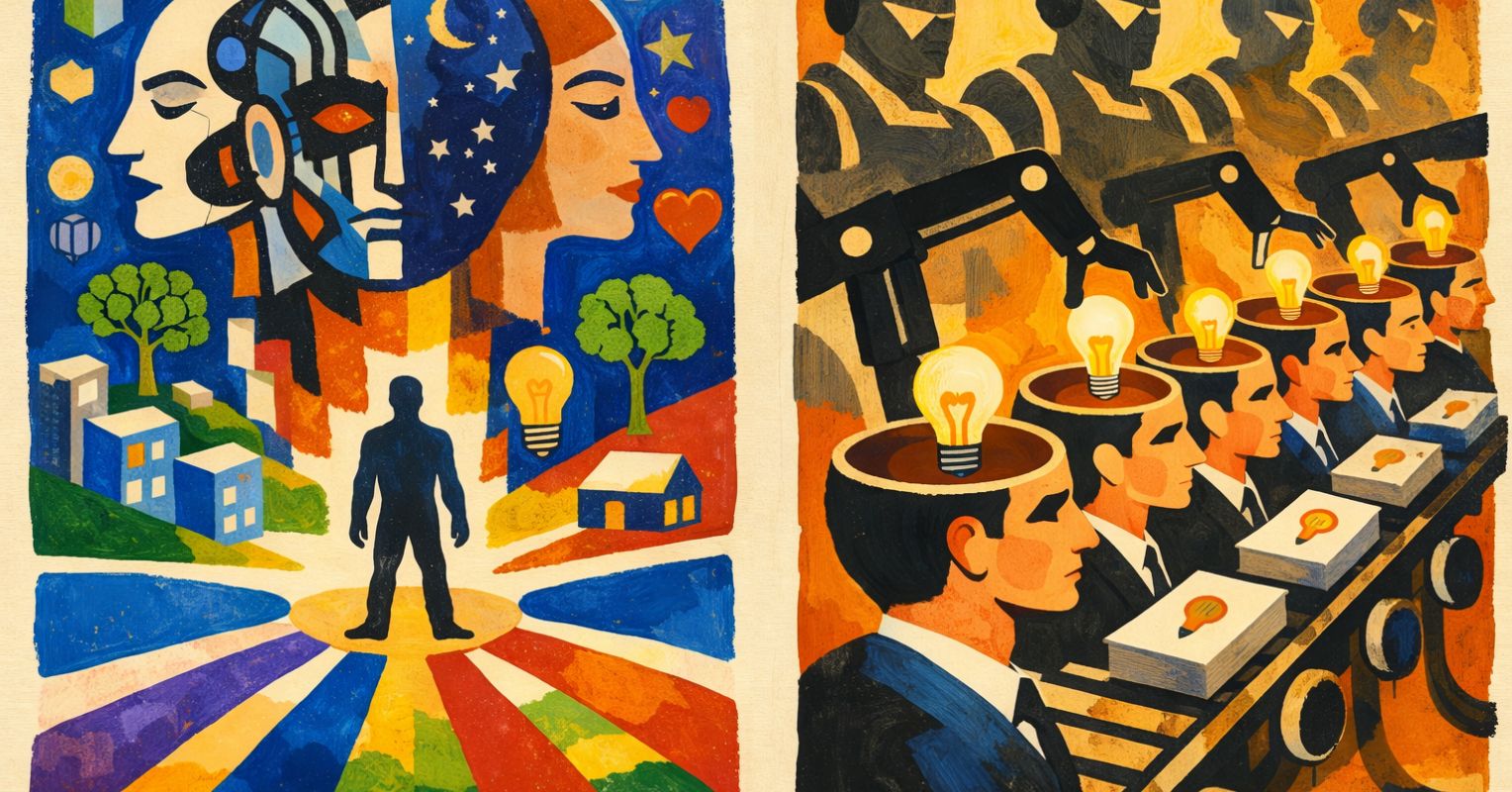
We find ourselves at a pivotal moment as artificial intelligence transforms our actions and identities. The discussions surrounding AI often swing between two extremes: augmentation, where machines enhance human abilities, and automation, where they gradually replace them entirely. However, a new idea is taking shape—amplification—where AI serves as a mirror and enhancer of our distinctly human qualities. Understanding this difference is crucial.
Does Augmentation Lead to Automation?
Recent studies examining millions of job listings reveal an intriguing paradox: a 0.87 correlation exists between roles most affected by automation and those greatly influenced by augmentation. The same jobs facing automation are simultaneously experiencing empowerment through AI. As tasks vanish, others intensify, occurring within the same roles. Skills vulnerable to AI-driven automation experienced a 16% decline in demand relative to a baseline, while skills benefiting from augmentation saw demand rise by 7%.
Furthermore, a separate study indicates that while generative AI enhances individual creativity, it simultaneously reduces collective diversity. AI-assisted stories scored higher on creativity assessments but regrettably became more homogenous—a creative convergence where individuals become marginally better yet increasingly similar.
Fuelled by our quest for efficiency, we may be unwittingly heading into an automation trap, masked by the guise of augmentation. By outsourcing creativity to algorithms trained on identical datasets, digesting the same prompts, and optimized for the same engagement metrics, we risk diluting the unique qualities that make human contributions valuable and diverse. Although AI can enhance productivity, boosting creative output by 25% and value by 50%, we must consider what we are being productive *for*. This compels us to reflect on our purpose, both as individuals and professionals.
The Algorithmic Self
Imagine how identity is being redefined when creativity is handed over to algorithms. Our emerging “algorithmic self” reflects a digitally mediated identity, shaped continuously by feedback from AI systems. Consider Spotify Wrapped, where millions eagerly await the algorithm’s interpretation of their listening habits. We increasingly regard machine-generated summaries of our behavior as more authoritative than our own reflections.
This represents abdication, not augmentation.
Amplification necessitates a nuanced approach: using AI to enhance self-awareness rather than replace it, to broaden our forms of expression rather than restrict them, and to highlight our distinctiveness over derivative trends.
The Four Dimensions of Our (Amplified) Identity
The journey from augmentation to amplification traverses four interconnected dimensions of human experience, which can serve as coordinates for mapping your unique presence in an AI-immersed world.
1. Aspirations (Purpose): What deeply motivates you? According to MIT research, features such as hope and vision are fundamental markers of authentic leadership—qualities that AI cannot replicate. Once considered peripheral “soft skills,” they are now essential for meaningful work.
AI lacks the persistence needed for challenging endeavors, the determination required when faced with setbacks, and the initiative to embark on unprecedented ventures. It is absent the intrinsic value orientation that encourages others to follow a human who commits to causes larger than personal interests. As AI’s capabilities expand, anchoring our professional identity in inherent purpose becomes increasingly vital.
2. Emotions (People): Our brains engage with human presence in a fundamentally different manner than with AI presence. Interactions with fellow humans activate extensive neural networks, encompassing more than just social cognition, signifying a unique connection that defies computational emulation.
Artifical emotional intelligence is a misleading term, creating a tempting trap: outsourcing our inner reflections to algorithms that deliver predetermined analyses of our moods and thoughts. What begins as exploration can morph into reliance, and ultimately, addiction. Agency decay surfaces when users become detached from the richness of their emotional experiences, favoring the algorithm’s insights over their own.
AI-enhanced journaling tools, emotion tracking apps, and therapeutic chatbots can provide structured prompts and reflections that foster self-awareness. The critical aspect is to maintain personal ownership over interpretation.
3. Thoughts (Pursuit): Knowledge work is undergoing a transformation, but not uniformly across all tasks. Certain cognitive tasks prove resistant to automation. Elements such as creativity and imagination—particularly the *visualization* of possibilities that extend beyond our current reality—remain definitively human, alongside humor, improvisation, ethical judgment, and the ability to weave fragmented ideas into groundbreaking innovations.
Such cognitive abilities become increasingly precious in the age of AI. The challenge lies in discerning when AI’s efficiency raises questions of cognitive depth. Overreliance on AI can lead to a narrow focus, making it harder to conceive alternatives once an AI-generated idea is acknowledged. However, our individual intellectual contributions stem from the very tangents, contradictions, and leaps of intuition that algorithms tend to iron out.
4. Behavior (Practice): Action manifests intention into reality. Yet, in an AI-enhanced workplace, the dynamics between intention and action grow complex. How individuals perceive their relationship with AI fundamentally influences their behavior and effectiveness.
Those who regard AI as a tool under their deliberate control retain agency. Your behavioral signature—how you uniquely approach challenges, engage with others, and grow through setbacks—becomes increasingly valuable as it stands out amidst AI’s standardization.
This is Part 1 of a series. In Part 2, we will delve into a practical ABCD framework aimed at nurturing your personal amplification practice and preserving authentic identity in an AI-saturated world.