Understanding the investment landscape for commodities can be daunting, especially as inflation concerns rise. Investors often turn to tangible assets, such as gold and various critical minerals, as a hedge against economic uncertainty. However, navigating this market, particularly for retail investors, presents significant challenges. Below, Satyajit Das delves into these complexities.
By Satyajit Das, a former banker and the author of several influential works on derivatives, including Traders, Guns & Money: Knowns and Unknowns in the Dazzling World of Derivatives (2006 and 2010), Extreme Money: The Masters of the Universe and the Cult of Risk (2011), and A Banquet of Consequence – Reloaded (2016 and 2021). His latest book focuses on ecotourism: Wild Quests: Journeys into Ecotourism and the Future for Animals (2024). This article was first published on 18 October 2025 in the New Indian Express print edition.
Growing concerns over inflation and the allure of tangible assets are driving many investors toward commodities. Gold continues to shine, alongside oil, gas, and essential minerals like copper, nickel, cobalt, lithium, and rare earth elements. This focus is largely fueled by the scarcity resulting from stagnant investments in new production. Yet, both direct investors and those seeking broader exposure via funds confront various obstacles when investing in these assets.
There are two primary methods for investing in commodities: purchasing shares in resource companies or acquiring the commodities themselves. Each approach comes with its own set of complexities.
Investing in shares of resource firms introduces a range of complications. Pure exposure to a desired commodity is often elusive, as many mining companies diversify their portfolios. Take BHP, the largest mining company globally by market capitalization, which produces iron ore, copper, and metallurgical coal. Similarly, Anglo American has a diverse operational footprint spanning diamonds, copper, iron ore, coal, nickel, manganese, and platinum group metals. These companies typically engage in various activities, including exploration, production, refining, and, in some cases, final distribution and sale.
Moreover, asset portfolios frequently change through corporate mergers, acquisitions, joint ventures, and divestitures. In 2022, for example, BHP consolidated its oil and gas assets into a joint venture to decrease its carbon footprint. After turning down a takeover offer from BHP, Anglo American proposed a complicated restructuring that emphasizes copper and iron ore. The oil and gas sector has also wavered regarding investments in renewable energy.
Even when a “pure play” company is available, several issues remain. Reserves estimates can often be inaccurate, as exemplified by the 1997 collapse of Bre-X Minerals, a prominent Canadian mining company that suffered substantial investor losses due to fraudulent gold contamination in core samples. Variations in production costs and breakeven prices related to differing ore bodies can also impact individual share performance. An old saying in mining describes it as “a hole in the ground with a liar standing next to it.”
Investors may also encounter currency risks, as resource companies operate in multiple jurisdictions. Many firms hedge their commodity price exposure to ensure that revenues cover costs and deliver satisfactory returns. Consequently, for those seeking to benefit from price appreciation in commodities, hedging alters the investment dynamics—hedged operators may not reap the rewards from higher prices.
Hedging introduces additional risks. Several companies have faced financial challenges due to heightened margin requirements on hedges. In 1999, a surge in gold prices put Ghana’s Ashanti Gold in jeopardy, as it had locked in the metal’s price, resulting in margin calls of $270 million that nearly bankrupted the company.
Production challenges, including adverse weather conditions, can also dilute the expected impacts of commodity price changes. Reduced output from one producer may benefit prices yet negatively affect shareholders within that company. The potential for accidents and legal liabilities, such as the Brazilian tailing dam failure involving BHP and Vale or BP’s oil spill in the Gulf of Mexico, remains a constant concern. Additionally, growing political risk—including sanctions, expropriations, and trade restrictions—adds to the complexity of the investment landscape.
Corporate financial engineering—such as leverage levels, refinancing risks, and borrowing costs—directly affects the stock performance of individual firms. The U.S. shale oil industry, for instance, relies heavily on the cost and availability of credit. Therefore, exposure to a stock does not necessarily translate to direct exposure to the sought-after commodity.
Direct investment in commodities poses its own set of challenges. Unlike financial assets, commodities are not traded in a uniform manner, making it difficult to obtain exposure. Frequently, there is no spot market, and most transactions occur under long-term contracts. Physical ownership can complicate matters regarding storage, transportation, insurance, logistics, and the risk of fraud. The fear of confiscation is also real; in 1933, the U.S. government prohibited gold hoarding and mandated that individuals sell their holdings to the Federal Reserve at a set price.
In practice, many investors rely on funds or collective investment vehicles that focus on liquid instruments to accommodate fund redemptions. Most of these funds track indices like the Goldman Sachs Commodity Index, which are heavily weighted toward tradeable commodities such as oil, gas, and precious metals like gold and silver. Gaining exposure to rare earths, titanium, nickel, or lithium requires fund investors to accept involvement in less liquid small companies. Fund disclosure documents often include warnings about these risks.
Funds often utilize commodity derivatives to achieve exposure due to the challenges in trading the underlying assets. However, this approach also introduces risks related to counterparty failures, typically involving banks, traders, or hedge funds. The requirement for collateral in derivatives transactions means that funds may face unexpected margin calls.
The increasing financialization of the commodity supply chain has shifted price-setting power from producers and users to traders. Derivatives now overshadow traditional supply and demand fundamentals. Commodity traders operating throughout the supply chain can influence prices through derivative trading while controlling physical operations. Price anomalies, such as backwardation (where forward prices are lower than spot prices), can result in derivatives not accurately tracking the underlying commodity price.
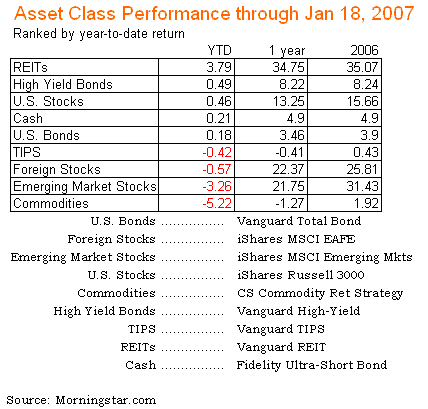
Ultimately, commodity funds provide generalized exposure to the asset class and may inaccurately hedge against inflation. Investors often find themselves exposed to index fluctuations and various unrelated factors due to the fund’s structure and operations. In recent years, commodity indices have occasionally underperformed or overperformed based on their heavy weighting toward energy, resulting in skewed exposure to key sectors, such as transition-critical materials and agricultural prices.
These challenges have prompted a quest for alternatives. Some investors have explored proxies by investing in companies that might benefit or suffer from price fluctuations, including trading firms or commodity consumers like airlines and electronics manufacturers. Others have focused on currencies tied to commodity price movements, such as the Australian Dollar, Brazilian Real, and pre-sanction Russian Ruble.
At best, investors may find their returns do not align closely with actual commodity price movements. They might logically understand the theoretical intricacies driving their investments, based on sound supply-demand principles, yet struggle to reflect these concepts in their actual results. This leaves many investors echoing Emily Dickinson’s sentiment: “I want to move to theory. Everything works in theory.”